Maybe most people didn’t notice, but a couple of weeks ago I said I was starting a (written) series on magical thinking vs thinking magically. I assume that most people who still come here are not interested in my ponderings, but started coming here when I was in a health crisis four years ago and they just wanted to know how I’m doing. For that I am deeply grateful. It is in the same way I get up in the mornings and immediately look for a posting about my friends Molly and Forrie, because I care so much about them during their very hard times.
But there are still those from my old blog and new people who are interested in my ponderings and it is to them I want to apologize. Some of these good people are where I was thirty years ago when the American Christian culture no longer made sense. Others are concerned as we are now entering a post-christian age for the first time in seventeen hundred years. No, the sky is not falling and maybe a better world is coming. Still others—many of them millennials—for whom late-stage postmodernism has robbed them of the aspiration for truth, which eventual erodes away the hope of meaning, and will finally destroy the foundation of ethics. For all of them, I attempt to speak sensibility into a new, nonsensical world. While my message is simple, to some, I am sure, I must sound like a babbling fool.
I have written three 5-6 page articles on magical thinking in the past two weeks, letting them soak (a crabbing term) for a couple of days, then delete them. While I love to think and to write, I have this tension within me that causes me to waver like this. It isn’t that I’m not sure what I ‘ve learned over the past thirty years in this journey. But I also fear—maybe with a smidgen of paranoia—that I will be misunderstood, or worse, clearly understood, but with offense. Because of that, I will keep this concise and then later do a series of podcasts about this topic for those who are really interested.
Definitions:
Magical Thinking . . . is a comforting belief that has little or no supporting evidence. While we all have these whimsical hopes, magical thinking finds its most welcoming home within politics or religion. Yet, even atheists participate in magical thinking, such as assuming there are meaning and morals in a cosmos that has no personal beginning and came into existence spontaneously, from nothing.
Magical thinking finds the greatest oxygen when the dominant philosophy of the society consigns reason as inferior to feelings, or just plain evil. Such was true during the period of Platonic Dualism of the Dark Ages and now, late postmodernism. The good news is that postmodernism has not been as exhaustive as Platonic Dualism because it did not have an overpowering church and king sustaining it for self-serving reasons. Also, once that reason was allowed a full expression, during the Enlightenment, there is no way to put that genie back in the bottle. Postmodernism did not kill science or the arts like Platonic Dualism did. If it had not been for the Enlightenment going to seed as modernism (believing that reason is perfect and will solve all our problems) there would never have been the opportunity for postmodernism to take root. Again, postmodernism isn’t the devil and made some healthy contributions in the beginning with the deconstruction of previously held social norms, but all philosophical movements/fads go to seed as something unhealthy for a culture.
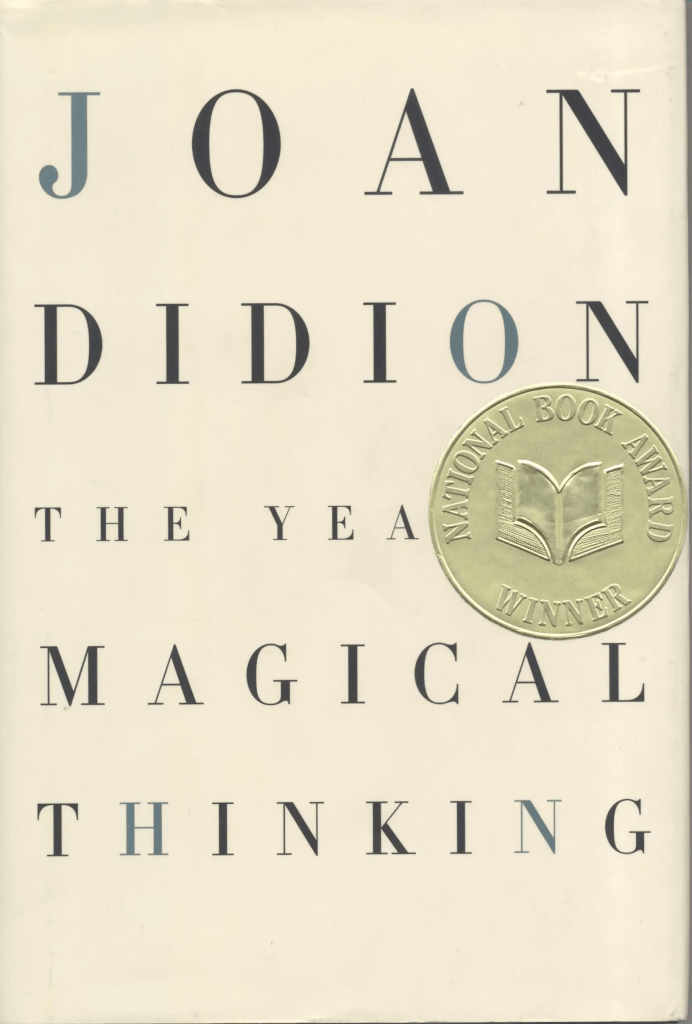
By the way, Joan Didion’s fantastic book (pictured above) was about her year, after her husband’s sudden death, of living in denial of that awful truth.
Thinking Magically: If you were to reverse-engineer the human mind (and the cosmos) you would have to conclude that the only facility that humans have for finding truth is reason. The senses collect data, reason evaluates the data for truth, and the emotions are powerful tools for applying that truth (screaming and running away from a poisonous snake, or crying and embracing a long lost friend). Atheists would have to assume that were are the way we are is due to shaping by natural selection, allowing the human to conform to the reality of the cosmos. The theists, including the Christian, would have to conclude this is the way the creator made us. To devalue reason as inferior or elevating emotions by calling them “spiritual,” (to make them sound supernatural, beyond the wonderful nature that God has given us) to me would be an affront to the creator. Remember, the Christian God created the cosmos, including our bodies, our reason, our emotions, and called it good.
The problem with reason, is simply it is not perfect. But we, subconsciously live (with all the trivial functions of our daily lives) with that imperfection by counting high probabilities as truth. It is highly probable, but not absolute, when I step on the floor beside my bed in the morning, I will not fall through to my death.
The same process applies to the big questions of life, our origins and purpose. While there is an absolute truth to those questions, our imperfect reason cannot establish such a truth absolutely. All religious, falsely promote their views a the default, no-brainer, answer or that you can feel your way to their notion of God. That is dishonest. The atheists consider their view as the no-brainer view as well. Contrary to what postmodernism would assert, the different religious views—which are inhabited by really good people, whom I respect—have profound differences between them. Using classical logic, one of them may be true, or none of them may be true, but it is impossible for all of them to be true, especially if they are saying opposite things. It is a cheap way to create social peace by asserting that all opinions are interchangeable.
Late-Postmodernism has declared that since reason is not perfect in finding the answers with absolute certainty, there are no answers, no truth. Somehow late-postmodernism still claims questions are good, despite there being no answers, which is an absurdity.
There must be a metaphysical separation between our ability to find truth with absolute certainty and the existence of truth. It is impossible for finite humans to count the stars as there are at least 200 billion trillion of them, always new ones being created and others exploding into supernovas or being swallowed by black holes. Yet, at any instant, there is an absolute number of stars in the cosmos, an absolute truth, not one more, not one less.
Thinking magically is like putting on a pair of glasses and suddenly you see the cosmos or reality, for what it is. Incredibly magic. All that exist being “supernatural,” created by God out of nothing. In that situation, there is no need for magical thinking. The emotions can be fully embraced and enjoyed for what they are, without interpreting emotions as spiritual, mystical, or supernatural, to give them meaning.
Yes, the atheist sometimes sees nature as magic, but that would be magical thinking for them, because their cosmos must have no purpose no meaning. Nothing can’t give rise to something. But, they are still human and therefore can be deeply moved by the essence of nature around them.
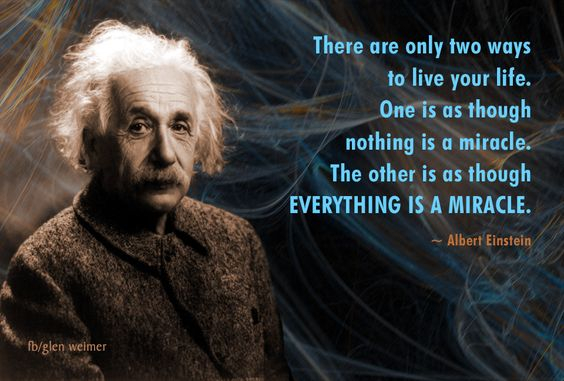
In closing, Albert Einstein stated it well, “There are only two ways to live your life. One is as though nothing is a miracle. The other is as though everything is a miracle.” I hear this mis-quoted often. Hallmark card material. But what he is saying is what I just said. If God created the cosmos out of nothing, the the entire friggin thing is supernatural. You don’t require a supernatural experience, an illogical mysticism, to have substance. I think that’s why the historical Jesus was so disappointed when his followers demand for a “miracle.” As if the cosmos wasn’t enough.
I wrote this quickly and without proofreading. I don’t expect anyone to agree with my opinions, and that’s okay. I’m not certain and I have great respect of those who believe otherwise. I will share more provocative thoughts when I find time this busy summer to do a podcast. Thanks for considering these thoughts.
Peace, Mike
 J. Michael Jones
Leave a comment