Since it has been some time since I’ve written on this topic, I must include clarifications. If one is honest, all possible answers to the big questions of how and why we exist end in absurdities, yet one must be ture (unless it was one no one has ever thought of). I was honest about the vulnerabilities of my own Christian viewpoint, briefly looked at agnosticism, and now atheism. But this is not meant to be an exhaustive discussion but only a “thumbnail” of a discussion.
The first post was about the cultural origins of atheism. In summary, atheism claims that it comes after much research and following the evidence. When I reconsidered atheism in the early 90s, I was surprised to find how similar it was to my old religious orientation, where social coercion was the reason I believed what I did, not evidence. There is no evidence that God doesn’t exist. There is only evidence that a particular kind of god doesn’t exist, one who is visible and does supernatural (outside the laws of nature) and widely visible (not one person’s personal experience) miracles on a routine basis. There is no evidence of other kinds of god not existing. It is unscientific to reach a conclusion, there is no god of any type, where there is no evidence of that conclusion. For the past 400 years, there is also plausible explanations of how and why we are here, but no proof that those explanations are correct. For example, there is overwhelming evidence of evolution’s role in the present state of life, but there is no evidence that evolution started the process, only conjecture.
This brings me to the second place of absurdity of atheism and that is with origins. To be fair (and I’ve already covered this) theism has its own absurdities in this area. Spend days meditating on the idea of an infinite god creating this finite cosmos. If God has always existed, what has he been up to for the past trillion to the trillionth power of years before creating us? It is hard to get your mind around.
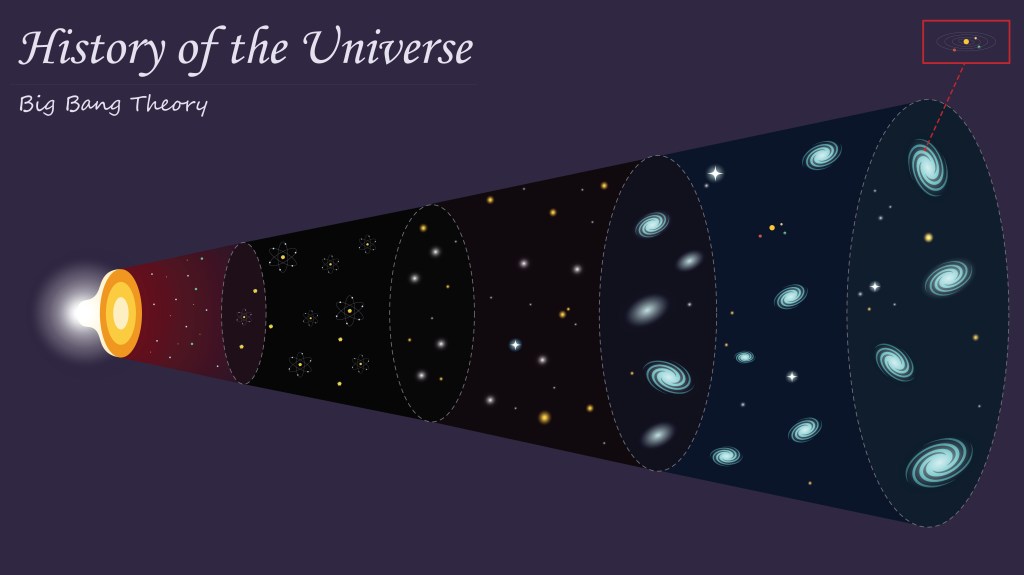
Atheists have the same problem. We live in a finite universe. It wasn’t that long ago that atheists asserted that the cosmos, the way it is, was eternal (past and future). But now we know much more about the cosmos, it is finite. It has a shelf life.
The Catholic priest/cosmologist Georges Lemaître, first proposed an expanding universe, thus a beginning, in 1931. The atheist cosmologists at first blamed his religious orientation for leading to the conclusion that the cosmos had a beginning. However, once more data was collected, the mathematics worked out, it was clear that Lemaître was correct. If you have an expanding universe, and if you work backwards with mathematics, you must end up with a point of singularity or beginning. All cosmologists now accept that as observable fact (red shift in the observation of the universe is expanding is definite, at least at this juncture in cosmological history).
This is a huge problem for the atheists because there is no evidence of how the cosmos could come from nothing. Yes, there are theories, and the atheists will hold on to these theories with the same kind of faith that the religious person holds onto beliefs that have no evidence. I’m sorry, but there is no difference.
For example, one (baseless) theory is that suddenly and for no reason, absolute emptiness split between matter and anti-matter or energy and a theoretical anti-energy (thanks to Einstein mathematical observations, we can use energy and matter interchangeably). It was like a giant door opened in space, matter and anti-matter flew out in opposite directions, and then, within a millisecond, they came flying back in and annihilating each other, but a tiny fragment of matter was left outside after the door closed (that would also mean that a tiny sliver of anti-matter was left “inside” whatever inside is). That tiny sliver of matter became the cosmos as we know it.
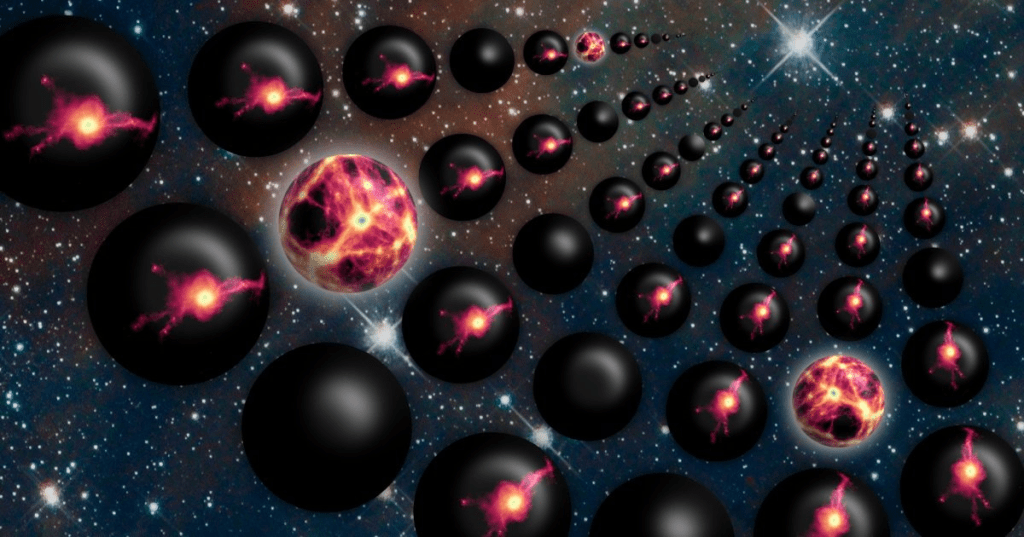
There are many problems with this imagination but the greatest one with all the imagined scenarios is the question of what was the “prime catalyst or mover.” To get past this problem, the atheist cosmologists throw out other imaginative scenarios including the proposed (but not proven) idea of string theory and deducting from that there are multiple universes. From that assertion, they try to create ways in which nothing can give birth to something. Irrational and absurd. I will come back to the prime mover problem in a minute.
After Lemaître’s idea was accepted, the atheist cosmologists imagined a oscillating cosmos. Out of nothing the universe appears. It expands to a point, then runs out of steam and collapses back into a point of singularity. That point is unsustainable and again explodes as another big bang and spews out the cosmos once again, which eventually reaches a point of equilibrium, and then collapses once more. They asserted that cycle has been continuous for a previous infinite number of cycles. Try and get your mind around that.
The problem with that is, thanks to Edwin Hubble, we have confirmation that the expansion of the universe is not slowing down (as we would predict) but due to an invisible force (“dark energy”), for which we have no clue what it is, the expansion of the universe is accelerating. Therefore, the math says the cosmos has a life cycle and will eventually spread out, the stars will all burn out, and the matter will spread to infinity, leaving a cold, dead, dark cosmos. So, something with a life cycle demands a beginning since recycling (as the pulsating cosmos idea proposed) is impossible.
This brings me back to the absurdity of the lack of a prime mover. There is no evidence of a process where nothing gives birth to something or where movement begins spontaneously. There have been many great thinkers in history who have tried to write ontological (theories without observable evidence) proofs of God’s existence, including St. Anselm (eleventh century), Thomas Aquinas (twelfth century), René Descartes (seventh century), Gottfried Leibniz (eighteenth century), and others. I will include in this list, Dr. Antony Flew, who just died about twenty years ago. I re-discovered Flew when I started writing this series of articles. I knew of him as a notorious atheist. I looked him up to find his quote about the “Invisible Gardner” as a proof of God not existing. To my surprise . . . rather shock, I learned that around 2000 he became a theist. He wrote a book, There is No a God, where he says he has been wrong his whole life an makes a strong philosophical argument for God’s existence. I digress.
In closing, I will point to Aquinas’s five arguments to support the existence of God. The first three are related to origins and are as follows:
The First Way: Motion
1. All bodies are either potentially in motion or actually in motion.
2. “But nothing can be reduced from potentiality to actuality, except by something in a state of actuality.”
3. Nothing can be at once in both actuality and potentiality in the same respect.
4. Therefore nothing can be at once in both actuality and potentiality with respect to motion.
5. Therefore nothing can move itself; it must be put into motion by something else.
6. If there were no “first mover, moved by no other” there would be no motion.
7. But there is motion.
8. Therefore there is a first mover, God.
The Second Way: Efficient Cause
1. Nothing is the efficient cause of itself.
2. If A is the efficient cause of B, then if A is absent, so is B.
3. Efficient causes are ordered from first cause, through intermediate cause(s), to ultimate effect.
4. By (2) and (3), if there is no first cause, there cannot be any ultimate effect.
5. But there are effects.
6. Therefore there must be a first cause for all of them: God.
The Third Way: Possibility and Necessity
1. “We find in nature things that are possible to be and not to be:” contingent beings.
2. Everything is either necessary or contingent.
3. Assume that everything is contingent.
4. “It is impossible for [contingent beings] always to exist, for that which can not-be at some time is not.”
5. Therefore, by (3) and (4), at one time there was nothing.
6. “That which does not exist begins to exist only through something already existing.”
7. Therefore, by (5) and (6), there is nothing now.
8. But there is something now!
9. Therefore (3) is false.
10. Therefore, by (2), there is a necessary being: God.
I’ve watched many atheists debate theists. I’ve also spoken (never argued) with atheists and I think I know how they react to these classical arguments for God’s existence. They borrow from one aspect of linguistic deconstruction, that everything someone says can be explained by their philosophical orientation. Therefore, they would say Aquinas gives his arguments, not as a keen observer of philosophy, but as a Catholic and therefore nothing he says can be taken seriously. However, I disagree. These arguments are valid and these men, Aquinas, Descartes et al are brilliant and should be taken seriously.
I also want to be clear that I’m not to be lumped with the evangelical apologist who starts with the premise (which I’ve mentioned before) that atheists are so, because of ignorance and immorality. I see atheists as good people, usually more thoughtful and interested in truth than the typical religious person. They have my full respect. Atheists make the best of friends because of their interest in honesty, which many types of religion can obscure.
With that said, my major point with this article is that the arguments against the absurdity of a sterile beginning without a mover (god) has the same psychological hallmarks as the religious person who believes in god but with a baseless (never looking or thinking about evidence) faith.
Mike


 J. Michael Jones
Leave a comment