I don’t like to leave things undone. I started a series on the absurdities of different answers to why/ how we or anything exist and my last world view to look at was atheism. In my perspective, there are no easy answers, and I call this “The Grand Enigma.” But that does not mean the pursuit is in vain.
Because it has been months since I discussed this topic, I will have to restate some of my points before I get to the absurdities of atheism specifically.
Each religious answer, by its nature, claims that it is the default position. Being brought up Christian, it had been instilled in me from an early age that only the stupid or immoral don’t believe in the Christian God and faith. When I became an evangelical of my own volition, age 18, that same concept of an obvious default position was reinforced. One of the verses the Christian points to is in Romans 1:20.For since the creation of the world God’s invisible qualities—his eternal power and divine nature—have been clearly seen, being understood from what has been made, so that people are without excuse.
As I said before, the Apostle Paul (supposedly) wrote this circa 57 CE and at that time, this statement made sense. There were few competing ideas to a divine creator. That is no longer true. Now, there are many credible explanations of the existence of the cosmos and us, without the role of divinity. I say credible, but I mean “appears credible,” because the atheistic view also has its own absurdities.
We are now living in a post-modern culture where the primary tenet is that there are no answers, no truth. One of the reasons this thinking fad has been so popular is that it appears to reduce this tension of the Grand Enigma. But like all other thinking fads, post-modernism will eventually fail. The movement will fail because we by instinct know that there must be answers and pretending there are none is like an intellectual narcotic, which will eventually wear off. The post-modernist will also eventually discover that without truth, there can be no morals. Within that paradigm, if you are an honest post-modernist, you must equate the pedophile and murderer with the greatest of saintly people, such as Mother Theresa.
When I finally realized that the evangelical world that I was part of was a farce (1990) I began an honest pursuit of truth. My Christian leader at the time (the very leader whose hypocrisy was the catalyst for me seeing the farce-ness of that movement) warned me, “Mike, people who think too much end up being atheists.”
My passion for finding truth would not be thwarted. I knew that if there was a divine creator, that creator would exist within truth, withstanding the greatest scrutiny, not in a place where you hide from truth by not thinking, or thinking magically and not looking at the alternatives. The risk of becoming an atheist was worth the honesty.
In the first half of the nineties, I began to study intensely. I had a very easy job as a PA officer in the Air Force, and I bought stacks of books to work, studying between patients and into the wee hours of the morning, once I got home.
Unravelling the farce-ness of evangelicalism was blatant. It is easy to deconstruct. I began to see that movement through the eyes of the non-believer, including the atheists and it wasn’t pretty. Then I began to digest and move in the direction of the atheists, who seemed to be far more honest about their pursuit. I can understand why those who are deep into any religion, and then are able to see their religion from the outside, honestly, end up in the atheist camp for good.
But my pursuit of honesty did not stop there. I was hungry for answers. But soon, I found myself facing the same type of intellectual gymnastics within atheism as I had faced as an evangelical. That surprised me. My new atheist mentors were taking on the exact same perspective as the evangelicals had, people who think differently from them were stupid and immoral. That there was no other option to the way they think, except for their stated position. Intellectual curiosity was constrained because believing some things, like there being a deity, was off limits. And lastly, they had to force all explanations into their model, even if those explanations were absurd.
The state of modern atheism is a fruit of the Enlightenment going to seed as Modernity. The Enlightenment, in my opinion, started out perfectly. We find truth by collecting evidence and then, after removing our bias, evaluating that evidence via human reason. But like all thinking fads, after a couple of hundred years, the Enlightenment drifted into Modernity. Modernity believed that science would solve all our problems and only things that can be observed can be true (scientific positivism). Therefore, because God was not directly observable, the possibility of there being a god was suddenly forbidden.
It was against scientific positivism that Soren Kierkegaard wrote, expressing in his books, Either/Or (1843), Fear and Trembling (1843), and The Sickness unto Death (1849), that truth is not objective but subjective, which eventually became the cornerstone for the present disastrous postmodernism, but I digress.
This idea of late Enlightenment-Modernity was truly arbitrary. The classical thinkers of the early Enlightenment would have considered it absurd to say if something isn’t observable, it isn’t real. They would have said, “If something isn’t observable means it is not observable and nothing else.” But modern atheism adopted this view for cultural reasons, just like their religious counterparts. With the thinking, “My view is superior to their view because they are stupid and immoral.”
But the honest scientist and philosopher cannot restrain their curiosity as they look for answers. The twentieth century Christian philosopher/theologian Francis Schaeffer used to say, “There is no difference between philosophy and theology in the questions asked, but only in the answers given.” He meant, that if your answer involves a divine creator, then immediately by definition, you are no longer a philosopher but a theologian. That is too bad. Thomas Aquinas, who is considered the greatest Christian theologian thought of himself as a philosopher. He could do that in the thirteenth century because philosophers, including the classical Greek philosophers such as Aristotle and Plato, could consider a divine creator as a possible answer because they lived before these artificial constraints of the late Enlightenment.
So, the first absurdity of atheist is that they live within the shadow of this new paradigm, that considering a God is off limits in the same way that for most Christians to even have a momentary thought that there could be no God, is the worse evil they could imagine. Honest thinkers must have no boundaries.
I have found the fruit of honest thinking is a new kind of confidence. I was plagued with doubts when I was an evangelical and knew that certain thoughts were off limits. But once I faced all the possible answers honestly and for me, coming back to Christianity, I have an intellectual peace that I never thought was possible.
This is getting long, and I have yet to address the granular issues of absurdities within atheism. But I hope I’ve established the narrative for my first point. The greatest absurdity of atheism is the fact that we and the cosmos exist, and it exists with an uncanny order. Any honest thinker must consider some type of divine being as one possible answer. Those who dismiss a deity out of hand and laughs at the ignorant for not understanding how time can somehow cure the need for a god, must realize that their position, just like the religious, is from an arbitrary dogma (truth must be directly observable) and social coercion of their subculture of atheism.
I will summarize some of the granular absurdities into just one, the final blow for my aspirations to be a good atheist. For me, it was mathematics. I have said, mathematics is the original language of God. It is too hard to explain here to those who have not endeavored into higher math. To get a taste of what I am talking about I encourage you to watch the outstanding BBC documentary series, The Story of Maths. It is a four-part series with the last one, imperative, “The Language of the Universe.” ( see: https://www.youtube.com/watch?v=hbDkSaSnbVM )
In the above-mentioned series, the group of mathematicians followed, all but one, state that humans didn’t invent math but discovered it as it was an intrinsic part of nature. The only exception was a Hindu mathematician and Hinduism, like Buddhism, asserts that nature is a human illusion. But the fact of mathematics overwhelmed me with such order that it was beyond my imagination that it could be from chance.
I could write a book on the other instances of order and impossibilities of a by-chance cosmos, but I do not have the space here. There are many absurdities, and bottlenecks, such as the impossibility of abiogenesis (where chemicals evolve into life).
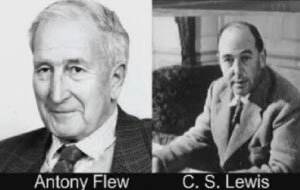
Antony Flew and C.S. Lewis, Oxford Rivals
But for those who want to explore this further, I highly recommend the book There is No God by Anthony Flew. (see: https://www.amazon.com/dp/B000W9169S/?bestFormat=true&k=there%20is%20no%20god&ref_=nb_sb_ss_w_scx-ent-pd-bk-d_de_k0_1_15&crid=17PDR4LUIQYWI&sprefix=Thre%20is%20No%20God)
When I started this series over six months ago, I wanted to study the atheists’ argument for there being no god. The most popular atheist I could remember from the 1990s was Anthony Flew. He was from Oxford and was C.S. Lewis’ greatest debate partners, C. S. Lewis of course representing theism and Flew atheism. To my shock, I found out that Flew had become a theist in the early 2000s. I bought his book this summer and it is a good argument about this issue of order and other abrusdities of theism.
So, I declare this topic as finished and thanks for coming along for this ride.
Mike

 J. Michael Jones
Leave a comment