One of the most common reasons that people leave Christianity is the inability to have intelligent discussions about hard questions and the anti-intellectual nature of the religion. But this has not always been that way.
The human mind is a beautiful thing. In the Christian Bible, Genesis 1:27 it is written, “So God created mankind in his own image, in the image of God he created them; male and female he created them.” This passage is clearly not talking about mankind being created like God in body. Yes, in the Middle Ages and before, God was depicted as an old man with a beard, such as in Michelangelo’s The Creation of Adam on the Sistine Chapel’s ceiling. For most of its history, the Christian church worshipped a small, bronze-aged god. However, now, with our understanding of the vast size and complexity of the universe, a God in the body of a man or woman, walking around the cosmos doing things, no longer makes sense. This is why it is ludicrous to get caught up in pronouns for God as God does not have a penis, vagina or secondary sexual traits. People who insist that God must be called “He” are reflecting their own chauvinistic mindset. So, what this passage is obviously talking about is the human mind.
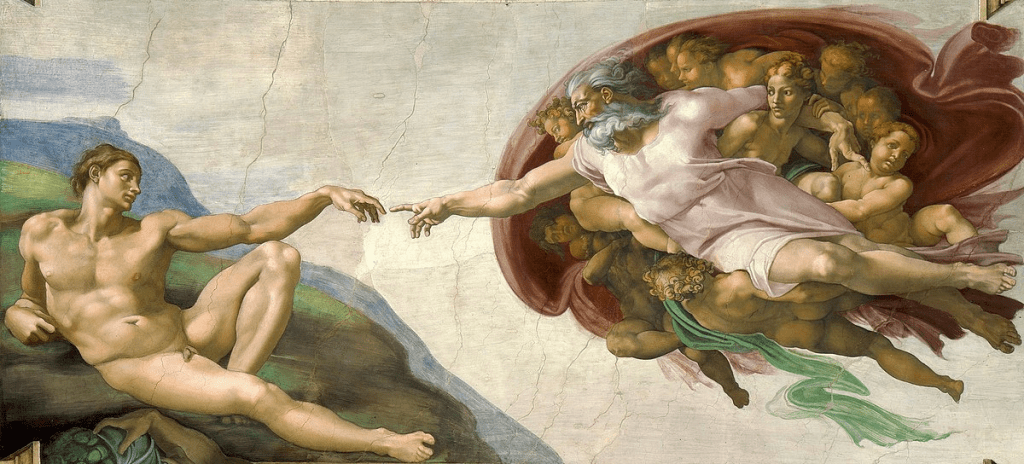
The Greek word for “mind” in the New Testament (for example Romans 8:6 is φρόνημα (phronēma), refers to a person’s orientation, disposition, or governing mindset. But in the present climate for American Christianity, both in the conservative and progressive wings, the human mind has been devalued as extraneous at best and evil at worst. But it has not always been that way.
Before I journey further in this discussion, I must clarify a couple of issues. The first one is that I am not discussing insanity. Yes, I realize that the cliché “loosing their minds,” is usually talking about mental health. But here I am talking about the loss of critical thinking.
The second issue, and I want to be clear, is not necessarily a moral issue. When I write things here that upset people, even those in my own church, they often turn it into a moral issue. “Mike, you are a horrible person and don’t have a real relationship with God.” I’ve heard this ad nauseam. It hurts. Please stop! I am not saying that the Christians who have given up on the beautiful mind and critical thinking are bad people, nor are they dumb people, and I have no doubts that their relationship with God is sincere. I am talking about a pattern of culture, which could be corrected if we resolved basic misconceptions. It only becomes a dumb problem if any of us refuse to consider alternatives to how we think, and it only becomes moral when we know we are thinking incorrectly and refuse to change for some personal gain.
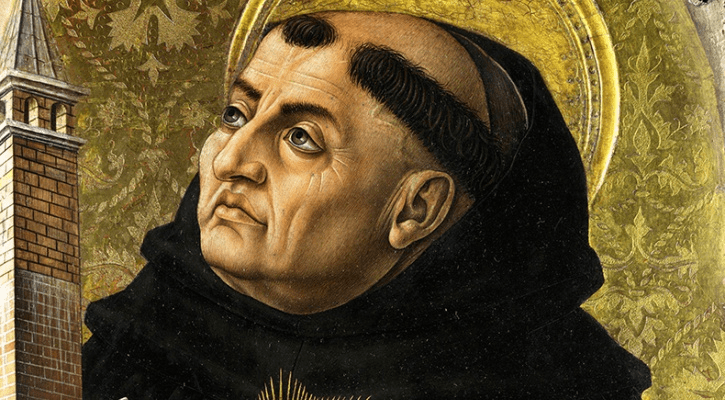
This is not personal. I agree fully with Thomas Aquinas’ statement, “We must love them both, those whose opinions we share and those whose opinions we reject. For both have labored in the search for truth and both have helped us in the finding of it.” No, truth is not relative as the progressive would say in this post-modernist culture, but the intentions of finding truth can be pure in two parties with opposite conclusions. I respect most of those with whom I disagree. I sincerely believe they are good people.
Lastly, I must mention that I have told this story here before, many times. But my redundancy is because with each post I do here, I may have a hundred first time visitors, who wander in “off the street,” for whom this is new. The other reason is for clarity. When I speak to long-time followers about this history, often they say that they have no clue what I’m talking about. I keep repeating this profoundly important story, hoping that one day I will break through, and the proverbial light bulb goes on.
My point is that wrong mindsets have real-life consequences. People are leaving Christianity by the droves because of the anti-intellectualism. As I sit typing this, intellectually incompetent people are taking over our government. This is directly the result of the American Evangelical’s low appraisal for knowledge, education, and critical thinking. A non-religious dictator is our new king, but the Evangelicals have ridden into the government under his cloak, as in a Trojan Horse, and are now the heart and soul of the government. Evangelicals wrote the playbook, Project 2025. In November, over 80% of Evangelicals voted for this king, who, to most thinking people, appears as an idiot and pathological liar. How could they be so deceived? It is a thinking problem.
I’m sorry I digressed. This is not just about politics. If there was no MAGA cult sweeping the nation, my points would still be valid. I must also humbly admit that the thinking problem is not the only reason people have left or would never consider Christianity, but it one of the top five reasons.
Brief History of Unthinking
The Hellenistic (secular) Jew, Paul of Tarsus was a well-educated man. After Paul was incarcerated, he appeared before Porcius Festus, a Roman procurator of Judea. As Paul was making his defense of how he went from a great Christian persecutor to a zealot for Christianity, Festus interrupted Paul and said. “You are out of your mind, Paul!” he shouted. “Your great learning is driving you insane.”
Paul was highly educated in the Greek tradition of logic and critical thinking. He was an intellectual of the first century and, in many ways, the founder of the Christian church.
During the Ante Pacem period (before Constatine legalized Christianity in 312 CE) the mainstream church had a deep respect for study, knowledge and what we would call intellectualism. One of the church’s centers was Alexandria Egypt, a center of high learning with the greatest library of the ancient world. Alexandria was the Cambridge or Oxford in the UK, or Boston’s Cambridge. Origen was the Christian intellectual of Alexandria. There were many other Christian intellectuals and thinkers, under the title “Apostolic Fathers” like Clement of Rome, Ignatius of Antioch, and Polycarp of Smyrna, along with later thinkers such as Justin Martyr, and Irenaeus. All of them would be appalled of what Christianity has become in the twenty-first century, where it is often synonymous with superstition, anti-thinking, anti-education, an ocean of baseless conspiracy theories, and the great devaluation of human reason.
Now, of course, Paul’s approach was not the only type of church that arose in the consequences of Jesus’ ministry. The Gnostics were a powerful cult that rivaled and was a thorn in the side of mainstream Christianity until the fourth century. It was then when Constantine, for the sake of political power, wanted to unify the church by quashing cults while absorbing some of their ideas into the mainstream church.
I could write pages on the Gnostics, but I will be brief here. They had a fundamental different view of metaphysics than Paul. They were dualistic, thinking that all of reality was divided between the inferior or evil material things, and the good spiritual things. They considered the human mind (brain) as material and therefore evil, relying on a mystical gnosis (knowledge) directly from God as the only good knowledge.
In the forth century as Constantine (who worshiped the sun God until his death) put himself as the leader of the Christian church, in the same way that our present king, while having a personal disdain for Christianity, has made himself the champion of much of the conservative Christian church, for political power. This present king’s words and thoughts are setting the tone of the conservative church, now and in its future. For example, my conservative Christian friends, as recently as the 1980s were concerned about the poor and disenfranchised. Now, they want to deport them, lock them up, and as one pastor told me, give them the death penalty if they came here illegally. Likewise, Constantine needed the marginalized Christian support to keep his power in the same way our unrighteous king requires the conservative Christians to stay in power. Constatine too set the mindset for Christianity starting in the fourth century.
Constatine shaped the nature of the fourth century church, building part of the philosophical basis on Gnostic ideas. The Gnostics had borrowed a very popular notion from Plato, dualism, but different from Plato, who put the human mind (logical contemplation) as the apogee of our being (and clearly in the upper story of good things) the new fourth-thirteenth century kings made it material and “of the flesh” and against God. This was very convenient to make the masses believe that critical thinking was against God, so that the Church-King duplex could absolutely control them. It was to the church and emperor’s advantage to keep the masses uneducated, unthinking, and poor. As Aristotle said, “It is also in the interests of the tyrant to make his subjects poor… the people are so occupied with their daily tasks that they have no time for plotting.” This resulted in the millennium of the Dark Ages.
I’ve heard modern post-modernist Christians use revisionist history to make the Dark Ages out to be a glorious time of Christianity, when everything was “spiritual.” It was not. It was horrible. Science died, art died, joy died, and people died at age 28. Meanwhile, in the Arab-Muslim world (after the seventh century) science, math, art and joy flourished. Bagdad was the “Mecca” of intellectual thought, while Europe was a hellish Getto.
History is not simple, but I must over-simplify it to make it palatable to those who do not study history. I believe that Thomas Aquinas (1225 -1274) was a once in a millennium genius, in the magnitude of Issac Newton, or Albert Einstein. I’m sure there were plenty of women geniuses and minorities who were never given the opportunity to shine. Their lights kept under a bushel due to racism and misogyny.
As a major shaper of the Catholic Church, Aquinas elevated human reason back to it’s intended place, as the sole human instrument or finding truth. I say “sole” but Aquinas did believe that some of the attributes of God were so mysterious that it took a divine inspiration to understand them. But this was far from the Gnostics who believed that all knowledge was directly from God and irrational and that reason, or study was Satan’s way of finding knowledge.
The Medici family of Florence, the richest family in the world, observed that Italy and all of Europe was in a very bad place and they wanted a new philosophical basis. The Medici “godfather” Cosimo started the Accademia Platonica di Firenze (Platonic Academy of Florence) to study and find this new path. One of the theologians who contributed to this discussion was Marsilio Ficino (1433 – 1499), a follower of Aquinas. Like Aquinas, two hundred years earlier, Ficino was clear that the root problem of the Dark Ages (they didn’t use that term yet) was this lowering of human reason as inferior and evil. That Aquinas was correct that human reason is not “of the flesh” but one of the most glorious gifts of God. This new mindset ushered in a remarkable period of the Renaissance, with all its beauty in art, music, writing, and science. The way I believe God intended us to live.
In closing, I will add that I have two favorite theologian – philosophers. Thomas Aquinas of the thirteenth century and Francis Schaeffer of the twentieth century. I do not believe in making mere mortals into heroes anymore, seeing then infallible. As a young man I ended up in a cult for doing that. So, I do not agree completely with either man. Interestingly, one of the areas I do not agree with Francis Schaeffer is his view of Thomas Aquinas. He asserted that Aquinas went too far, making human reason autonomous and perfect. I’ve read a lot of Thomas Aquinas, and I do not see that. He was a humble genius. He acknowledged the limits of human reason. On December 6, 1273, a year before his death, Aquinas tried to describe a spiritual experience during mass that was so incredible that all his brilliant writings (and he was a prolific writer) “were as straw” in comparison. He stopped writing at that juncture.

When I speak of the merits of human reason, many Christians make the same assumption about me, that I am like the character Spock on Star Trek. I am also a person of deep feelings and have had such profound experiences with God that it has left me mute. I never knew the mystery of God as an evangelical and having weird pretend experiences all the time as I do now, when I look at this incredible cosmos that we live in, honestly.
Next time, I will carry this development into our present time. I will use many illustrations of how the Christian church in the past 100-150 years has chosen to return to the mindset of the Dark Ages and that is one of the main reasons that the church and our whole country is in jeopardy of failing now.
Ciao, Mike


 J. Michael Jones
Leave a comment