I thought it was best to follow up quickly with my next installment, as my last post could be easily misunderstood. No, I was not suggesting that our brains program us for mischief, and therefore we bear no responsibility for our actions.
The Two Models of Human Consciousness or Personhood
My point with the last post was that there are two models of personhood or consciousness. The most widely accepted Christian view (what I will call Model 1) is that we are immaterial ghosts (the soul), inhabiting a material body but with little influence from that body, including the brain. Yes, there is language in the Bible that suggests that, but there is also language that does not. To further the confusion, I will mention that the Greek word that is translated “soul or spirit” in the New Testament is ψυχή (psychē), which is also means mind (thinking as in the brain) and is synonymous with the modern word psyche.
Model 2, is that we are a product of our material brains, however, I do not deny that consciousness supersedes this brain. In this model, the material has a dominant influence over our personalities and actions, albeit not always in a fatalistic manner, in my humble opinion. This is the metaphysical difference I was writing about.
We are left with these two models. If you are a Christian of the first book only, not considering what we can observe from nature, we are only spirits; our personalities, emotions, thoughts, and morality are pliable because it is spiritual (literally means “air”) and thus immaterial.
In the second model, nature (genetics, physical impacts on the brain), and experiences (nurture) are written into the material hardware of the brain, and while not immutable, are inflexible. Keep this thought in mind as I move on to the practical application of godliness and hypocrisy.
Christian Sanctification and the Myth of Godliness
This is how AI defines the Christian doctrine of sanctification: In Christianity, sanctification is the process of being “made holy” or “set apart” for God’s purposes. It is a transformation of the believer’s life that occurs after salvation and involves being freed from the power of sin and becoming more like Christ. This process is initiated by the Holy Spirit and is both a positional, one-time event and a progressive, ongoing journey of growth in holiness.
So, many Christians therefore assume, since we are only spiritual beings, that once they become a Christian, they are immediately better, morally, than the non-Christian. Then they undergo certain rituals or steps as they progress along this path of superior morality, eventually reaching a point of “godliness.” Godliness is a subjective term, but I will give the definition that AI came up with: Christian godliness is a lifestyle of reverence for God, expressed through character, conduct, and actions that are consistent with God’s will and character. It stems from an internal relationship with Jesus Christ, empowered by the Holy Spirit, and moves beyond mere outward religious acts to a genuine desire to please and honor God in all aspects of life.
For twenty years, I was part of a very intense discipleship group called the Navigators. We called our leaders “godly” and had a pursuit of godliness ourselves. We had an understanding that godliness meant virtually perfect. We would never question a command by our godly leader because they were perfect/godly. How we got to godliness was illustrated by a simple wheel the Navigators used:
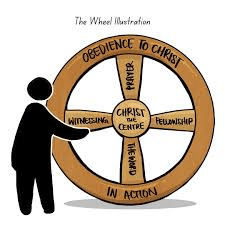
The Bill Gothard organization also focused on personal godliness and their basis of godliness was authority (with women at the bottom). Pastors become more godly by submitting to Christ, husbands by submitting to their pastors, and women by submitting to their husbands.

These two methods of godliness assumes a simple, pliable soul that can be tamed and directed with little effort. It is the hallmark of all cults and some churches with cult-like natures, that those in authority are godly, and almost infallible.
In the model of our personas being just spirit is like rowing a small pliable rowboat, where you have complete control over your direction at all times, even though the world around you is in a storm of confusion. We can turn to the left or the right on a dime, if you know how to steer a rowboat. There are plenty of religous people ready to brainwash you into one of their methods of steering.

In the other model, where our material brains have a powerful influence over who we are, based on nature (genetics, brain trauma) and nurture (upbringing, previous habits, social influences), we have some ability to turn the direction of who we are, but it tedious. Still, it is like rowing a small boat but a boat attached to a vast, full tanker. Even a muscular person can barely move it.

The Problem
Imagine, for a moment, that you are with a group of Christians who believe in Model Number 1. However, in reality, life exists in model number 2. What would happen?
I believe on a psychosocial level, there would be a great bifurcation between who you think you are, who you think your group is, and who you really are. Between the façade of godliness and the reality of your human nature, a dark space is created where the mischief can sprout and grow. That is the place of the secret life—hypocrisy haven.
I must point out that in model number 2, people do not start at the same point. Due to the interplay of nature and nurture, some individuals possess a moral advantage. I’ve had many atheist friends over the years who would never, ever molest children or do the inappropriate touching that Bill Gothard and other Christian leaders have done.
The Story of Don
One of the most “godly” people I knew as a teenager was my girlfriend’s youth pastor, Don. He was exceptionally gifted, articulate, charismatic, and could play the guitar and sing like a professional. He had a wild testimony, coming out of a life of sex and drugs, then he saw Billy Graham on TV, and converted.
Don was also the head of Campus Crusade for Christ at the local university. When I was in college, I worked with Don on a project to bring the (then-famous) Christian apologist Josh McDowell to campus for a series of lectures and debates. Before he left, Josh was so impressed with Don that he invited him to join his ministry full-time.
Soon after that, one of my best friends, who lived on the dorm floor where Don was an RA, had an interesting encounter with a rough-looking woman looking for Don. She told my friend that Don had sex with her at a motel off campus the previous night and snuck out without paying what he had promised.
My friend told Don about it, thinking that the woman was crazy. But to my friend’s surprise, Don said, “I’m busted! I knew I couldn’t get away without paying her.”
My friend waited, his mouth gapped open, for Don to expound. Don went on to say something like, “I like them whores and I still use drugs, I know, I’m a complete phony.”
In a state of shock, I went to find Don. He resigned from Campus Crusade and disappeared for a while. When I saw him and talked with him, he told me that he had never left his life of sex and drugs but only pretended to do so because that’s what people wanted to believe.
The last I heard of Don was about three years later, when he was arrested for manufacturing and distributing child pornography.
I could, and I’m sure you can too, tell many stories like this.
Conclusion
I want to elaborate on this in a subsequent post, but I will draw some conclusions here. I’ve lived for almost twenty years as a “Godly man,” in the eyes of evangelicals. No, I didn’t visit the whores, take drugs, or touch young girls inappropriately, but I bet there were times I wanted to. When Jesus spoke about “sins of the heart” being the same as actual sins, I don’t think he was trying to raise the standards, as many evangelicals believe. I think he was trying to humble the religious, who considered themselves far superior to others who openly engaged in those things.
In the human condition, there are several impulses, but the two strongest (at least for men) are sexual and grasping for significance. The lust for money and power are issues about personal significance, as sometimes sex is. It is naive to think as Christians that we have a different nature. Girls are not always safe around some men, including Christian men. The lust for significance makes Christians very competitive. They demonize those outside the faith as morally inferior. Within the faith, there is an insatiable competition over who has the correct dogmas, ideas, or behavior. I know from experience that competition can be brutal.
Respectfully, Mike


 J. Michael Jones
Leave a comment