Introduction
I was taught, as a child in the Bible Belt and later as an adult in an evangelical discipleship group, that the Earth is only 6,000 years old and that Genesis is a literal, historical account of the Earth’s creation and the origin of the human species. Therefore, humans were created fully formed in the first week, with no genetic relationship to any other “kind” and, indeed, no human evolution.
It was also considered a literal interpretation of the Bible that the death of any kind could not have happened on Earth until the historical people, Adam and Eve, sinned. Their sin brought death not only to humans but also to plants, animals, and even single-celled organisms like bacteria, if you carried that idea to its extreme. These views were all based on assumptions about Biblical narratives that were neither precise nor clear. And many of these ideas, such as the infallibility of scripture, are recent additions.
The third part of this story is that humanity is born into sin and is destined for eternal damnation in Hell unless they believe in Jesus and are therefore redeemed. In Calvinist institutions, they go further by assuming that most people were created for the very purpose to suffer eternally in Hell, and they have no choice about it. At the same time, a minority are called to be Christians, and they have no choice about it.
When religious ideas become culture, they become fixed and considered immoral to challenge. An example of this is at the end of a debate between Bill Nye, The Science Guy, and Ken Ham, an outspoken young Earth Creationist and owner of the Ark Encounter in Kentucky, they asked both men, “What would it take to change your mind?” Bill Nye said, “Good evidence.” Ken Ham said, “Nothing” (implying that not even good evidence).
This supports my experience in both science and religion, that the agenda of science is to find the truth, and that of religion is to enforce cultural conformity.
My life would be so much easier if reality supported my original view… but it does not. As I have written before, I have spent decades studying, seeking factual evidence to support the beliefs with which I was raised. However, in seeking truth, I have found overwhelming evidence for an ancient Earth, 4.5 billion years old, and over 6,000 fossils of intermediate forms (between apes and humans), along with numerous tools, hearths, shelters, and other supporting artifacts, and strong DNA evidence suggesting human evolution at some level.
I must submit to my conscience, acknowledging that if there is a God, that God lives in reality, not by deceit and swindling. However, my position comes at a high cost. I have lost many friends over this issue and am esteemed as an inferior Christian, if a Christian at all. As I’ve mentioned before, in my last church, I was declared a non-Christian because I did not support forcing the teens to believe in a 6,000-year-old-Earth.
To be clear, I don’t have the same attitude toward those who disagree with me as they do toward me. I have full respect for those who believe in a six-thousand-year-old Earth and in the creation of Adam and Eve as the first humans. I have to respect them because that was my position for decades.
Neither do I believe that not accepting an old Earth or evolution is a moral problem unless the person holding that position misrepresents the evidence, which they often do. Unfortunately, misinformation, conspiracy theories, and lies have become the tools that Christians use to combat these threats to their religious tenets. One problem is that this behavior extends to other areas of truth-seeking. For example, when you demonize old Earth or evolutionary scientists as being stupid, evil, working for Satan, or with a harmful agenda, you then generalize to other areas of science, where Christians spread conspiracy theories about pandemics and vaccines, or dismantle the education and scientific programs of our country, as Christian Nationalists are doing as I type.
The Problem
So here is the problem. There is as much evidence that humans had earlier transitional forms and that the Earth is billions of years old as there is evidence that it rains. But with this overwhelming evidence, how do we reconcile it with the basic Christian tenets, mentioned above?”
I have chosen just one of those transitional human forms to continue this discussion, Homo Naledi.
Who is Homo Naledi?
There are at least 21 species of human-like creatures that are neither homo sapiens nor primates. The oldest of these has been reliably dated to more than 3 million years ago. While these have been called “transitional forms” in the human evolutionary tree, they don’t form a logical sequence. Homo Naledi exemplifies this misalignment. Based on its brain size, it should be a very early example of a hominin (in the human-like family); however, to everyone’s shock, it is a relatively recent species, living just 300,000 years ago (the sediments in which the fossils were found were dated using Uranium-Thorium dating). In contrast, the Neanderthals, so similar to modern humans that they could interbreed with us, appeared 130,000 years ago.
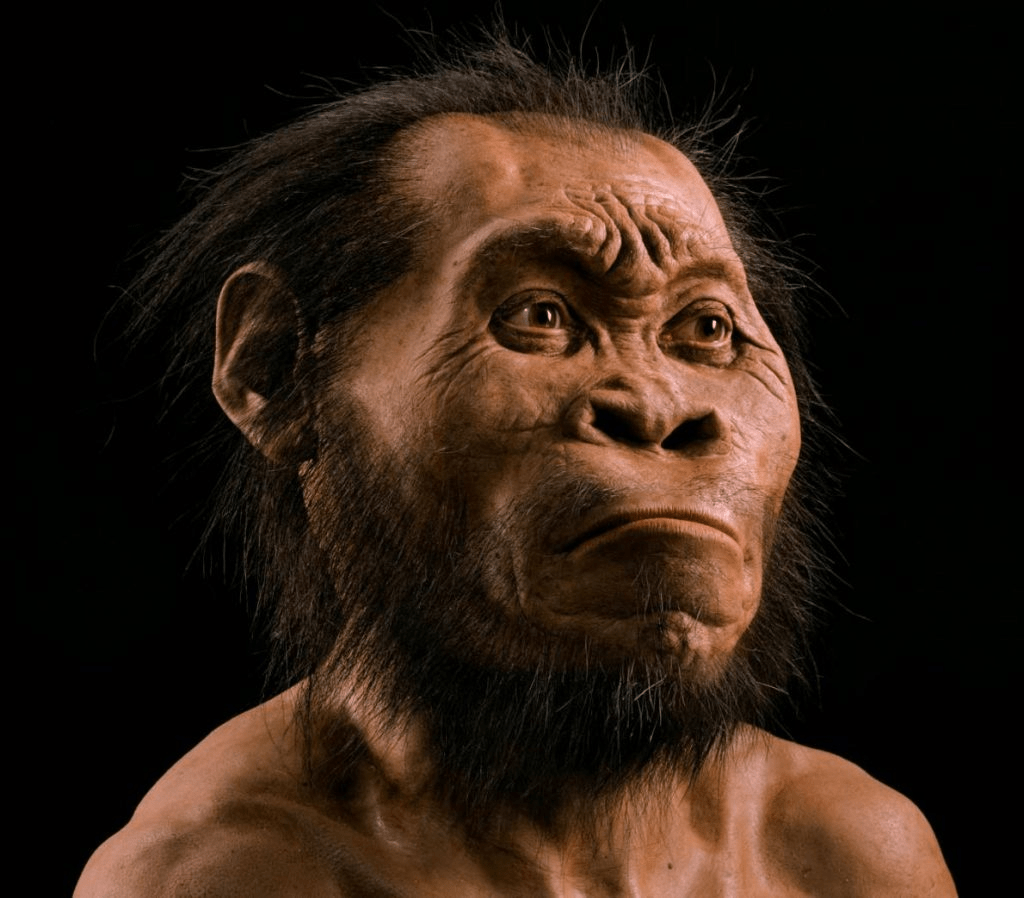
Homo Naledi was found in the Rising Star cave system in South Africa by amateur cavers in 2013. It was a very familiar cave that many people had access to. However, these cavers noticed a crack that went straight down for 30 feet, which they had never explored. Once they reached the bottom of this shaft, they observed fossilized bones scattered across the chamber floor. Netflix has an excellent documentary titled Unknown: Cave of Bones. More than 1,500 fossilized bones have been found, representing 15 individuals of Homo Naledis.
In summary, Homo Naledi walked upright like we do, from the neck down was very human-like, especially from the hips down, but had an ape-like face and brain. It is believed, but not proven, that Homo Haledi made tools, built fires, buried their dead, and did art, none of which apes do (except for some simple tool making).
Going forward in this series, I will speculate on how we can maintain our integrity in seeking factual truth and understanding the Christian message.
I will mention that much of this disharmony has come from using the single scripture, the Bible, without its accompanying guide (as described by Augustine and Aquinas), the second book of reality. For those who hold only the young earth creationist view, it seems they are looking through binoculars, with one side, the reality side, taped over. Nature or reality is also God’s truth.
I will also connect this series with my passion for giving people a reason not to abandon Christ. As the Bible scholar Peter Enns wrote, “I feel that if we do not engage Scripture with future believers in mind, we will unwittingly erect unnecessary and tragic barriers to belief.”
Respectfully,
Mike


 J. Michael Jones
Leave a comment