Introduction:
I have put off discussing this topic for years. I could imagine that nearly 100% of Christians, at this point in cultural history, believe that their faith is centered on “spirituality” or subjective truths rather than objectivity. That objectivity, looking at evidence, is driven by arrogance or a lack of faith, a deep spiritual flaw. By questioning that premise, I will likely invite more criticism. It is the most sacred of cows–pun intended–of religion.
But I don’t take on these topics to personally criticise others, but to address the hard questions that aren’t allowed to be discussed within the walls of the organized church.
The conservative church does not allow a discussion of those hard questions because it believes it has all the answers, those answers have been codified (made into law), and to ask a question about them only proves you are not a Christian, or a very bad one.
The progressive church does not welcome hard questions because, I think, in a reaction to the conservative church’s divisiveness, it champions peace at the cost of looking at hard questions. The progressive church has been heavily influenced by postmodern thinkers such as Brian McClearn, Rob Bell, and Richard Rohr. The very essence of postmodernism is that there are no absolute answers or that all answers are equally valid. Therefore, questions with the pursuit of real answers are superfluous at best, a sign of spiritual inferiority at worst.
The reason I ask hard questions isn’t arrogance, as Rohr suggests. Every hard question invites personal attacks and loses me more friends. Yet, I know from experience, one of the major reasons people are leaving Christianity, or would never consider it in the first place, is the refusal to address the hardest of life’s questions. These are the people who keep me awake at night. With active, incurable cancer, I know that my days on this Earth are numbered. So, I write with the urgency that on my deathbed, I will know I’ve done everything I could to pursue the honest truth and to listen to real questions.
Disclaimer:
I want to be clear, this discussion is not personal and certainly not an issue of morality or intelligence. I’ve written before that I think most people who are Christian (or any religion) are so for the wrong reasons. However, if they are correct, it doesn’t matter… minus a couple of caveats. Regardless of how they think about God, I trust them to find their own way. In other words, even if you strongly disagree with me, I respect you. Not because, like Rohr, McClearn, or Bell, I do not believe all answers are the same. But like Aquinas, I know how hard it is to find true answers in the noise of the cosmos, and I respect all of you who pursue truth, because we are on the same path of seeking it, even though I must assume that some of us reach the wrong answers.
Caveat 1: If you approach a significant conclusion in your life, let’s say it is Christianity being true, in a subjective way, even if you are correct, you are more likely to approach other topics in a subjective way, and they may not be correct. For example, if you say, “I know God is real because I can feel Him in my spirit,” and even if God is real, you are more likely to say, “I will not buy flood insurance for my house by the river because my spirit tells me it is the wrong thing to do.”
Studies have shown that conservative Christians are more likely to believe non-religious lies without evidence, such as baseless conspiracy theories. These false beliefs, like vaccines are bad, have real-life consequences, like death, even the death of children. But if the core of your religion is to believe something without evidence (objective), then it only makes sense that you will believe other things with no evidence.
Caveat 2:
When you have a religion that requires members to base it only on subjectivity, then that religion is out of reach to the many people for whom rationality and objectivity are important.
Conclusion:
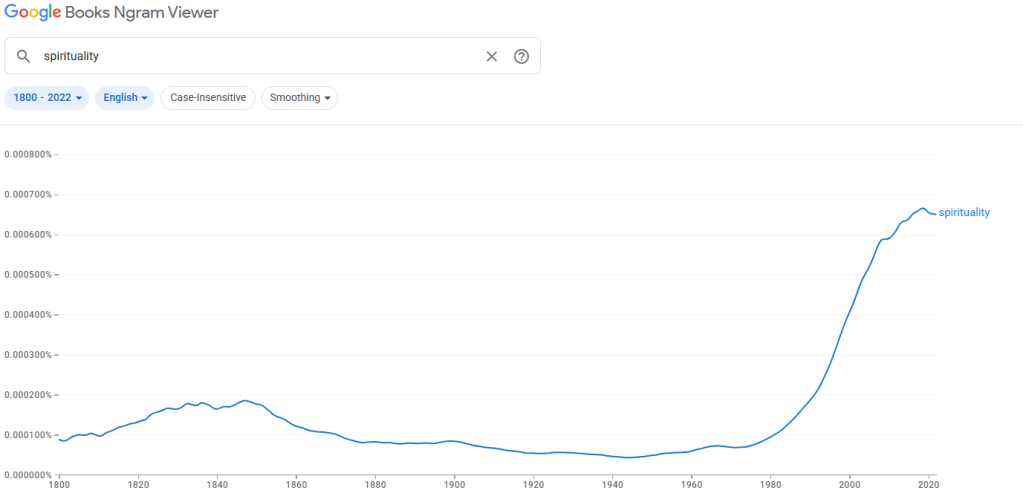
I will close this first article with a premise I am now confident in: human reason and rationality are God-given as our primary tools for finding truth. Our emotions are wonderful and are the spice of life, yet poor tools for finding truth. Religion elevates basic human emotions into a supernatural state of “spirituality.” This overemphasis on subjective spirituality is a new phenomenon within Christianity. To demonstrate, I will show the results from the Google Ngram Viewer, which analyzes words in print over time. I will pick up on this discussion next time.


 J. Michael Jones
Leave a comment