Since it has been a couple of weeks since I left this topic, out of my own paranoia, I want to reiterate my purpose. No, my purpose is not to criticize those who depend on subjective spirituality as an imperative part of their relationship with God. I am writing for those who, like me, have tried a brand of Christianity that relied heavily upon spirituality and subjectivity, and found it wanting or possibly a self-delusion. I want to write about it honestly and objectively for that group, and I hope that those who depend on a spiritual subjectivity for their own relationship with God will tolerate us, who don’t.
The History of Spirituality
After I left evangelicalism, I began a thirty-year study, which has profoundly changed my life. The first topic I studied, which pulled me out of my initial disillusionment and despair and into hope, was history. The history of Western civilization and, eventually, the history of American evangelicalism. When you don’t know history, you accept the present as the default, the normal, or the best version of what can be.
The other problem, particularly for the religious, is “providence.” They accept the way things are as God wants them to be. “It’s all part of God’s plan, right?”
The problem of not knowing history and believing in providence is that it leaves us powerless to change history for the better. Most of the Arab world lives under the thumbs of despots. The Arab Spring was an aberration. It is because the Arab culture, via the influence of Islam and deterministic brands of Christianity, has an even higher view of providence.
Back in America, an evangelical friend, who voted for Trump twice, said that he’s not worried about Trump’s immorality, his enriching his family from the presidency, his cruelty, or even his sexual misconduct, including rape and likely pedophilia, because he is president because of God’s providence (thus exculpating my friend from any responsibility).
I believe that we, as the church, are left on this Earth to love it and to change it toward the better. Therefore, fighting injustice, cruelty, the destruction of God’s nature, and fighting against suffering, including cancer and other diseases. If all these bad things were “God’s providence,” then we should all stay out of trouble and sit on our hands.
First, I will start with the Ngram Viewer, Google’s tool for searching for the use of a word in print over time. You will see that the words “spiritual” and “spirituality” took off in the late 1980s.
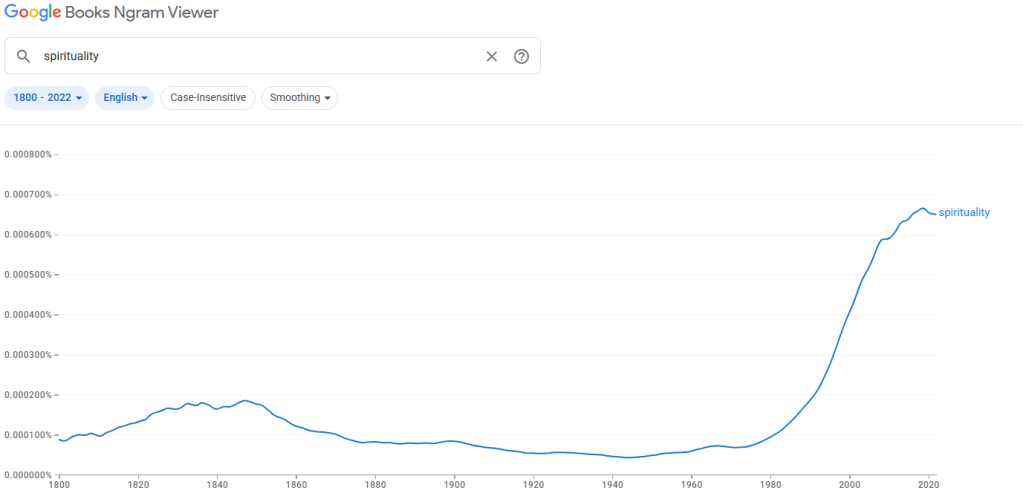
No, I don’t believe that “spirituality” has become a buzzword at present because of God’s big plan (as Rob Bell says). When you look at history briefly, you see that a Christian, Thomas Aquinas, laid the groundwork for the Scientific Revolution and the Enlightenment. However, toward the end of the Enlightenment (the late eighteenth and early nineteenth centuries), the Christian church began to feel threatened by it. Objectivism questioned many held Christian traditions, the age of the Earth, common miracles, and a literal interpretation of Genesis. In response, Soren Kierkegaard (mostly) created a second pathway to truth, subjectivity. No evidence required, only personal experience.
I personally think this was a big mistake. We are just starting to see some of the consequences of that movement in the chaos that the church is bringing to America via the people they have put into power. This is only the foreshadowing of what is to come if we do not return to evidence-based truth. There is an enormous storm brewing on the horizon, and I believe that tempest is AI. If we do not return to evidence-based, objective truth, even in our religious experiences, I’m afraid we will lose the ability to find reality.
I personally believe that God has given us rationality, using objective evidence as the only common way we find truth. I use the word “common” to leave the door open for divine inspiration, as a rare and uncommon way that we discover truth, and we have to be careful with it, as we have many internal emotional decoys.
So, subjectivity quickly (over 100 years) became the mainstay of how Christians find “truth.” Kiregaard believed that our very relationship with God depends on an irrational leap of faith that honors God. But that creates huge problems, because I don’t think that is the way that God has created us, or the cosmos we live in.
Over time, this subjectivity has become more and more extreme until we have reached the point of this postmodernist society, best expressed by Indiana Jones:
We are now living in an age where the view that is popular, even within Christianity, is that it does not matter what you believe, but how hard you believe it. Really? While that sounds sexy and spiritual, take it to its logical conclusion. No, it does matter what you believe, not how hard you believe it. But this is where we are at. While conservative Christianity has its own problems with subjectiveism, the progressive churches, such as the one I attend, have a fairly large number of attendees who eventually reach the point, for the sake of peace, I believe, that it doesn’t matter if you believe in God, believe that Jesus was the messiah, believe in Ahura Mazda, The Buddha, or even worship a stick, as long as you have a certain feeling that you can define as spiritual.
This isn’t about who’s going to Heaven or Hell, who is better than the other, but about what is factually true. Basic logic says that two opposites can’t be true at the same time. Once you start living your everyday life in the same way as your religious life, not caring about objective truth, it becomes impossible to live day to day.
I will also be clear that I don’t measure people based on what they believe, although that is important, but on how they live out Christ’s command to love. So, a Buddhist who loves, I respect more than a Christian who doesn’t, even though I believe the Christian is most correct philosophically, but not in practice.
Peace, Mike
 J. Michael Jones
Leave a comment