Introduction
If there is a core topic to my twenty-plus years of blogging, this is it. I have approached this topic from many angles for clarity, and this time will be no exception.
Christianity, and in some ways all of Western civilization, is at a crisis point. It is not the first time, nor will it be the last. There is a sharp decline in Christianity in America, as measured by church attendance or other surveys. This only captures the tip of the iceberg, as within both conservative and progressive forms of Christianity, there is a migration away from the early Christian ideals (ideals, not just ideas) among those who are staying. While there is a tremendous difference between the methods of these two ends of the Christian spectrum, the conservatives are turning to things like politically driven conspiracy theories, marginalized groups they must hate, and Christian nationalism, and the progressives, turning to nebulous spirituality, they are each driven by the same thing: a rejection of reason, the objective, for the subjective.
But this is not simply a Christian problem, as I alluded to; it is a problem of Western civilization. The chaos of our present government is just one symptom of this crisis.
My Point of View
I must be clear, especially for my new followers, I do not approach this from a religious perspective, but a philosophical one. I will write what I wrote two years ago, which cost me my best and last friend. I despise religion and love philosophy. But, as I did then, I will define what I call religion. It is a human-derived, highly competitive system of rituals and mores that serves a single purpose: increasing one’s sense of piety as compared to others. Therefore, when you discuss a topic from a religious perspective, the subject is always reduced to morality. I believe A, and you believe B, but I am morally superior to you because I know with certainty that God likes A better. When religious people attack me, they always make it a moral problem. “I can’t believe you wrote that. Shameful.”
I will mention again that the historical Jesus of Galilee’s greatest nemesis was religion. I will also add that, as the name suggests, philosophy is the love of wisdom (philos=love, sophia= wisdom). This is the same love that King Solomon had in Hebrew tradition, which delighted God so much that God made him very rich.
So, while I consider this topic very important, it is not a moral problem… initially. It is a philosophical problem, the way we choose to think. And I certainly don’t make it a problem of intelligence, “I’m smarter than you,” kind of attitude. Therefore, unlike when religious people attack me, I have full respect for those who disagree with me. I will quote my favorite Christian thinker, Thomas Aquinas, again, “We must love them both, those whose opinions we share and those whose opinions we reject. For both have labored in the search for truth and both have helped us in the finding of it.”
I will point out, as I know Aquinas well, that he was not saying what you will hear in a progressive church today, that we love them both, because all truths are the same, which is a very postmodernist viewpoint.
So, while this is not a moral problem, the way we think has serious consequences, and the quality of our lives will diminish when our thinking is not congruent with the world we live in. I will discuss this further as I move through the articles.
The Impetus
Something in my life always provokes my writing; this time, there is no exception. I listen to hours of lectures every day, most in the natural sciences, some in history, and a few in Biblical studies. Oddly, you might think, I don’t trust religious Biblical experts as I once did, because they have an agenda. They start with the belief, a dogma, and then try to force the Bible to support it—confirmation bias. One Biblical scholar who doesn’t work from a dogmatic angle, Peter Enns, is one of my favorites, although I haven’t read any of his books recently or watched him online. He was a scholar who was not held captive by Christian cultural beliefs, yet he approached Biblical scholarship honestly, and he is still a Christian… tentatively, as you will see.
Two days ago, while I was searching for a paleoanthropology lecture on YouTube, for some odd reason, it put a very personal video by Peter Enns (below) in my queue. Maybe it was because I was listening to a New Testament scholar, Bart Ehrman, a couple of days before that. I listened to this video and was deeply moved and saddened because Peter is a very good man whom I deeply respect, but he is wrestling with this very issue. As a progressive Christian, he is at a crossroads of what he calls his analytical mind, which is pointing to atheism, or his emotional mind, pointing to the mystery of God, but is irrational. What saddens me isn’t that he is being foolish, but that he is being exactly typical. Many progressives made this choice, to leave reason, which you think will lead to atheism, in exchange for more mystery in the subjective or emotional. But they didn’t have to—a false choice.
I spent almost forty years in the heart of irrational/mystical Christianity, and in the end, it failed. Certainty based on the subjective often leads to emotional abuse, because our most devious nature comes to the surface when it has a cover. Coming out of that, I turned back to reason. Like in this cartoon below (which I shared before), reason first leads you to doubt. If you get caught up in that layer, as Enns was demonstrating, you end up rejecting all, including God, for the sake of the clearly objective. But as the cartoon demonstrates, if you keep moving, keep studying, and thinking rationally, you end up back with God and a profound objective mystery, far beyond what you could experience as a mystical, subjective Christian. The Cosmos screams of a rational creator and a mysterious one.
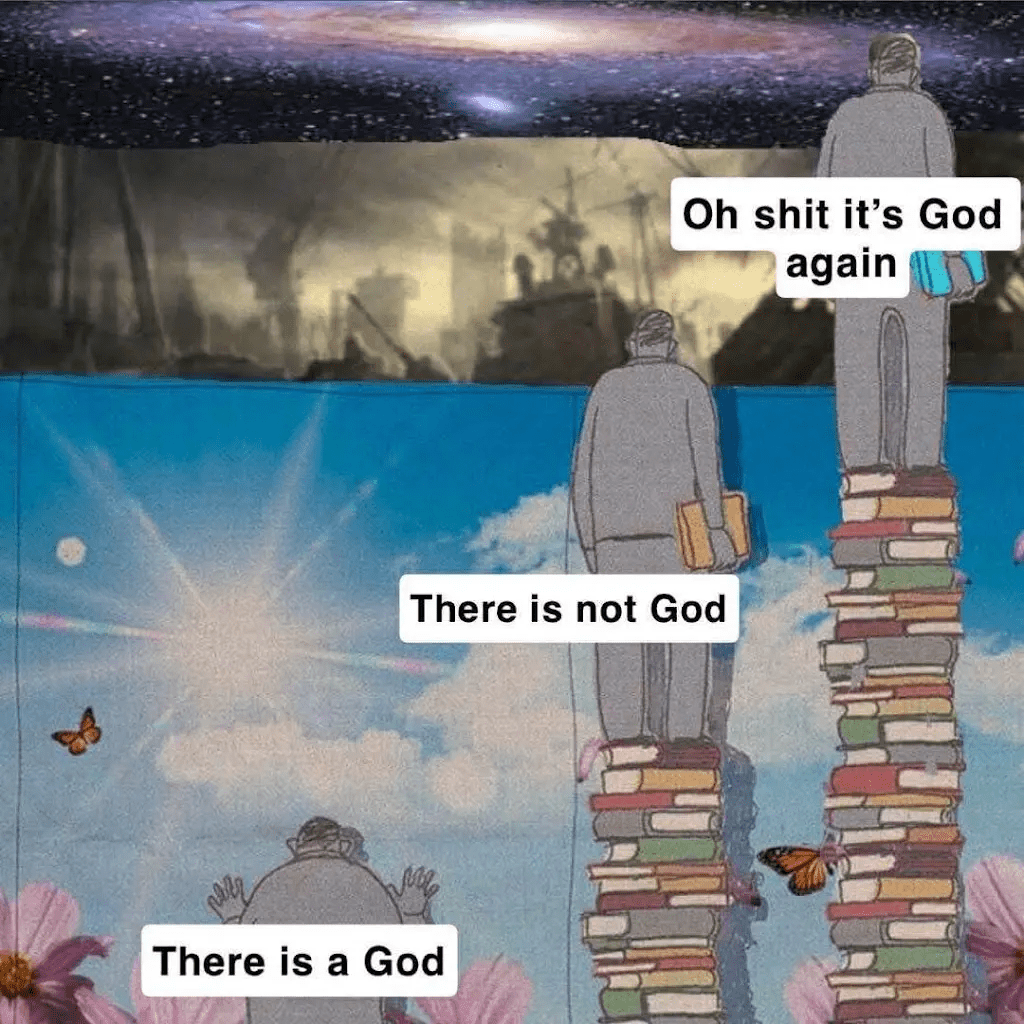
So, listen to Peter struggle with what he calls his left and right brain, meaning reason and experience or emotion. He is self-aware that he is not an expert on neuroanatomy, so I, who has spent my career in neurology, will point out that the neuroanatomy and function of the brain is far more complicated than that. But it does have an integrated system of rational (mathematical-cognitive) thinking and our emotions.
I will point out that later, I found out he made this video seven years ago, before I first met him.
Peace, Mike
 J. Michael Jones
Leave a comment