Come with me on an imaginary journey. You are a native resident of the Dutch village, Zundert. While it is now known for its world’s largest flower float parade, Bloemencorso, which puts our Pasadena Rose Parade to shame, it is the birthplace of their favorite son, Vincent van Gogh. The parade was started to showcase their local dahlia farms, in contrast to Pasadena’s parade showcasing roses, but their love of van Gogh is evident in the many floats in the Bloemencorso that honor him.

Now imagine that the village is not only proud of their native son but also totally obsessed with him, to the point that they have built a cult around his persona. Each home has an altar dedicated to the man, with a copy of the only authenticated photo of him (below).

Each family in Zundert has a copy of the Pulitzer Prize-winning book, and considered the best biography, Van Gogh: The Life by Steven Naifeh and Gregory White Smith. They study this book weekly to learn more about their hero. However, because a van Gogh painting sells for 50 to 100 million dollars, not only does no one in the village own one of his paintings, but they have never seen one in person.
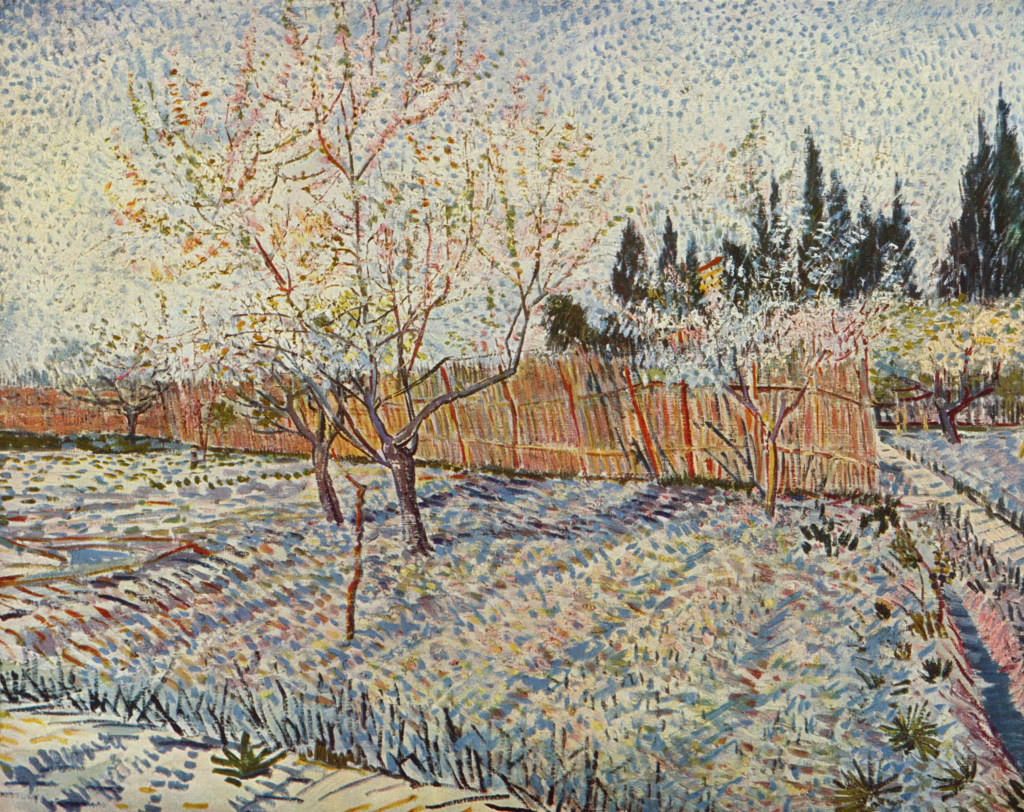
Now imagine that the descendants of van Gogh turned his boyhood home into a museum dedicated to him. It is filled with his original paintings, his clothes, his personal diary and writings, his dishes, his furniture, his doodles, and even a handkerchief with his snott, which he blew out while standing in a cold field painting The Starry Night. Admission for local residents is free.

Now imagine that no one in the village has ever visited the museum, nor have they any curiosity about what’s inside. Does this make sense to you? It doesn’t to me.
However, this is exactly what is occurring in Christianity. We have a book, the Bible, inspired by God, written by men, to give us insights into the character of God. Beyond that book, we have layers of human culture, sometimes loosely based on it, that not only shape how we think about that God but also how we live. However, we also have the cosmos, which is the exact handiwork of the living God, and most Christians have no curiosity about it, except for admiring its beauty from afar… which would be the equivalent of driving by the museum and giving it a glance.
Science is simply the study of the cosmos or nature. The word science is from the Latin scientia, which has its root in scire, meaning “to know.” Science is the pursuit of knowledge about the cosmos that the creator, whom we claim we believe in, handmade, and is packed full of information about his character. And best of all, it is real.
You would think we who believe in a divine creator would be obsessed with the things he has made, because they objectively teach us so much about him and his mystery. Far more than the subjective mystery that religion imposes. But there was a time when most of the scientists were Christian and pursued science because of their Christianity, not despite it. Even the Scientific Revolution of the seventeenth century was inspired by one of the greatest Christian theologians, Thomas Aquinas. But what the hell has happened?
I had a conversation with an old conservative Christian friend a few years ago. In this conversation, he was sharing baseless conspiracy theories, such as wearing masks during COVID was the attempt of the liberals to feminize men (forcing them to wear veils). The vaccine was created to cause people to become sterile because liberals, such as Anthony Fauci and Bill Gates, want humans to disappear off the face of the earth. He asked me how I got brainwashed by the liberals. I shared, especially in light of the cancer of my immune system, I followed the science (and the science was evolving because this was a novel virus).
My friend’s response was, “Science?” He laughed, “Science is from Satan… it gave us abortions.”
The truth is, science has done more to preserve the life of the fetus and newborn, as well as the mother’s, than anything. Before science, 50% of babies died before adulthood.
A few years ago, I attempted to become more involved with my progressive church by agreeing to help with adult education on Sunday mornings. I set up two classes introducing science and reason as a very important part of our relationship with the rational God. The only feedback I had from the two classes, from the same man, was that it was terrible. He said, with a smirk, “We don’t find God with science; if you use science or reason, you don’t know God like I do.” As I’ve commented before, religion is very competitive, and I would never declare that my relationship with God is better than someone else’s, only that it is far better, far more mysterious, than it was when I was a very serious evangelical and a missionary to the Muslims… because of science and reason.
My point here is that this negative view of science and reason saturates Christendom from end to end. Subjective truth is the new buzzword. This is a new development over the past 150 years, and, in my opinion, it is absurd and dangerous, but not immoral per se. I will connect the dots to how this unhealthy way of thinking has led to the chaos we watch on our TV news today.
Back to The Dilemma of Peter Enns
I will circle back to the introduction to this series, the video by Peter Enns. So, you won’t misunderstand, he is a good man, for whom I have a great deal of respect, a man far better than me. But in the video (seven years ago), you will see him wrestling with his “analytical mind” versus his “experience” or emotional self as the way to know God. Having followed him since then, it appears he has chosen the latter. But I find this sad, due to the unhealthy perspective that dominates Christianity in the twenty-first century.
I’ve shared before how I spent almost forty years in Evangelicalism. Before that, as a high school student, I was profoundly curious about the cosmos, but my brand of Christianity crushed that curiosity. Science was taught as the enemy of God. I will write more about the why of that later.
I will say that, since leaving Evangelicalism and allowing my curiosity to bloom, it has profoundly enriched my relationship with God, far more than religion ever did. If you think you must turn to imagined, irrational mysticism to know the rational God, you have never studied cosmology, quantum mechanics, or the intricacies of cell life. My study of them has blown my mind.
In Peace,
Mike
 J. Michael Jones
Leave a comment