A Quiet Harbor
I love writing… blogging is my favorite. It has been a very busy month, and it feels so good to be back at the blogging keyboard, but only for a few days in this quiet harbor.
I took a trip with my family to Florida, and I meant to write there, but my travel computer took its last breath soon after my arrival. That was a good thing because I could focus on my family, some of whom I only see once a year or every two years. Then, as I had planned, as soon as I returned home, I had the delivery of a sissor lift to do all the work on the ceiling of my cottage. The ceiling is twenty feet at its peak. Because of my cancer, I normally can’t work on the cottage more than 2-3 hours per day due to exhaustion. However, with the lift for only a week and a tremendous amount of work to do, I had to work six hours per day, finishing on Monday. Then I had two medical appointments on Tuesday, dropping Denise off to catch a flight to Minnesota at four this morning, another medical appointment, and, whew, I am now back at my computer. I have just a few days to write before going back to the hospital for three days next week, cancer follow-up and infusions on Monday, shoulder surgery on Thursday, then back to the hospital Friday morning for an all-day IVIG infusion. That will put me out of commission for several weeks, and that’s why I had to get this overhead work done this past week.
So, my first order of business is to finish up my series on Subjective Vs Objective truth, a paradigm shift. My point with this introduction is that I may post several times over the next few days, then disappear until I can type with two hands again.
The Problem, Restated
We are living in a Post-Christian world, and I am confident that Christianity’s influence on the broader culture will continue to diminish. The total loss of truth in our national government is a symptom. Christian nationalism is an ill-thought-out, desperate plot to reverse this path to irrelevancy. I have carefully followed the reasons people are finding Christianity irrelevant to their own lives, and those reasons are multifactorial.
While I am concerned about all the reasons for leaving, what keeps me up at night are those who are leaving because they are being told by both the conservative and progressive churches that faith must be subjective. Any attempts at objectivity are “of the flesh” or, as Richard Rohr (one of the most popular gurus of the progressive church) says, “an exercise in arrogance.”
No, I am not criticising you if your “spiritual life” is purely subjective. But I will criticize the organized church for not giving others, with what Peter Enns calls his “analytical mind,” who love evidence and objectivity, the space to co-exist with them.
The impetus for this series of articles was watching Bible scholar Peter Enns struggle in real time with this dilemma, feeling he had no choice but to give up his rational mind to stay within Christianity. Subjectivity can only sustain a thoughtful person for so long.
New Data
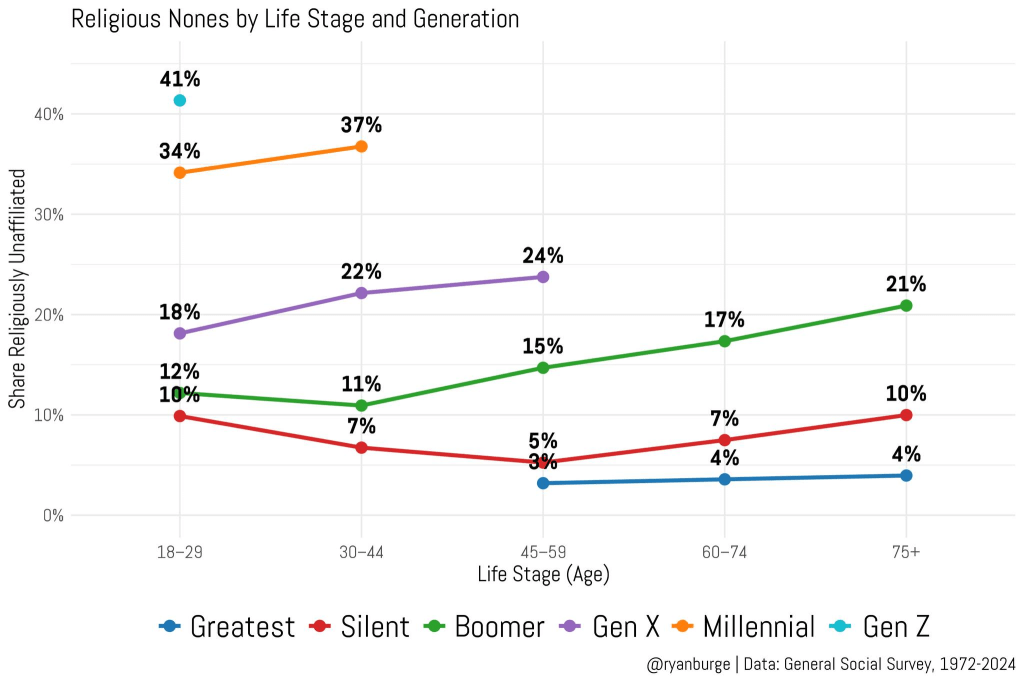
Ryan Burge is a professor of practice at the John C. Danforth Center at Washington University in St. Louis, and he is working on a couple of books to be released in as many years that examine this trend comprehensively in America. He shared the chart below, showing how each generation is becoming less religious, and that view only deepens over their life.
More data to support my point, Christianity, and religion in general are dying. Notice that only the silent generation follows the myth that people who leave the church when they are young will always come back later as adults.
The Supra-Natural
Philip Yancey’s book, Disappointment with God, opens with a story about a theology graduate student whom Philip was very impressed with, who suddenly leaves Christianity for good when he learns that a supernatural miracle he thought he had witnessed was not true after all.
Most people use the word “supernatural,” but I think the prefix “supra ” expresses it better. Super is derived from the Latin super, which is a derivative of the even older word uper, meaning “above”. Uper is obviously the root of the English word upper. However, super has come to mean immediately above, attached to what is below it. The prefix “supra ” is a closely connected word, from the Latin suprā, which also means above, but has come to mean far above, or at least not attached to what is below it. So, something attached to your roof, such as a solar panel, could be called a super-roof placement; however, if it were hovering above your roof, like a bird or a cloud, a supra-roof would be better. So Supra-natural best describes what I want to address.
After almost forty years as a devoted religious person, and thirty years deeply involved in hard science, I’ve come to the conclusion that the cosmologist and particle physicist know more about the nature of God, whether they acknowledge it or not, than the most astute monk or theologian. Their journey is within the objective, too. I will also add that there is a real problem when your religion requires supra-natural events, when those events aren’t really happening, or at least not routinely. Yet, I will also say that real Supranaturality is everywhere, but we have been programmed not to see it. I will explain later.
Next time, I want to pick up on this notion of the supra-natural, and how a major paradigm shift in how we look at reality is needed.
I will close with one verse from Matthew 12: 38 Then some of the Pharisees and teachers of the law said to him, “Teacher, we want to see a sign from you.”
39 He answered, “A wicked and adulterous generation asks for a sign! But none will be given it except the sign of the prophet Jonah. 40 For as Jonah was three days and three nights in the belly of a huge fish, so the Son of Man will be three days and three nights in the heart of the earth.
In Peace, Mike
 J. Michael Jones
Leave a comment