I’m feeling a bit helpless this morning, being a one-armed man. I wasn’t expecting to write until my arm was out of a sling. Yet, there is nothing else I can do. I’ve watched many lectures, listened to my book, Brian Cox’s The Elegant Universe, and I’ve spent many hours editing my new book, How Cancer Taught Me to Swear. But for me at least, I can only edit for so many hours before I need a break. I’ve also watched a few episodes of Columbo, but even that is starting to feel a bit boring.
Even with my arm in a sling, I was tempted to work on my cottage a little bit yesterday, but paid for it dearly last night with a lot of pain in my shoulder.

As a medical provider, I spent years doing dictation, so I’m comfortable with that. So, now, I am using Microsoft Word’s Dictate to write this article. It is slow going.
I have spent many hours researching for my new book. I have learned many things about my cancer journey, and this writing has been cathartic. And I’ve also spent a lot of time researching the whole concept of saying “swear words” in the Christian community. I had blogs on this very topic several years ago.
If you know me well, you will know that I have been deconstructing Christian culture for almost 30 years. The vast majority of what we believe as “Christian” is culture, not something the Bible tells us. I’ve had to pay a high price for not being a conformist within American Christianity, seen as the devil by many, but I do this for a reason. Actually, for two reasons.
The apostle Paul warned the early church not to be taken captive by tradition and culture. But once you’re inside a culture, and that culture tells you that all their “truths” are from the Bible and therefore mandated or essential, it is hard to convince someone otherwise. But the two problems are that Christian culture has many things that are not only not from the Bible but are harmful to the real message of Jesus Christ. One of those harms is that it prevents many people from having access to Jesus. When you tell rational people that they must check their reason (or what Peter Enns called their analytical mind) at the door of the church, or that they have to take on many cultural mores to be a Christian, such as having to love the Sunday morning worship service of a church, you create a pinch point that many people cannot assimilate.
If I enter my evangelical mind for a moment, the old Mike pre-1990, I would have said, “So what? That’s their fault.”
But this is not how the Bible looks at it. There was such a cultural issue at the time of the early church, forcing men to be circumcised to be Christians. The apostle Paul was outraged at this attitude and behavior within the church. Jesus himself described that it would be better for a millstone to be tied around your neck and drowned in the sea than to interfere with one of the children trying to find his Kingdom. So, this first problem, requiring people to follow a huge list of cultural mores to be a good Christian, is shameful. Speaking in a particular language, what I call “christianese,” is just one of the examples of this imposing cultural ideas that have nothing to do with the Bible. Christianese, is a language where you not only do not use a long litany of words that’s been deemed arbitrarily as “foul,” but you must also exhibit Pan Am smiles, especially in a church, and never speak of anything that’s hard in your life unless you have some victorious, often supernatural resolution of that hard thing. Showing sadness is quite taboo in most Christian circles. Expressing doubt, which is very healthy, is also taboo. As I’ve always said, doubt is the first step on the path to finding truth. I could go on and on, but I want to pivot here and focus on the title of this article, The Sin of Emotions.
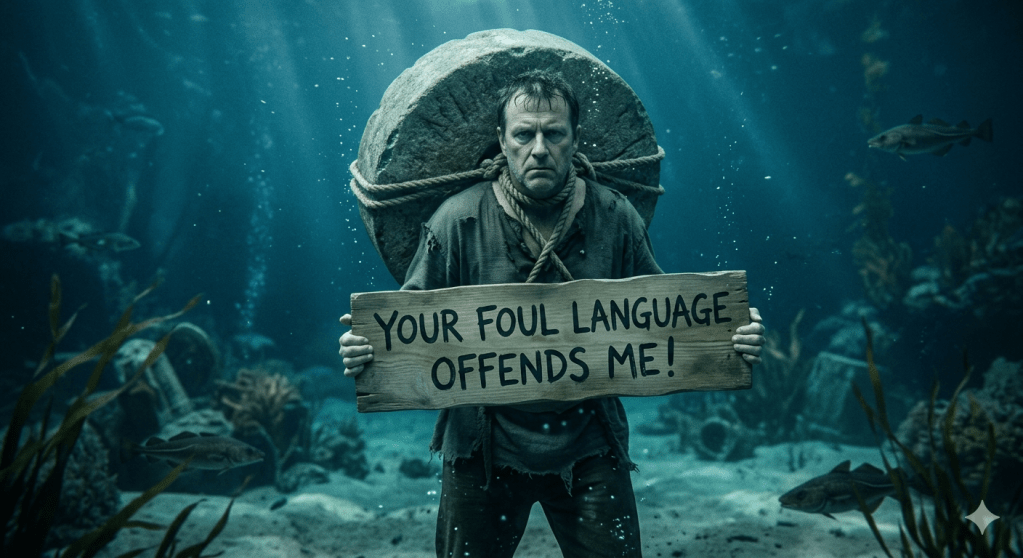
The second problem with codifying cultural mores as Christian dogma is the fact that many of those mores are unhealthy to us spiritually or emotionally. Classifying human emotions as sin is one example.
As I studied the history of what we call today “swear words,” most of them appear to date to the late 19th century, which we refer to as the “Victorian Period.” During that time, the Christian religion went to seed, as some historians call “The cult of respectability.” Competitive piety became a defining MO of the Christian culture. To play the game of piety, you require many rules to keep score and to determine the winner. So, the Victorians expanded the teachings of the Bible into comprehensive rules of all of life.
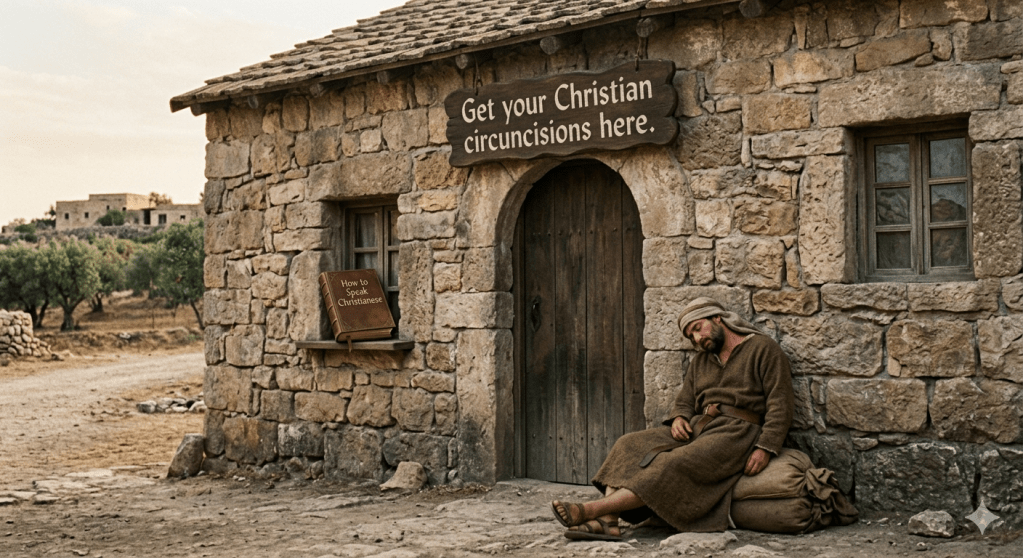
One clear example is expanding the bible’s teaching against drunkenness to making all consumption of alcohol a sin. The Bible is clear about loving language and unloving language. But the Victorians expanded this, and oversimplified it, by identifying certain words as loving or unloving. So, from their rationale, I could say to someone, “Man, you’re as smart as hell!” And that would be classified as “unloving,” because it used the word hell. Or, I could say to someone, as someone said to me, “I have read your blog, and it’s disgusting. I can tell you’re a real God hater, and you’re a very bad man.” And that would be considered loving because it doesn’t use any of the words on the list.
But as I continued studying this, I soon realized what the Victorians were trying to do, besides creating their own language of christianese, was to expand the simple teachings of the Bible about not letting anger get out of control to making all human emotions taboo. The reason they listed certain words as taboo is that what we call swear words are conduits of emotions.
So, I’m going to shift here, and I want to make sure I’m clear. I’m not promoting the idea that Christians start using words from this list. It’s up to them as there is no dogma to guide them here except loving language. It’s not about particular words. I do ask for grace and tolerance for those outside your Christian culture who use these words to express their emotions.
But the problem for the Christian is that emotions themselves have now become taboo. As an example of this, the Christian sees the problem, if you dissect it, of someone shouting “damn it” when they stubbed their toe, is offensive because they’re venting anger. So, while having anger is a normal human emotion condoned by God, who creates us this way, it is now codified by the Christian culture as sin.
When I was an evangelical, we worked hard to hide our anger. The only place where anger was allowed was what we called “righteous anger.” But an example of this so-called righteous anger was feeling outrage when we saw a gay person or someone getting an abortion because we knew how much God hated such people… which is another story.

But while you can find references to emotions going to extremes, such as anger, as a problem, now the expression of them at all is considered a sin.
You never see good Christian people behaving at a funeral the same way I’ve seen good Muslim people do. The Muslim, not subject to this cultural bottleneck of the Victorian age, gives full vent to their heartache, while the good Christian tries their best to suppress the grief, because they believe it is a sin.
You can express joy if you make it spiritual and attribute it to the Holy Spirit.
I will close by discussing another healthy emotion that is taboo: self-pity. Like the other emotions, self-pity is normal and healthy unless it consumes someone. Actually, self-pity is an echo of justice, which is one of the most important things to God. We feel self-pity when we feel injustice. A child in Gaza, whose parents were killed by a bomb, whose house was demolished, who lost a leg and an eye, can feel pity for themselves, because it is unfair. To feel self-pity in that case is to agree with God, that justice, fairness is the ideal, injustice and unfairness an aberration.
I hate to use myself as an example, honestly, because I fear that others will judge me for showing emotions. But I tell this story soberly, as an observer of human behavior, and there is no better subject to observe than myself.
When I was first diagnosed with cancer, I was doing terribly, barely able to walk with a life expectancy of nine months. I bumped into a Christian couple I knew from church on my way out of the hospital, and the wife, to my surprise, never said hello but went straight into a stern lecture, shaking her finger as she lectured, “You’d better not feel sorry for yourself. God gave you cancer for a reason, and he doesn’t make mistakes. You better not turn your back on him.” And she walked away as I whispered into the back of her head, “Hello.”
But I sensed she felt that human emotions of any kind were evil, and that she was following God’s directive to straighten me out. But it felt profoundly unloving to me at a time when I felt desperation.
To cap this was a positive statement, I have had many other people from my church show nothing but grace and kindness, the essence of loving language.
Peace,
Mike, the One-Armed Bandit
 J. Michael Jones
Leave a comment