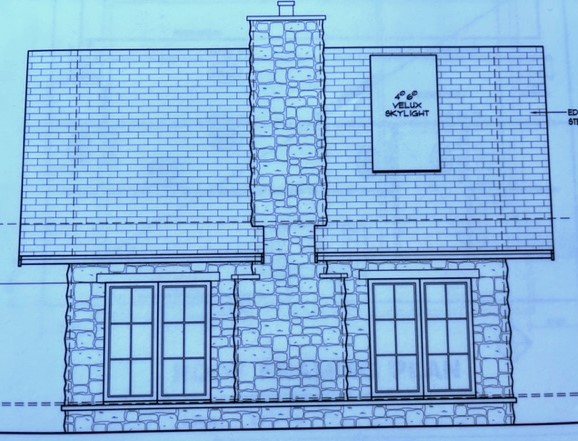
Today was a landmark day. After two and a half years of patience, my permit was issued today. Hallelujah! Now, the hard work begins.
I am the general contractor for this project and will end up doing most of the work myself. I need to learn to do good plumbing, framing, electrical work, roofing, and wear many other hats. I feel like I’m a freshman in college again, books everywhere. But that’s a good thing. When your brain is taken up with dreams and plans, it leaves little space for mischievous thoughts, such as worry or sadness. Right now, the only part I want to contract out is the concrete foundation.
Foundation
I don’t know how it is in the rest of the country, but it is a challenge to find skilled work here. Historically, it has been because there such a high demand for building and limited skilled workers. While building might have slowed down across the country, it has not here. I have been trying to secure a foundation company for over a year. I think I have finally nailed that down. We have an informal agreement, but the owner will be here in two weeks to go over details and finalize a written contract.
Water
Potable water has been the impetus of the long delay. The community did not want me tying into their well due to fears I was building this as a rental. I am not. A new well would be north of 65K. I turned to rainwater catchment, but after two years, that was a complete waste of time and money. The company, which is the premier company in Seattle, fumbled the ball. So, with pity in my eyes, I was able to persuade the community that this building was an important part of my moving forward in my struggle against my illness. They agreed to give me their permission.
The next step was trying to find the plastic waterline, which was buried about 30-40 years ago. I spent about six weeks on this quest. I started by creating a straight line from the assumed water source, about 100 yards to our house. I began digging trenches across this line in several places, down to 36 inches, without success. Not only did I have to dig this by hand, but I had to use gardening tools to avoid cutting the line with a shovel or maddock.
Then I got smarter. I met with the one neighbor who was living here (actually she was living in our house in those days) when the waterline was put in. To my surprise, she drew a map from memory, where the line came in from the north, rather than the west. She seemed to know what she was talking about. At that juncture, I could have started digging random trenches again, or pay a plumber 2 K to come with ground penetrating radar to find it, or to think more. I pulled up a county LIDAR image, which had a tiny, 1/4 inch, indentation running in that direction. Then I used Google Earth.
In archeology, they often can find buried artifacts such as buildings and walls via crop lines. When earth has been disturbed, vegetation above the disturbed soil is a little greener. It is so subtle that you can’t see it with your eye on the ground, but you can see it from space. The reason is, disturbed ground retains moisture better.
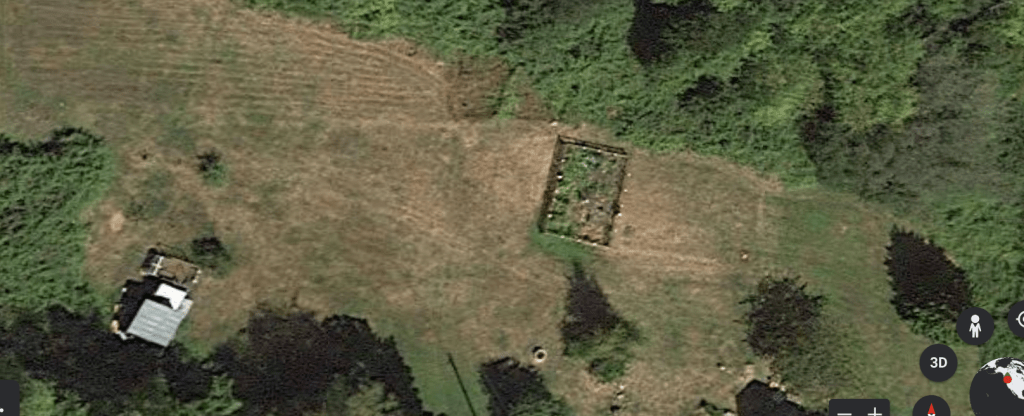
Above is the Google Earth image of our property. The rectangle object in the center is Denise’s garden (who a group of you helped build when I was just diagnosed with cancer and couldn’t do it, thanks again!). The west is to the left. You can see the mow lines in the field that generally run from east to west, but if you look carefully, just west of the garden, you will see slightly darker line going from the southeast (right lower) to the northwest (upper left). My first trench across this line nailed the waterline, just 14 inches down. Finding the waterline was essential before breaking ground.
I will keep you posted as I progress and I will try to make this interesting enough to be “read-worthy.”
Mike


 J. Michael Jones
Leave a reply to Ron Cancel reply