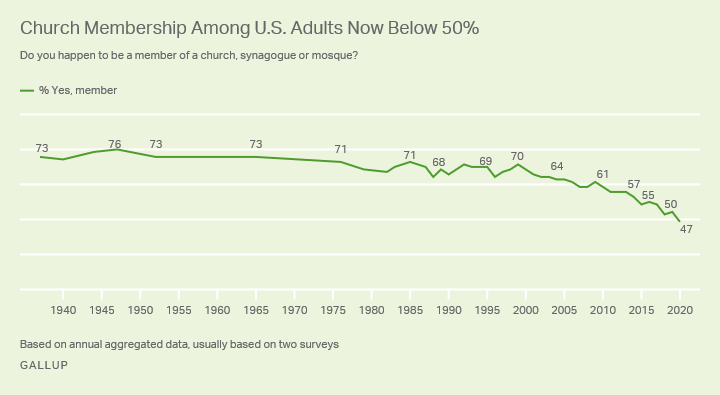
It is inevitable that we are entering a post-Christian world. Europe entered this phase 75 years ago and now it is America’s turn. For the first time (2020), less than 50% of Americans are church members. When you do visit a church, it is an ocean of gray or bald heads. When you divide it by age, the fall from “Christianity” is more dramatic. In the ages of 18 to 29, only 21% attend a religious institution (church) and only 31% say they believe in the God of the Bible.1
I suspect the non-Christian welcomes this development. The Christian who deeply appreciates the traditional Christian culture can also take solace that there will be a remnant of that culture for many years to come, likely beyond their lifetime. There are, however, three ways that Christian folks are reacting to this inevitability, not understanding that they are a century too late.
- Denial. The first is denial. On more than one occasion, when I brought this truth up within a church setting, people seemed taken aback or angered, and it is often directed at me, not recognizing that I was just the messenger.
- Confrontation. The second, and most common, is the demonization of secular culture. This is the root of the so-called “culture wars.” These Christians believe that this secularization is the fault of the “bad people” outside the church (never blaming their own mischief and irrelevance). Some within that movement now support a Christian nationalism, where their “Christian” culture is imposed by the secular government upon all of America, as their attempt to stop the Christian hemorrhage and to restore an imagined “Christian nation.” They must be poor students of history. Thomas Jefferson didn’t wear a “What would Jesus do,” bracelet . . . I promise.
- Compromise. This is where my writing intersects between the post-Christian and late post-modernism (as contrasted with early post-modernism circa 1950). With this approach, the Christian adapts to the late post-modern worldview by adopting the tenet that there are no answers, no truth. I recently heard a post-modernist pastor say that questions are still okay, while there no answers, which is bizarre. All opinions are the same in that system of thought. This classic view of post-modernism is expressed well in the major one-liner from the new Indiana Jones movie, Dial of Destiny. “It’s not so much what you believe, but how hard you believe it.” Imagine I believe I can fly with all my heart. Come to the Deception Pass bridge (160 feet to the water) tonight and I will demonstrate how faith conquers reality because there is no truth, no Newton’s second law of gravitation, no principle of no free gasses in water and the requirement for free gases for organism that use lungs for respiration, such as myself. This tenet of post-modernism doesn’t bother me because of some religious dogma I hold, which I don’t as I’m not religious, but from classical logic, opposites are never the same. Truth is real and that which is consistent with reality.
While I imagine that for the atheists, a post-christian culture is something they would applaud, I think there could be a good outcome for Christians too, when you understand it as a “post-Christian culture” world and not a “post-Jesus” world. Jesus removed from the religion and culture that built up around him over two thousand years, is simple and palatable, even to the atheists. But you would first have to accept the notion that christian culture is a human invention rather than something made by God. There is an overwhelming belief among Christians (Muslims have the same view) that by God’s providence, the state of their religious culture is how God intended it. I have a hunch that’s not true, yet without certainty. It is just a thought worth pondering.
This long written introduction applies to two pod casts, the first with more introductory thoughts, and a shorter second one to wrap up the idea. I do not express these ideas to create conflict but to encourage those who may be discouraged with the state of the chruch, or those disillusioned altogether. I have no quarrel with those (who I suspect are most people) who strongly disagree with this thought. It is just a thought shared with respect and peace.
Podcasts:
Preparing for a Post Christian Culture Requires a Paradigm Shift Listen Here.
Preparing for a Post Christian Culture Part II, Rethinking the conversion of Constantine. Constantine, consider a saint by the Eastern Orthodox Church, was not baptised until his death bed because he wanted the freedom to worship other gods (in his case, his favorite, Sol Invictus) besides the Christian one. Yet, he set the followers of the historical Jesus on a path of insitutionalized religion. Listen here
Mike (now back to cottage building)


 J. Michael Jones
Leave a reply to Craig A Clark Cancel reply