If you know a little about how AI algorithms work, you realize you can ask AI a question five times and get five different, but closely related, answers. I just ran the question, “Why are so many people leaving Christianity?” and below is the answer, which I copied and pasted this morning:
1. Disagreements with Teachings and Doctrines:
- Moral and ethical concerns: Many people are leaving Christianity due to disagreements with specific teachings, particularly those related to LGBTQ+ rights, gender roles, and other social issues.
- Lack of evidence or logical inconsistencies: Some find it difficult to reconcile certain theological concepts, like the Trinity, with their own understanding of the world or find the Bible’s stories illogical.
- Contradictions between teachings and practices: Some individuals are disillusioned by the disconnect between what the church preaches and how it behaves in practice, especially regarding social justice and inclusivity.
2. Disillusionment with Religious Institutions:
- Church scandals and abuse: Scandals involving clergy abuse or other misconduct can erode trust in religious institutions.
- Perceived hypocrisy:Some find the church to be hypocritical in its teachings and practices, leading to a sense of disillusionment.
- Lack of inclusivity and acceptance: Some feel unwelcome or excluded from church communities, especially those who are LGBTQ+, people of color, or have disabilities.
I hope to address each issue in the future, however, I want to finish this series first. There is a thinking crisis within Christianity, manifest by the conservative churches embracing political and other conspiracy theories without question, and the progressive churches embracing postmodernism without critical thinking. I don’t think people realize how new both of these ideas are, and reverting back to a healthier way to think is not that difficult.
I will be clear again, unlike the dogmatists (those religious people who have certainty about a plethora of dogmas, and see those who disagree with them are morally repugnant and bad people), I am not making this a moral issue or an issue of intelligence and certainly those who disagree with me are not bad people. This is about culture, and I believe if we thought differently, there would be fewer people leaving Christianity, and life would be better for all of us and our country. That is my only point. No, I’m not the enemy of the church, but I see the church the way that Jesus did, not as a specific institution but as an invisible tribe of call-out ones. The stories below will give some clues on why I gave up on working within the organized church.
Story Time
I tell these stories only to illustrate the thinking problem in some Christian entities.
I was a deacon in a large evangelical church on the shores of Lake Superior. One year, they set their goal to reach the “unchurched.” I took this idea seriously. Our town had two distinct groups: those who went to the churches on Sunday morning and those who went to the bars on Saturday night. I met with the nice, humble, and quiet pastor and came up with the idea to create a discussion group in the largest bar in town on Saturday nights. I would lead it. The pastor was onboard. I got approval from the bar owner. At the next deacon meeting, I shared my plan. The head deacon, Bob, who was the real church leader, became enraged at me because my “phony meeting” was in an evil place where they serve alcohol, Satan’s domain (the disdain for drinking alcohol is endemic in some conservative Christian cultures, and has nothing to do with the Bible).
With disappointment, since I could not get the Church’s approval for this meeting, I decided to teach a philosophy course in the local library, specifically juxtaposing the philosophical presuppositions of Eastern religions with those of the Judeo-Christian traditions. The greatest threats to Christianity in the twenty-first century are the different philosophical tenets of Eastern religions. Many of those leaving Christianity are going to Buddhism or creating an illogical hybrid.
I presented this idea to the deacons, and Bob was livid at me again, because “philosophy is of the devil.” I wanted to finish the course, so I resigned from the deacon board and did it without the church’s blessing. BTW, “philosophy” is literally the “love of wisdom,” the same wisdom that the book of Proverbs glorifies.
I shared my discouragement toward my church with two of my philosophy students. They were both graduates of Calvin College, a Christian Reformed school in Michigan. They encouraged me to try out the reformed church, where I might find more critical thinking.
I took my family to the local Reformed Church the next Sunday. We were seated in the small congregation, and the speaker came to the pulpit and shared, “As you know, I am a short-wave radio operator, and last night I was talking to Christian brothers in India. They told me that Jesus has been living in India for ten years, and he has been raising tens of thousands of people from the dead, but we never hear about it because of our liberal media in America, which doesn’t want us to know about it. With our financial support, they could tell the world.”
I cringed and shook my head in disgust. Sitting next to me were a woman and two men. I noticed the woman staring at me as I shook my head.
After church, I took my family to Ponderosa Steak House. By coincidence, I assume, the woman and two men, who were sitting next to me at church, were there as well.
I sat at the head of a long table, my family filling in the rest of the chairs. The woman and two men sat right behind me, so close that I had to scoot in so they could get in their chairs. We made brief introductions. Then the woman shouted, “The Holy Spirit has told me that you are satanic and we want to cast the demons out of you right here, right now.”
Embarrassed, I asked her to leave me alone. Then she and the two men stood up and began trying to perform an exorcism on me loudly, right in the restaurant, making a scene. I left my steak, my family, and went out to our VW van and cried. The organized church had completely lost its freakin mind.
I am sure there are safer, saner churches, but this lack of God-given rationality and critical thinking permeates much of the American Christian culture today. They are burning books, squashing science, ending the arts, spreading conspiracy theories about vaccines and science, and taking over our government.
These thinking problems are reflected in the above AI readout. That’s why it is important. We also function much better when we live in reality rather than imaginary worlds of conspiracy theories and magical thinking. But how did we get here?
How We Got Here, Finale
I had a complex, and more accurate, description of this historical journey, but for the sake of the reader, I am only sharing the abridged version.
I ended the last post where the Scientific Revolution and the Enlightenment (1600-1900), from their great success, went too far into philosophical objectivism, meaning here, if something cannot be seen and studied, then it doesn’t exist. This was a mistake.
Previously, the scientific revolution only conflicted with Christian culture (age of the earth, evolution, heliocentric model of the solar system), however, with objectivism, the essential tenets of Christian faith were challenged. God cannot be directly observed or studied (although you can know a lot indirectly), giving rise to a new atheism, such as Baron d’Holbach. Previously, most of the European thinkers and scientists were Christians, such as Isaac Newton.
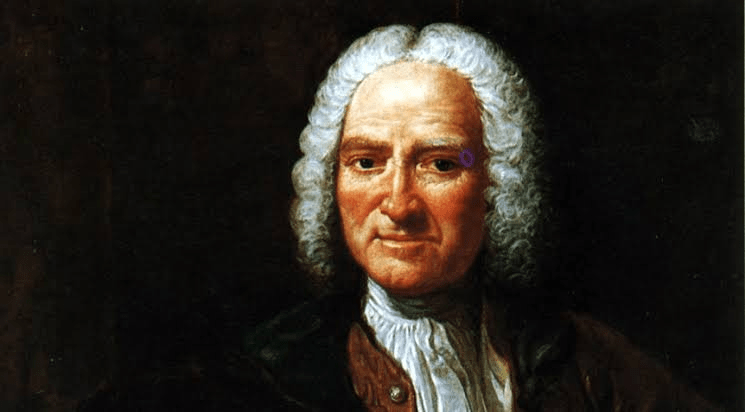
Danish theologian, Soren Kierkegaard (1813-1855), challenged objectivism by first suggesting that some truths are subjective, not requiring direct observation but based on life’s experiences (existentialism). Then he went on to say later that all truth is subjective (reached by emotions, not objective reasoning). This was a huge departure from the epistemological (how truth is found) views held since the classic Greek philosophers.

I agree with the twentieth-century Christian philosopher Francis Schaeffer that this was a philosophical tragedy, what Schaeffer calls Kierkegaard’s blind leap into absurdity.
Kierkegaard’s ideas were slow to get traction. However, civilization’s ground became more fertile from their disillusionment with the later Enlightenment. Then, rational science not only gave us a much better life, but also created greater cruelty. For example, steam engines greatly increased the production of cotton and other textiles, but also created the opportunity for slavery on the cotton farms and child labor in the mills. Alfred Nobel invented chemical explosives (nitroglycerin and dynamite), but then saw the great harm they brought to people in war, and he created the Peace Prize in remorse.
Then came the awful chemical weapons in World War I. My grandfather died from lung disease in his sixties, from chemical weapon damage in the trenches of World War I.
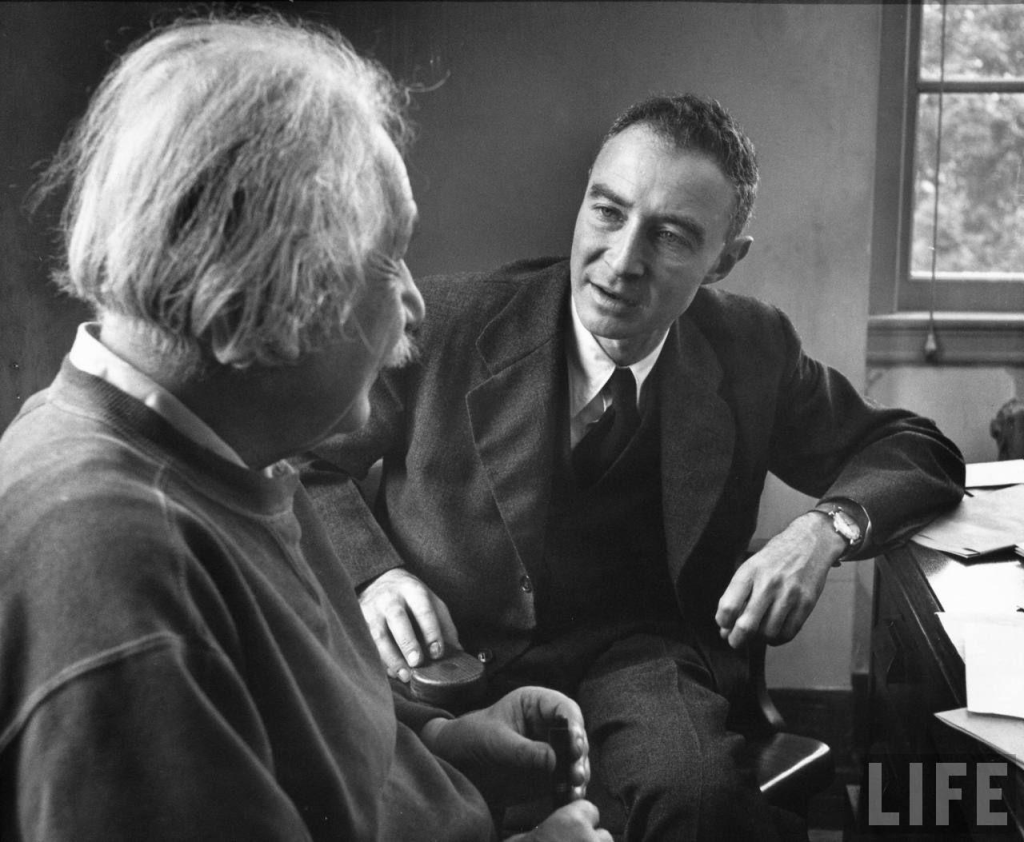
Albert Einstein found the link between matter and energy, paving the way for nuclear weapons. However, Einstein and Oppenheimer (who built the bomb), like Nobel, were peace activists.
This disillusionment with the objective truth of science caused more people to believe in Kierkegaard’s subjective truth, a truth you can create inside your head with no connection to objective reality. The word “faith” that you hear in most Christian churches today is a Kierkegaardian faith. A blind leap with no evidence. This new world, which followed modernity (where science was thought to solve all our problems), was labeled “post-modernism.”
In the 1960s, a post-modern mindset began to deconstruct much of the modern culture. Gender roles and racism were questioned. The war in Vietnam was questioned. These were good things. But, like an out-of-control wildfire, post-modernism began to question all truths, removing any foundational rationality. This has led to the notion inside the progressive Christian culture that the answer to the decline of the church’s influence is harmony, and they build that harmony on the notion that there is no external, objective truth . . . Therefore, Buddhism and Christianity can both be true, even though their fundamental tenets are the opposite. I suggested I could present a Sunday school class at my church to look at the differences between Christianity and Buddhism, and some thought that might offend someone.
This is not about dogma; it is about reason. But postmodernism is failing because its followers will learn that, while it is attractive on the surface, when you throw away all notions of objective truth, you end up standing in the middle of the desert alone, with nothing but empty feelings. You cannot fight racism without the objective truth that God created all people equal. You cannot reject pedophilia if the pedophile can create their own subjective reality inside their head. There has to be an external, objective truth that says it is morally wrong.
DONE! After 8 long articles, I have finished this story.
Epilogue
In the future, I will try to write more concisely. My next post will be on the simple steps of how we get out of this thinking crisis. If you want a jump start, I will suggest again Francis Collins book, The Road to Wisdom.
As Always, in Peace,
Mike


 J. Michael Jones
Leave a reply to J. Michael Jones Cancel reply