Here is the love chapter in I Corinthians that everyone is familiar with. While it makes for great poetry, this is one place in the Bible that is meant to be taken literally. The Greek word for love in this passage, of course, is Agape. As you read it, meditate on what this means for us on a granular level.
1 If I speak with human eloquence and angelic ecstasy but don’t love, I’m nothing but the creaking of a rusty gate.
2 If I speak God’s Word with power, revealing all his mysteries and making everything plain as day, and if I have faith that says to a mountain, “Jump,” and it jumps, but I don’t love, I’m nothing.
3-7 If I give everything I own to the poor and even go to the stake to be burned as a martyr, but I don’t love, I’ve gotten nowhere. So, no matter what I say, what I believe, and what I do, I’m bankrupt without love.
Love never gives up.
Love cares more for others than for self.
Love doesn’t want what it doesn’t have.
Love doesn’t strut,
Doesn’t have a swelled head,
Doesn’t force itself on others,
Isn’t always “me first,”
Doesn’t fly off the handle,
Doesn’t keep score of the sins of others,
Doesn’t revel when others grovel,
Takes pleasure in the flowering of truth,
Puts up with anything,
Trusts God always,
Always looks for the best,
Never looks back,
But keeps going to the end.
8-10 Love never dies. Inspired speech will be over some day; praying in tongues will end; understanding will reach its limit. We know only a portion of the truth, and what we say about God is always incomplete. But when the Complete arrives, our incompletes will be canceled.
11 When I was an infant at my mother’s breast, I gurgled and cooed like any infant. When I grew up, I left those infant ways for good.
12 We don’t yet see things clearly. We’re squinting in a fog, peering through a mist. But it won’t be long before the weather clears and the sun shines bright! We’ll see it all then, see it all as clearly as God sees us, knowing him directly just as he knows us!
13 But for right now, until that completeness, we have three things to do to lead us toward that consummation: Trust steadily in God, hope unswervingly, love extravagantly. And the best of the three is love.
I Corinthians Chapter 13, The Message
The major takeaway is that Agape love is the single highest calling of all humans. For the Christian, it is not fighting the culture wars, stopping LGBTQ, ending abortions, killing Muslims, taking over the government, or banding science that teaches things like evolution and an old earth. The highest calling isn’t having certainty about all things the Bible appears to say, as defined by that particular Christian subculture.
The second takeaway is what real agape love looks like. While that chapter has many examples, Jesus summed it up in John 15:13, “Greater love has no one than this, that someone lay down his life for his friends.”
I will provide a practical example of what this kind of love looks like.
Father Maximilian Kolbe
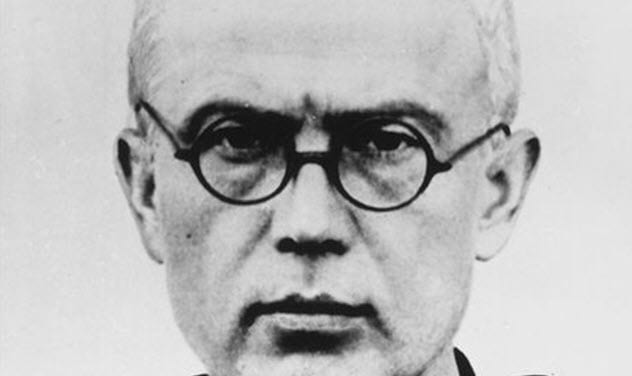
Maximilian Kolbe was a Polish priest who was sent to Auschwitz in 1941. Here is his story:
The Nazis slowly starved prisoners at the death camp as they each received small rations that couldn’t sustain a child. Every prisoner received a cup of imitation coffee each morning and weak soup and half a loaf of bread following work. With everyone struggling to secure a place to receive their ration of food, Father Maximilian Kolbe would stand aside to allow others to eat, which meant there was often limited food left for him.
There was also a rule in Auschwitz that 10 men would be killed if one attempted to escape from the concentration camp. A man from Kolbe’s bunker escaped in July 1941, so 10 men were selected to be starved to death.
As Franciszek Gajowniczek, one of the chosen prisoners, cried in anguish, Kolbe stepped forward to the commandant and said, “I am a Catholic priest. Let me take his place. I am old. He has a wife and children.” The commandant accepted his request, and the priest took Gajowniczek’s place.
After two weeks of hunger and thirst, Kolbe was the only person in the group who was fully conscious. He raised his left arm to Bock, an executioner, who injected the priest with a fatal dose of carbolic acid on August 14, 1941.[7]
Making Love Personal
When I examine my life, and I am a biased observer, I give myself mixed reviews about how I love.
I have a gift in one aspect of love, empathy. I feel deeply what I suspect others feel. For this reason, I worked in chronic pain, headaches, which affect women more than men. Women in pain are often neglected by mainstream medicine.
I remember having coffee with a conservative Christian. A non-binary person (a man dressed as a woman) walked into the shop. The person across the table groaned, “Look at that. It makes me sick to my stomach.” I turned around to see what he was talking about. When I saw the person, I immediately felt their lifelong struggle with sexual identity. The pain of being rejected and not fitting in with society, and hearing the critical voices, like the person across the table from me. I only felt compassion.
In 1983, a science fiction movie, Brainstorm, was released. It was about a computer that could record a person’s experiences, including their emotional response to those experiences. Another person could plug into the computer and feel deeply the experience that someone else had. The plot was a struggle to use this tool for good or evil. This is a dim reflection of what empathy looks like.
In the area where I don’t give myself high marks is my willingness to put others’ needs above my own. This is at the low end of the continuum of giving up my own life for someone else. Sure, I would throw myself in front of a train for my family, but could I sacrifice my own life for someone else, or even a stranger like Father Kolbe? I don’t think so. I’m too selfish.
Have you ever had a call in the middle of the night from a friend in trouble, such as a broken-down car? I have and I don’t like it. I like my bed, and if I help, I begrudgingly get up to help them. This isn’t love. I had an aunt who sincerely would get up in that case, thinking of nothing but the needs of the other person. There are people within my church whom I admire for their self-sacrifice for others. Chuck, Elizabeth and Doug, Jeff and Val, David, and Jolynn, plus many others. I wish I could emulate their love.
Before I end this, I want to do one more post, and that is love imitators.
Respectfully, Mike


Leave a Reply