I don’t usually do organized tours when I travel. One exception was in 2016. I had gone to Malta for almost a month to finish writing my book, Butterflies in the Belfry. I was staying in a five-hundred-year-old tiny stone flat that had started as an animal stable and still had a manger carved in the wall (part of it was a cave) and a well in the floor. But it was only 25 feet from the Mediterranean. It was a great place to focus and write, sipping good coffee outside in the warming sun, and watching the locals work on their gondolas and fishing boats. But it was winter, and it was cold at night in my cave.
Denise joined me for my last week, finally warming up my bed enough to sleep. We toured the archipelago of Malta and then, because the time was limited, signed up for a bus tour of Sicily. The tour began with a boat ride from Valletta, Malta, to Pozzallo, Sicily, and then continued by bus as we explored the triangular island. One part of the trip I was looking forward to was a ride to the top of Mount Etna. I love geology almost as much as I love history. You may not know that Etna is a volcano that has been erupting intermittently (more often than not) for nearly 3,000 years, including on the day we visited the summit.
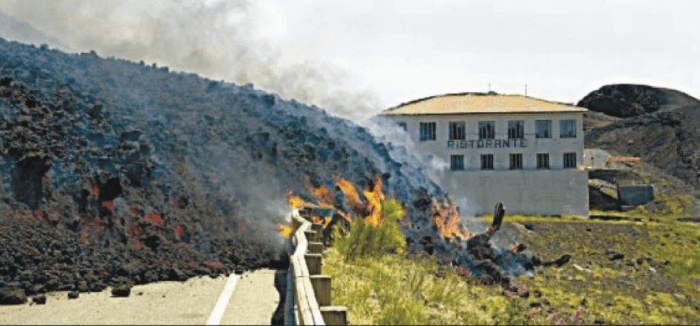
We passed many ruins on our way up the mountain, dating back to the Roman era and continuing up to the twentieth century. As we passed one old set of buildings on our right, the bus stopped, and the tour guide pointed out how the lava had come down the mountain, but then flowed around the buildings, which were an old convent. She told the story of how that lava flow was diverted by the hand of God, sparing the lives of the nuns. It became a famous legend in Italy as a miracle.
Sitting in the front seat of the bus, I noticed on the other side of the road, a few hundred meters up the mountain, some corners of old stone buildings were protruding from the lava. I asked the guide, “What are those buildings?”
She commented to me, “Oh, that was the monastery. They were all killed by the same eruption.”
I had to chuckle, thinking about the irony. God spared the nuns but burned the monks to death in their beds. It must have been a horrible death.
The state of Texas is on our hearts this week. It must be. Maybe as many as one hundred and fifty people have drowned. Close your eyes and imagine what that was like. A young girl at a church camp woke up in the middle of the night with a torrent of water pouring in through the windows and doors of her cabin. Suddenly, water is going down her windpipe, and she is choking, terror overcoming her. Or you feel your RV moving, floating, before it is torn apart, and you are thrown in the rapids where it is impossible to swim. The suffocation by water must be a horrible death.

Along the Guadalupe River, there are at least a dozen youth camps, many of them Christian. Amid this horrible tragedy, spoken through anguished faces, fighting back the tears, people asserting their confidence that a loving God was in complete control and had providence over the events, not one drop of water falling from the sky without his permission.
I have written before about the concept of theological fatalism, and I will write much more about it in the future, but this week, it weighed heavily on my heart. One of the most common reasons people leave Christianity for good, or never consider it, is what the Christian Writer, Philip Yancy, calls, Disappointment with God.
Christian fatalism, God controlling every drop of water, every inch of lava, every red light on the highway, every falling bomb during a war, is the default way for Christians to think. For me to suggest that God abdicates control over these events always draws the accusation that my God is too small.
Karl Marx, not a fan of religion, would say that humans creating a God in their minds that has control over every atom, and loves us with infinite love, is the real opium of religion. But it is the ideal. This concept of providence is comforting… until tragedy strikes. Then suddenly, we are thrown into an intellectual and emotional dilemma.
Yes, you can find language in the Bible that suggests that God controls everything, even the cause of suffering. You can also find numerous passages in the Bible that suggest that true evil and accidents occur. The question is why the reader accepts one view and not the other, from the same Bible?
The Christian parents of the camp girls in Texas, presently overcome by grief, one day will start to ask God, “Why?” “Why did he murder our little angel? Was it punishment for something? Was it to teach us something? What a cruel teacher he must be.” It becomes a superstitious exercise, not answers, but a plethora of assumptions. It always ends with the absurdity. If the parents don’t leave God at that juncture, their hearts will never be the same. Their ideals were shattered. This is the cost of a benevolent-omnipotent God.
Believing that an infinite, loving God would murder the innocent, whom he loves, in cold blood, creates a dysfunction. This cognitive dissonance is like that of a woman who is deeply in love with a man who gets drunk every weekend and beats the living shit out of her, while mumbling, “I love you babe.”
My Muslim friends have this same theological fatalism but with a twist. Their God (and they share the same Abrahamic God, but with different interpretations) is not as benevolent as the Christian God. They have told me that the Christian concept of God is a weak, feminine God who “feels our pain.” Their God is a mighty God who strikes evil with a fist of stone. For them, most tragedies are seen as punishment. Maybe some Muslim somewhere would believe that God strikes to teach or correct, but not the Muslims I knew. My Muslim friends would say, “The drowning of the girls was because of their sin. Wearing makeup or dresses that are too short.” Maybe some nutty Christians would have the same conclusion. Absurd! That God is a sociopath.
I left evangelicalism for good. It is a miracle (almost) that I am not an atheist today, after I experienced my first tragedy in 1990. But I eventually found the rational Christianity of Thomas Aquinas. It starts with the premise that human reason, as imperfect as it is, is God’s gift for making sense of the world. This new way of thinking has led me to a God far bigger than the God I knew as an evangelical. By studying God’s other book (Thomas Aquinas said that God has given us two books, scripture and nature or reality), cosmology, quantum mechanics, paleoanthropology, geology, and history, I’ve found a God who is far more mysterious than the Bronze Age, limited God I followed as an evangelical. It is mind-blowing. So, within this new framework, there is a God who is loving and omnipotent, but not a micromanager of nature by choice. Why? I don’t know. My view seems irrational, but not nearly as ludicrous as a loving God who is profoundly cruel.
Rationally, when we look into the eyes of tragedy, there are only a few options:
- There is no God, but we are at the mercy of the whims of nature, which follows the laws of physics.
- There is a God, but like the Greek and Roman Gods, he/she is too weak to manage nature, but themselves are controlled by the forces of nature.
- There is a God that controls all of nature, but is not a loving God, and strikes humans with tragedy for his pleasure.
- There is a benevolent God, who is omnipotent, but who chooses to allow nature to play out according to the laws of cause and effect. If someone gets drunk, and alcohol is having the typical impact on the human brain, and then that person gets behind the wheel of a four-thousand-pound car, driving at 90 MPH, swerves across the yellow line and hits your baby head-on, these were all the rational consequences of the laws of physics. But these things are not a sensible consequence of a God who loves your baby and yet uses his hand to direct that car to crash into your baby’s car, killing her.
In other words, shit happens in an imperfect world. People get cancer when a cell reproduces billions of times perfectly, but just once, it makes a mistake. A mutation. No, this is not a deliberate act of God, and saying so doesn’t diminish God; instead, it makes God beyond our understanding. No, I do not have cancer, as one evangelical claimed, as a punishment for me not having orthodox ideas, such as a fatalistic God, or that the organized church was created by God exactly as he wanted. Or because in very frustrating times, I might say, “Shit.” Surely, God is not so petty.
So, the storm in Texas followed logical meteorological laws, and the laws of physics. The sea is warming, and storms with more rain are our future. By attributing this to just an act of God, is also a way we project responsibility away from ourselves. We do live in a dangerous world. Step off a cliff and you will fall to your death.
God bless the people of Texas. Give infinite grace to the hearts of the dear folks have lost people.
I had to write this out of an impulse. I woke up thinking about this. I will conclude my series on the dereligionization of Jesus of Nazareth. Then, I’ve decided to turn and focus on my ideas of rational Christianity. That is one facet that I have not found people discussing online.
In respect, Mike


Leave a Reply