I was about to give up on this topic for a couple of reasons. The first reason is that, of my 341 subscribers and a dozen “drop-by” readers, two clicked on one of the videos I posted last time explaining quantum mechanics. I must always do introspection first. Did I not present the topic interestingly? Did I overestimate the interest of my readers? I may add a third reason: some subscribers are far above me in their understanding of Quantum Mechanics, so they do not need to watch an elementary video on the topic or listen to me, a silly novice. But I am taking a novel approach to what Quantum Mechanics can teach us about God. After all, like all of nature, it is part of the “Second book” of God.
The second reason I almost abandoned this topic was that whenever I did my due diligence on the subject by searching for “Quantum Mechanics and God,” I always ended up going down the same rabbit hole: “Quantum Mechanics and Spirituality.”
In this postmodern world, “spirituality” has become very popular, not just inside the Christian culture, but I even hear atheists talking about spirituality or the ambiguous “energy.” I will spend a whole series writing about our new obsession with spirituality (which wasn’t true just fifty years ago), but I’ll briefly mention why it is not what I’m talking about with Quantum Mechanics.
Spirit and spirituality have roots, at least in Western Civilization, going back to the concept of air. For example, the Greek New Testament word for spirit and spiritual is πνεῦμα (pneûma), which means related to air. I’ve heard Christians, including preachers, try to make something bigger out of this, such as “God’s breath,” but it simply means air. This has a long history, going back far before the Late Bronze Age of the Old Testament, where air was seen as an immaterial force (meaning, in this case, without a material nature). They did not understand the nature of the free gases —nitrogen, oxygen, and carbon dioxide —which, of course, are molecules made up of material atoms. As a result, they assumed this invisible substance was supernatural. You couldn’t hold air in your hand (they thought), but it had the power to move a ship a thousand miles, or turn a grindstone to make flour, or, in a storm, destroy an entire village. Magical.
When new age spiritualists try to use the bizarre world of Quantum Mechanics to prove that we are in a spiritual world, or the Christian uses it as proof that God is irrational, it tells me that they have no clue what Quantum Mechanics really is. The root of this spirituality is in Eastern religions, which starts with the premise that there is no material world, what we see as material is just an illusion, and everything is spiritual. This dovetails with the false Christian metaphysical concept, which was the dominant view before Aquinas, that the material world and human reason was Satan’s domain, and only the spiritual mattered. A perversion of Platonic Dualism. This is not supported by canonical scriptures, which clearly write of God, the creator of the material, the beautiful relationship of humans and Earth (scriptures tell a symbolic story of humans made from the substance of the Earth, dirt), the glory of creation and human, God-given, reason.
While Quantum Mechanics is bizarre in places, as I will explain, it is anchored in the material. As a matter of fact, it is the basis of the material. While it seems irrational in places, it was first discovered by mathematics, followed by experimental observations. Mathematics is profoundly orderly and rational. I call it the original language of God. In the early 1990s, when I was toying with atheism, mathematics, including acoustical mathematics (what we know better as music), were a couple of the key elements that brought me back to theism.
What Quantum Mechanics Really Tells Us About the Creator
Let’s start over. The written scriptures tell us that a personal being created the material world out of nothing. It doesn’t tell us how, beyond “God breathed it into existence.” In God’s other book, the witness of nature, God tells us how he built reality. Wouldn’t we like to know how?
I realize that most religious people don’t understand me or my tribe of like-minded people. We are weirdos in their eyes. But for me, looking at Christian people, I am clueless about their lack of curiosity. I suspect this is the nature of manufactured religion. It crushes curiosity for the sake of conformity. But, with that said, I don’t look at them the way they look at us, as a problem of immorality. Most of them are very good people, whom I am honored to count as friends.
The Greek philosopher, Democritus, speculated in the fifth and fourth centuries BCE that the material world has a fundamental building block that was indivisible, which he called the atom from the Greek, ἄτομον (atomon), which means “uncuttable.” In the early 1800s, John Dalton developed the concept of the atom, based on mathematical calculations.
As most of us learned in high school, if not before, the atom is structured with a central nucleus, consisting of a positively charged (electrically) proton, and an uncharged neutron, and orbited by negatively charged electrons.
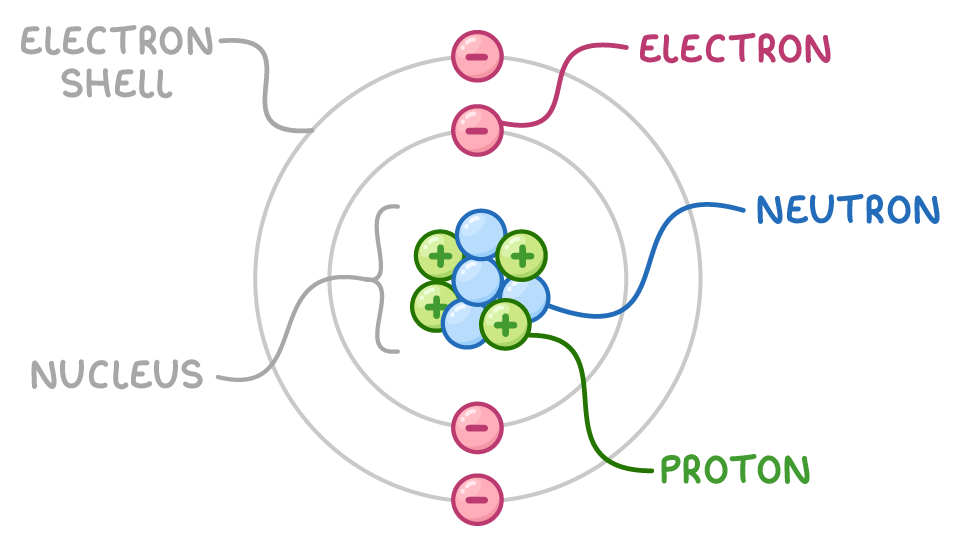
Quantum Mechanics found that there is a deeper, more fundamental level of structure than the atom (subatomic). While the orbiting electrons are subatomic particles themselves, the neutrons and protons are built out of subatomic particles called quarks. The neutron has one up quark and two down quarks. The proton has two up quarks and one down quark.
In the next post, I will get into some of the behaviors and mysteries of the subatomic world. Remember, if you are a theist, looking at this tiny world is like looking directly at the brush strokes of a great painter, but in this case, the painter is God. How can we not be curious about these things?
Respectfully, Mike
P.S. My writings are evolving into a niche. I am speaking directly to those who desire honesty, including emotional honesty, at the highest level, for whom religion, including popular forms of Christianity no longer make sense or just the curious. I have always welcomed atheists friends, and friends from different religions, too. Please share my site with people you know who have these interests, who have doubts and want an honest conversation. It is for these people I write and think about while awake and in slumber.
 J. Michael Jones
Leave a comment