My father built the red-brick house I grew up in. After his passing, I would go home and do repairs on the house, and I felt a special closeness with my father. I saw how he had laid the bricks with care, with his fingerprints still in the mortar. I saw the imprint of his hammer on the studs, where he had missed the nail. I could smell the lingering smoke of his Pall Mall cigarettes in the insulation and almost the scent of his Old Spice aftershave.

This is how science has enriched my personal relationship with God. I am so curious about how this universe is put together, which brings me closer to the one who created it. Unfortunately, there is a war on science in the Christian-religious community. No, I don’t think those who shun science and objective, evidence-based truth have an inferior relationship with God than me. I only wish I could change their bias against those of us who appreciate science and the evidence-based search for truth.

Quantum mechanics is not some high-brow scientific theory. It is all around us. It is inside of us. It describes how the real world works on an elementary level. If one tiny part of Quantum mechanics were to fail, the Universe—as we know it—would self-destruct. If there is a God, as we theists believe, then that creator chose to create the Universe with this strange nature. You may also say that the creator knew that the Universe could not exist with any other elementary nature. There is a reason it is made this way.
Some examples of the uses of quantum mechanics in our macro world include MRI machines, electromagnetism, GPS satellites, and the navigation of birds (and possibly butterflies).
I don’t want to belabor this discussion, but I want to define the major players in Quantum Mechanics and discuss what they say about the creator. Below is a chart of all the subatomic particles, the actors in this strange world that holds up all of reality, known as the Standard Model of Elementary Particles. I will not attempt to describe each particle so as not to bore my reader. No, this chart will not be on the final exam (wink). But do take note of the complexity and counterintuitive nature of reality. I will use straightforward examples.
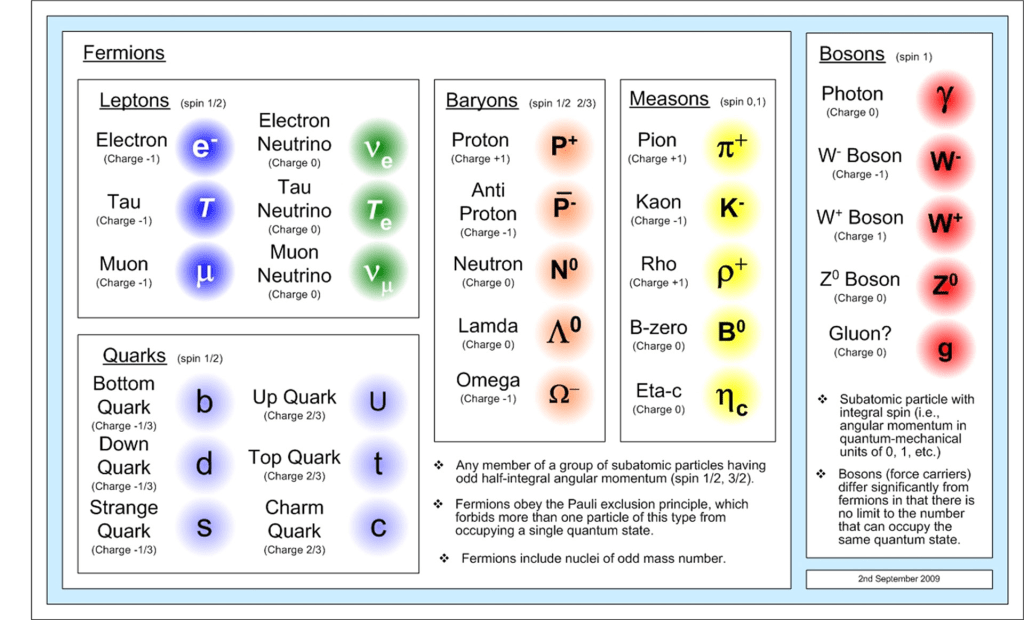
The Mysterious World of Quantum
1. Wave-Particle Nature. In the quantum world, fundamental entities like photons and electrons can act as both waves and particles, depending on how they are measured. This was a profound discovery, which opened the door to the bizarre quantum world.
In the macro world, it would be like saying that when you throw a rock into a pond, the rock doesn’t just cause a ring of ripples on the surface; the physical rock becomes those ripples, and there is no longer a rock sinking to the bottom of the pond. Stop those wrinkles, and the rock reappears.
2. Superposition. A quantum object can exist in all its possible states at the same time until it is observed. Imagine you had a massive pile of plastic blocks, half of which were star-shaped and half were square. Half of the star-shaped blocks were blue, half were red, and the same for the square-shaped blocks. So, a quarter of the blocks would be star-red blocks, a quarter would be star-blue blocks, a quarter would be square-red blocks, and a quarter would be square-blue blocks. That makes sense.
If these blocks were subatomic particles, if you sent them through a screen that took out all the star-shaped particles (particles don’t have these shapes, but I’m using this as an example), you would end up with only square-shaped particles, half red and half blue. But then, if you screened out the red particles, you would have only square-blue particles. But then, if you took the blue particles and screened them for shape, half would be square and half would be star-shaped because blue particles and red particles are always half square and half star-shaped, even if you started with just square particles. The same goes for color: half of the blue blocks are always star-shaped, and half are always square-shaped.

This doesn’t make sense in the macro world, but it is how particles behave on the micro level. If you want to dive into this much deeper, but still on a simple level, watch this hour-long video from MIT.
3. Quantum Entanglements. If you had a pair of particles with a special relationship called “quantum entanglement,” they would always be complementary to each other. For example, if one is right-handed, then the other is always left-handed. However, if you force the left-handed one to be right-handed, the other will instantly be left-handed. If you separated them by a trillion miles, this change would still be instantaneous. How does one particle know the handedness of the other? This would be much faster than the speed of light, so distance must not be real. Quantum computers rely heavily on this characteristic.
4. The Uncertainty Principle. It is the nature of the quantum world that you cannot measure two properties of a particle, such as position and momentum, at the same time. It has nothing to do with how we measure them, our instruments, or our skill, but the nature of the particles that will not allow two measurements at once.
5. Relativity. Moving away from the quantum world to the world of relativity, we would also find many strange things. For example, energy and mass are interchangeable. The absolute speed limit in the Universe is 299,792.458 kilometers per second. Gravity is a function of a mass distorting the fabric of space-time (however, I believe it is purely a function of time as mass distorts the speed of time via time dilation, so the closest part to the mass is at a slower time, creating a vertical tension, perceived as gravity).
Conclusion: Some of you know Quantum Mechanics far better than me, and my examples may seem silly. Others of you have no interest in the topic, and certainly cannot imagine how it would relate to your relationship with God. But I hope you sense how learning about creation teaches us more about God. By only looking at the first book (scriptures), you see a simple God who speaks, and things happen. But when you look directly at nature (the second book), you see the complexity and mystery of how it happened. It is truly mind-blowing.
One of the fallacies that I’ve often been confronted with via everyday American Christians is that science takes away the mystery of God. That is profoundly misinformed.
Newton told us about gravity and its principles, but to this day, no one knows how it works. No one knows how the strong and weak nuclear forces work, without which, atoms would fly apart into their subatomic particles. Calling it magic, or just God, only gives a tiny glimpse of the incredible mystery.
Scientists, with all their knowledge about nature, are standing only ankle deep on the shores of the Pacific with an ocean of the mysterious unknown. The more we know, the greater the mystery we find. When I listen to lectures on quantum mechanics, string theory, or the like… I start to smell the presence of God. When I hear the mathematics woven into a piece performed by a classical orchestra, I can taste God.
Respectfully, Mike


Leave a Reply