I just returned from Iceland, fifth trip. I went to watch a volcano erupt. It was a long shot, five days to catch an eruption that has taken six months to build. No, it didn’t erupt so I’m now watching it online. But I did get a lot of writing done there, as well as hikes and hotsprings.
I’ve spent most of my writing time in the past couple of weeks working on this new book, How Cancer Taught Me to Swear, trying to produce one chapter per day. It was not my plan to write nonfiction again, ever. I also do not like to write about myself, as it gives me a creepy, narcissistic feeling. But this was the one book, out of five, that agents would favor as being the most sellable, if I do it right. A quirky take on cancer.
Besides the creepy, narcissistic feeling, the other reason I didn’t want to write this book is that it will give religious people yet one more reason to want to punch me in the mouth. The concept of some words being forbidden to say (what I call “Christianese”) is a deeply held belief in most Christian communities. I’ve written about this before, but once again, I am up to my eyeballs in research on the topic, looking at the issue from the historical, Biblical, and psychological perspectives.

To give away the ending of the book, and the book will be far more than just this ending, none of what we call swearing or profane language has anything to do with the Bible. The Bible has directions for two things related to speech: 1) not attributing to God things he didn’t do (using his name or authority in vain), such as saying God used a hurricane to kill people because of the gays, and 2) it is good to say things that are loving and encouraging to others. “Foul” language is hurtful language, not specific words. Full stop.

Most “foul words” date to the Victorian period, when it became socially fashionable to appear pious. It was also at that time that sex became nasty. In my humble opinion, this was when we as Christians started to lose sight of the historical and simple teachings of Jesus on love, and Christianity began to go to seed as a complex and burdensome religion. It wasn’t the firsts time. That religion now is trying to take over our government, and it is the reason so many are leaving it.
I will say it once more, I hate religion because it is a poor substitute for the authentic and simple following of Jesus. Religion, rather than being a safe place, is packed from wall to wall, corner to corner scrutinization, trying to prove who is the most pious.
I will be clear, and define it once more what I mean by religion, as it is different than the standard colloquial understanding of the word. The kind of religion that I hate is a highly competitive human-created system with the single objective of enhancing one’s feeling of piety. I was in that world for forty years of my life… what a waste. In that system, the main way of increasing one’s sense of piety is through public display and comparison with those inside and outside one’s religion. They demonize those outside their faith. Inside their faith, they make everything a moral issue and often start conversations with a condescending “I’m surprised you believe that.” In the end, it works against Jesus’s mandate to speak encouraging, loving words, which is true Christianese.
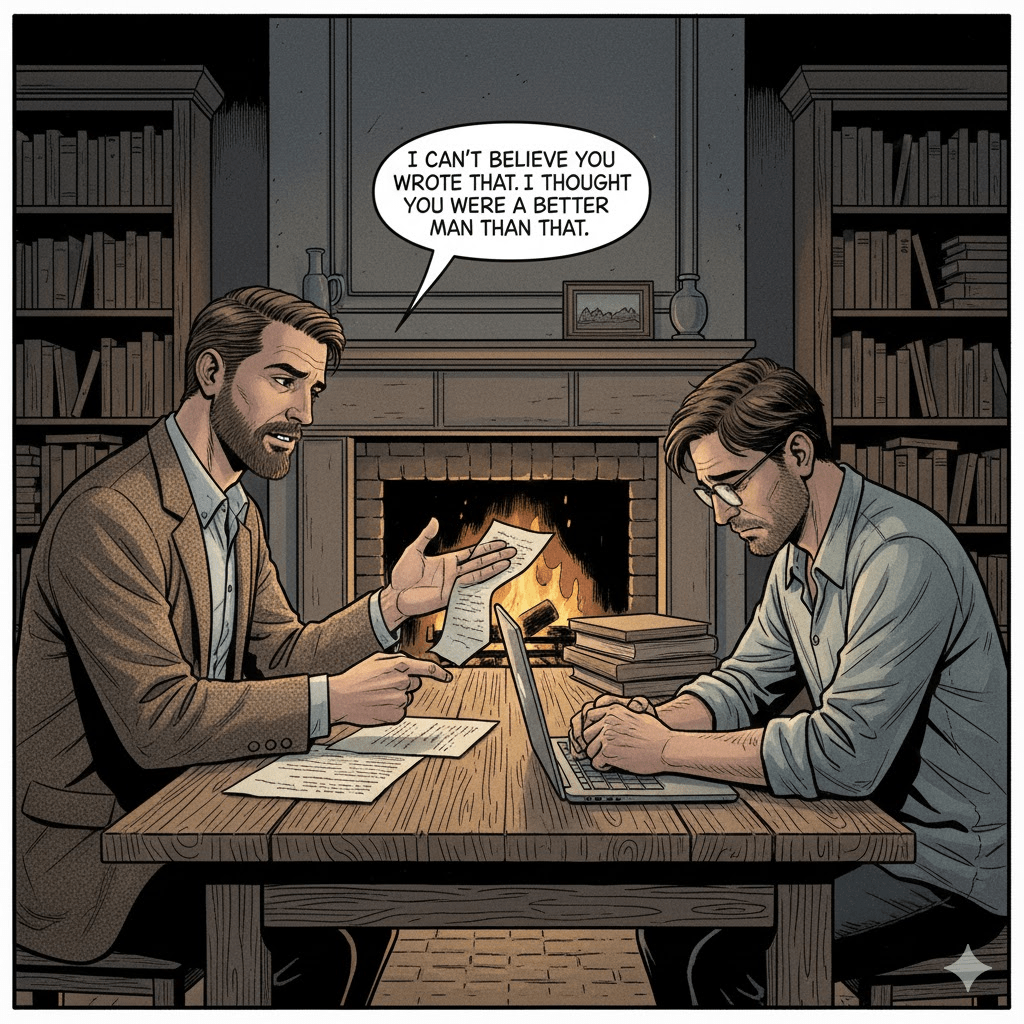
I am certainly not encouraging people who don’t feel comfortable saying certain words to start using them. That is NOT my point. But the issue of swearing has two implications. The first is that it grossly oversimplifies our connection to the creator by reducing it to an artificial surface marker, word choice. In the Bible belt, if you say “shit,” it proves that you are not a Christian, or not a very good one and that God is so small, he worries about your word choice instead of your attitude. However, it is almost impossible to dislodge the belief that some words are intrinsically evil.
Imagine you are the Apostle Peter, climbing onto a roof to rest. You have a dream or vision of an angel coming down with a large sheet. They open it, and there are cue cards that have words like “Shit,” “Dam,” Or “Hell,” and the angel says, “Say these words out loud.” Most Christians would not say them, even if the Angel came back three times, as they did with the real story of Peter and unclean meat. The idea that certain words are intrinsically unclean is so deeply embedded in our psyche that it runs against the grain of our whole worldview to think otherwise.
The other reason that it is unhealthy to require new Christians (or old ones, for that matter) to speak Christianese is that language is only the tip of the iceberg of the plethora of things that we make as requirements to be a Christian. So, in my perspective, it becomes like the passage in Matthew 18:6 6 “If anyone causes one of these little ones—those who believe in me—to stumble, it would be better for them to have a large millstone hung around their neck and to be drowned in the depths of the sea.”
We should not be in the business of making it harder for anyone to embrace the historical Jesus, not forcing them to speak Christianese, to believe that the earth is 6000 years old, to think that gay people are to be hated, to believe about a hundred dogmas that are represented in the Bible only by inference and imagination.
The last reason that making Christianese the official language of Christianity is unhealthy, in my humble opinion, is that it represents a much deeper issue. “Swear words” are almost always associated with emotion. However, I admit that some people use them now as just words. But forbidding their use is represents a deeper fallacy.
Off and on, throughout the history of the church, Christians have flirted with or adopted unhealthy concepts, first proposed by first century Christian Gnostics. It is the idea of a dualistic reality, where this earth, our bodies, nature, reason, and our emotions are all dirty, created by an inferior god, or maybe Satan himself. That only the “spiritual” has merit. WIth that kind of thinking, the Victorians also frowned on the public showing of emotions. “Chin up” was the slogan at the time.
My heart hurts thinking of how many times I’ve watch good Christians go through a personal tragedy and they would not allow themselves to grieve, be sad, or even be angry at the circumstance. We were human before we were religious. The raw form of us, is how we were made. I put this in my book and I will say it here, “The wailings of the saints should surpass that of the sinner.” Being Christian should make us more human, more origiinal. We were created in God’s image. God is not a robot.
A Word of Gratitude-Life is Good
In our part of the world, we are experiencing record flooding. However, I have not heard of any deaths yet, although there has been plenty of property damage. Our prayers are with those people.

This got me thinking about how much I feel like I have to pinch myself to live where I do and to see how well all five of my children are doing. The fact that I’m living with cancer, with just one blood draw away from my life going back into a nightmarish tailspin, and death, I am so grateful for how well I am doing at this time.
People used to say that I have wanderlust. While it is true that when I go on vacation, I always check for houses for sale, even in Iceland, thinking about how much I would love to live in those places. But we have lived her for twenty-two years and can’t imagine ever living anywhere else. We are blessed.
Mike


 J. Michael Jones
Leave a reply to eric holden Cancel reply