The Organized Church
I will end this thought with this article. From my personal studies of what the Bible honestly says, and what history shows, I am convinced that the present organized church, with its centerpiece, the Sunday morning worship service, is not a mandate for Christianity. I realize that this cuts across cultural beliefs and will likely make many Christians mad at me. However, I’m not making this a moral issue. In other words, the current state of church structure and practice is not wrong in my opinion. Most Christians could not imagine Christianity in any other way. It is just not essential.
The problem only lies in the fact that a large group of people are leaving the church, not because they don’t like the simple messaging of the historical Jesus of Galilee, to love God and others as yourself, but because of the Christian culture that Christians have manufactured. This is what I think the Apostle Paul was referring to when he wrote in Colossians 2:8, “See to it that no one takes you captive through hollow and deceptive philosophy, which depends on human tradition and the elemental spiritual forces of this world rather than on Christ.”
Judaism, as most Christians know, has plenty of descriptions of temples and rituals of worship in the Old Testament. Islam, in the words of the Koran, has language about houses (mosques) and rituals of worship, included in the English paraphrase below (only the Koran in Classical Arabic is considered the Koran; translations into English are considered paraphrases), such as:
7:29: Say, [O Muhammad], “My Lord has ordered justice and that you maintain yourselves [in worship of Him] at every place [or time] of prostration, and invoke Him, sincere to Him in religion.” Just as He originated you, you will return [to life]—
9:18: “The mosques of Allah should only be maintained by those who believe in Allah and the Last Day, establish prayer, pay alms-tax, and fear none but Allah. It is right to hope that they will be among the ˹truly˺ guided.”
9:19: “Do you ˹pagans˺ consider providing the pilgrims with water and maintaining the Sacred Mosque as equal to believing in Allah and the Last Day and struggling in the cause of Allah? They are not equal in Allah’s sight. And Allah does not guide the wrongdoing people.”
72:18: “And [He revealed] that the masjids are for Allah, so do not invoke with Allah anyone.”
72:19: “And that when the Servant of Allah stood up supplicating Him, they almost became about him a compacted mass.”
Christianity is very different. Worship or buildings were not part of the original plan. Please prove me wrong if I am, but do not attack me personally, as I’m just trying my best to find the facts. The evidence that Christians give for these systems is tradition and history, believing that if this is the way things are, then God intended it to be that way. I disagree with this conclusion.
Remember, the word “church” in the New Testament means “the called out ones.” I think John chapter 4 says a lot about worship, and it doesn’t describe rituals; rather, it’s different from the Judaic past: we will worship in spirit and truth.
I think a good modern example of the “called out ones” is how the city of Minneapolis responded to ICE’s overreach last winter. People came together from all walks of life (many of them Christian groups) for one purpose: to love, support, and encourage their neighbors. While some of that effort included formal meetings, much of it was organic and spontaneous.
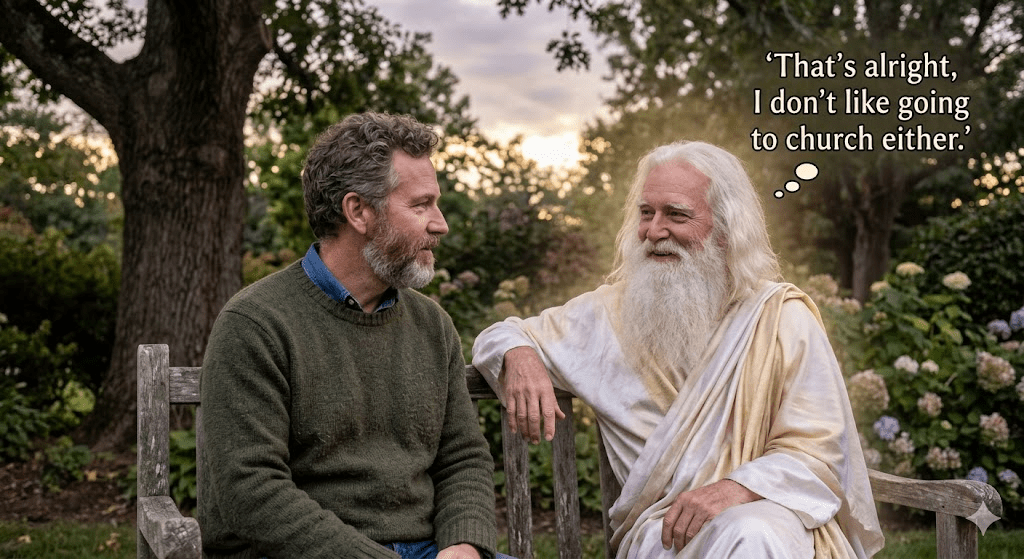
I suspect that while many Christians truly love the Sunday morning worship service, many attend as an act of penitence. As Baptists, we wore perfect-attendance pins on our jackets to prove our piety. We always felt guilty if we did not go to church, and we knew that God was mad at us. But we hated going. Our pastor was extremely boring. Fortunately, the pastor at the church I attend now delivers some of the best sermons I’ve heard. Still, our culture says, “good people go to church.” What frustrates most parents when their kids leave Christianity is that they are “not in church.” That doesn’t bother me. My only concern is that when they give up a personal creator, it is impossible to find honest meaning in life.
Practical Implications
Our present state of church organization, structure, and rituals is DEEPLY embedded in the minds of Christians. As I said before, I’ve witnessed that you can’t even change the time the church starts without pissing off a lot of people. So, I would never suggest that a local church try to discontinue the Sunday morning church service, but maybe in the far future, if the church wants to survive. The main point I will make is that, after an honest review, I believe the Sunday morning worship service, which requires a great deal of energy to pull off, is extraneous, as is the building and most of the organization. Not evil, but extraneous.
A Couple of Examples
To demonstrate my point that the Sunday morning worship service is an act of penitence (meaning trying to win God’s favor), I will share a couple of stories. At least one I’ve written about before.
I shared about a church I was part of in the 1990s. It was a very large evangelical church, and we set a goal to reach out and serve the “un-churched” that year. Our community was divided between the evangelicals, the Lutherans, the Catholics, and the largest group, the “nones.” So, I thought it would be a good idea to meet the nones on their terms. I described before how I met with the pastor about my idea, and he approved. I went to the owner of the largest bar in town (one of the best places to find nones) and asked if I could set up a church meeting there each Saturday. While he looked confused, he agreed, but only if we bought beer.
At the next elders’ meeting, I shared my idea. Bob, the head elder (and the one with the most power in the church), became very angry at me. “You would bring God’s word into a place where they serve beer?”
“Yeah,” I said.
“Would you require them to attend church here the following morning?”
“How can I require any adult to do anything unless I’m the police?”
“You make me sick to my stomach,” he shouted. “Not only do you want to bring God’s holy word to a place where they serve beer, and likely smoke, but you also want to give these people another sorry excuse not to attend church.”
Again, there is no commandment about attending church. That is a man-made requirement. The only directive, as Paul suggests, is not to ignore one another but to encourage one another.
A few years before this aforementioned experience, I had coffee with an old pastor friend. I shared my discoveries about the church with him, and I wanted him to prove me wrong. But what he said was very revealing.
“Mike, do you understand what this would mean if I declared the Sunday morning worship service as optional? If the denomination did not fire me immediately, then people would just stop coming to Sunday morning worship. Yeah, we could try to meet around a meal during the week as Christians did in the first century, but then, there would be no clear place to focus and… to be honest, to give their tithe, and I would be toast. Then I would lose my job, my retirement, my health insurance, and everything I have worked for all these years.”
So, for pragmatic reasons, I dream of a church that has the stability of the organized church, but has a focus on small groups, so much focus that the traditional Sunday morning worship is clearly expressed as optional, only for those who enjoy and want it, not as a ritual for penitence. Not because of social coercion, “Good people go to church, bad people don’t.” However, it would bring a huge challenge for the modern church to break with such a strongly held tradition, yet I think it would be a giant step in reversing the church’s decline, with one caveat. This new church, without a center for a worship service, must follow Paul’s recommendations to become a center of encouragement for all people.
A Personal Perspective
On a personal note, if I did not have cancer of my immune system, where I will likely die someday from an infection after someone coughs on me, I would focus my involvement with my church on small groups, mid-week meals (which they have had and I applaud our church for such things), and even the coffee hour on Sundays, all of which I prefer to a worship service because in these intiamate settings, real encouragement can occur, rather than putting all the encouragement on the shoulders of one person, the pastor.
I feel a little safer, from an infectious disease standpoint, in a large, open meeting, which I attend occasionally, especially if it’s outside.
So, the mandate for the church, as I’ve said many times, is to love everyone and to encourage one another, full stop. Playing competitive piety is not encouraging but demeaning.
I’m not going to address the sacraments; however, I advise you to read the New Testament sources of those rituals honestly. I don’t think Jesus intended for them to become rituals that often go to seed as meaningless actions. If I read the original Greek correctly, regarding “The Lord’s Supper,” when Jesus was eating a full meal with his disciples, he said, “When you eat such a meal, remember me and I how I gave my body as the bread and my blood as the wine.” My paraphrase.
Finally, this view has helped me avoid losing sleep when my own children are unchurched. I respect their decision because I don’t care for the Christian religion myself. But I am concerned if they lose their belief in a personal Creator and Jesus as the Messiah and the firstborn of how we all should live and have hope that in a purely naturalistic world, there is no reason for meaning, hope, or morals.
Lastly, if we insist that all believers participate in the Sunday morning worship service, to be a Christian, many people will be forced out of our Christian community for no good reason. If you love the Sunday morning worship service, then I say God bless you. However, it is tempting for you to think that those who don’t love it are somehow inferior. “They don’t know God like I do, or they would love to come.” That is not true. I know for me, it is hard to comprehend people who say they love God but do not love science, the study of things God has made, yet I must resist the temptation to think something is wrong with them.
Let’s all respect and encourage one another.
Peace, Mike
P.S. I am going to move to other topics. I’ve been observing what people are reading, and I will let that direct my future topics.


Leave a Reply