I am going to take a break from my series on the philosophical history of Western Civilization, with the point of how we got here. I know that some are not interested in history. While my readership is not slipping, I do notice that many are reading what I’ve written about my battle with cancer. Once again, I am doing well right now, so it is hard to write about cancer. However, I am writing a book about this cancer experience, How Cancer Taught Me to Swear. I am going to post below one chapter that I was editing this morning. This is not the final version. I thought I had posted it before, but I can’t find it.
Chapter Seven, Mikos Theos
One of the prayer requests that Chubby, bearded Bob, took for a while back in the early nineteen nineties in that warehouse-looking church was from the family of Mrs. Lindell. She had been diagnosed with an aggressive form of lung cancer, and she had never been a smoker. It looked grave for her, so her family was passionate about their prayer requests, and the church was praying earnestly for her healing.
I didn’t know Mrs. Lindell personally and had never spoken to her in church. By that time, I had left the Air Force and was part of an Internal Medicine practice in town. One day, one of the physicians in our practice, Dr. Nolan, asked me to return Mrs. Lindell’s call, as she had been calling about the results of her chest CT scan. I’ve been told that I have a lot of empathy and am tactful in delivering bad news to patients, one of my few gifts, I suppose, so I think that’s why he asked me to talk to her.
I read the radiologist’s report very carefully, pulled up the scan on my computer monitor, and studied it. The noticeable cancer lesions filled her lungs and the hilar, or central, part of her chest. The radiologist, who had compared it with her previous scan two months earlier, reported that there were “no new lesions and that those present seem stable.”
There is this strange ritual that we cancer patients must get used to, or go mad, and that is the periodic unveiling of our test reports. For the past seven years, I have had a monthly ritual of checking on my cancer blood tests. As I sit in front of my laptop, cursor hovering over the “Test Result” button on my patient portal, I imagine I am lying in the center of the Roman Colosseum, wearing a loincloth, of course, dirt clinging to my sweaty chest, blood caked in my hair. My opponent, Gladiator Myeloma, is standing over me with a trident in one hand, a net in the other, looking up at the emperor. There’s a dead silence as we wait for the “pollice verso,” the thumbs up or down. Will the next few weeks be a living hell, and then I die? Or will there be a respite from the ongoing battle for another month? With one simple click, I will know.
I assume Mrs. Lindell had been nervously waiting for her CT scan results, as she had started a new chemo program. I dialed her number, and she answered quickly. I could feel the tension in her voice. “Uh, hello.”
“Mrs. Lindell, this is Mike Jones. I’m a PA at Dr. Nolan’s office, and I have the results of your CT scan.” I tried to put the report in the most positive light: “The good news is that the radiologist says there are no new lesions and the ones you have are stable, so the new chemo program must be working.”
Immediately, she began shouting, “Praise God, I knew He would heal me, praise God… oh, thank you, Jesus!”
“Mrs. Lindell, I don’t know if you understood what I said. The old lesions are still there, but the good news is that you may be responding to the chemo and things are stable.”
“Oh, I’m done with chemo; God has healed me. This had nothing to do with those terrible chemicals. I’m never going back to that oncologist.”
Did I put this in too positive a light?
“Mrs. Lindell, no, you need to keep your appointment for chemo. The cancer is still there; it is just stable, so the chemo is starting to work.”
“Get behind me, Satan!” She yelled. “I’m not listening to you sowing doubts. I’m healed. I can feel it!”
The following Sunday morning, as chubby, bearded Bob, in his clean flannel shirt, took to the podium for the weekly harvesting of prayer requests, Mrs. Lindell’s grown son, sitting right beside her, stood up. “I have some exciting news. Mom has been completely healed, praise God.”
He was interrupted by shouts of praise and cheers from all the well-meaning people in the church who loved her.
When things were quiet, the son continued, “There’s no trace of cancer in her now, and the doctors are all stunned, calling it a miracle. They’ve never seen anything like it.”
Is he talking about my phone call? Doesn’t he realize that I’m sitting here in the church twenty feet from him?
I was speechless. I noticed I hadn’t seen her around church for a while. Then, four months later, came the news that shocked everyone in the church… but me. Mrs. Lindell was dead.
There is a saying, and I agree wholeheartedly, that you never tell someone how to deal with loss, including the loss of their own healthy body and future, as happens with a cancer diagnosis. I discovered that plenty of people are ready to steer me in an unhealthy direction.
One of my favorite baristas and her husband were starting a multilevel marketing business, selling health milkshakes on the side. While trying to talk me into buying her product, citing all the health benefits, I mumbled, “You see, I was just diagnosed with cancer and I’m fighting for my life right now, so I’m not interested.” Without missing a beat, she quickly added, “Our health shake has also cured cancer.” Really? If so, the creator would have won a Nobel Prize in medicine, and the company would not need a multi-level marketing scheme to promote their product. Maybe she had good intentions, but what I heard at that desperate moment in my life was, “I don’t give a damn about your cancer; I just want to make a buck at your expense.”
I think most of us with cancer are approached by friends or relatives who have a secret cure they want to tell us about. Maybe they have good intentions, but if they are selling the stuff, the intentions are often blurred.
I became angry at a pastor friend who told another friend to stop her chemo and go on a natural, “Christian treatment.” When I asked him if he was selling this product, he wrote me a note that he had the right to make money off the product the same way I made a living off “prescribing chemical drugs.” For my forty-year career in medicine, I was never paid for what I prescribed. But the problem was that the chemo this friend was on has a track record spanning decades of treating breast cancer effectively and safely. When I looked up this supplement he was selling, there was not a single study supporting it, yet the founder (by the way, who had spent time in prison for selling phony attic insulation) was claiming that God had given him the formula. But the problem is, the evidence is clear: if this friend went off her chemo, she would likely die. That’s what pissed me off. That people prey on those who are suffering from this horrible disease for the sake of a few pennies. The division is not between natural and chemical; it is between what has been proven safe and effective and what has not. When natural supplements lack this kind of proof, too often they resort to spinning baseless conspiracy theories against evidence-based medicine.
Another unhealthy way of managing cancer is the religious community’s idea that if you pray right and have enough faith, you will be completely healed. So, there are personal implications for unanswered prayers. It becomes shameful when God doesn’t do something, because the blame must rest on you… Certainly not God. At least that is the thought. I have prayed my heart out for healing for seven arduous years, and there must always be hope, but also realism. A Christian friend said to me, “I’ll have my brother pray for you. He’s a real saint, and God listens to him.” What was she implying? Am I so much of a schmuck that God ignores my prayers?
When I was an evangelical, my God was a “Mikos Theos,” Greek for “small God.” Even if you think that the Old and New Testaments were inspired by God, which I do, you must realize that they were written in the late Bronze and early Roman ages, to people of that time, while they are meant for us too. At the time of their writing, the entire cosmos was measured in hundreds of miles; all the planets, galaxies, galaxy clusters, supermassive black holes, exoplanets, comets, and other bodies were within Earth’s atmosphere. If those scriptures tried to describe a God big enough to have created the entire 90 billion light-year wide cosmos, building everything out of atoms, which are built out of quarks, bosons, electrons, and the rest of the Standard Model of quantum physics’ particles or fields, upon the backdrop of incredible mathematical equations, no one at that time would have known what the hell the scriptures were talking about, and have been discarded as written by fools.
There are problems with having a small Bronze Age God in a vast cosmos. This small God is containable, incarcerated within the boundaries of our wants. We ascribe qualities to Him (and it must be a “Him” in this model, suggesting that God, like the Cerne Abbas Giant, has a giant penis too), including what he likes, doesn’t like, who he hates, who he loves (us, of course), which political party He belongs to, when and how he will end history, His dreams, and wishes. I know as an evangelical that I had made God into my pal… a pal with superpowers, a genie! He found me parking spaces at Costco, made the clouds form images of the cross, and helped me pick out the correct underwear in college so that I wouldn’t become gay. So, He was my butler. To make this God bigger, yet still my bud, he not only knew my every thought but had control over every aspect of my life with puppeteer strings—a micromanager, an autocrat. So, in that model, something like cancer must have meaning. However, the greatest theological or philosophical concept I’ve discovered is… Cancer Sucks! It is meaningless!
To appease this petty God, I used to think we must pray just the right way, with delusional faith, and perhaps, if He is having a good morning, He would withdraw the suffering He has given.
The New Testament book of Hebrews, chapter eleven, begins: “Faith is the assurance of things hoped for.” I was taught, in a way that took it out of context, that if we believe anything hard enough, it becomes true. Magic! As Indiana Jones said in the Dial of Destiny, “And I’ve come to believe it’s not so much what you believe. It’s how hard you believe it.” This is the axiom of postmodernism, but isn’t this also the recipe for insanity? So, if I thought hard enough that I was Superman or Davy Crockett, would I be them? Or Napoleon? Or a grapefruit? Or cured of cancer? Welcome to the inpatient psych ward.
When I dissected that passage in Hebrews after leaving evangelicalism and looked at the original Greek, I came away with almost the opposite meaning. One of the Greek words in that passage for faith is “hupostasis.” This Greek word means “foundation,” like the stone foundation of a house. Something you know to be true, objectively. That you can trust. It is not a whimsical, irrational leap into the dark, as the modern world, heavily influenced by postmodernism, portrays it.
The “things hoped for” represents the Greek term Elpizomenōn, which can mean “things expected.” So, you can read this passage as “Due to your foundational certainties, you can be confident that the things you expect to happen will happen.”
The hardest lesson for me to learn was the first time I had a significant life disappointment: when my belief in the evangelical God collapsed, and, overnight, I became the devil in the eyes of all my Christian friends. What got me out of that depression, two years later, was when I saw a bumper sticker that read, “Shit Happens.” Most tragedies are not part of some big master plan. When I figured this out in the 1990s, it saved me from a lot of angst when my life was turned on its head, and I went from excellent health to having cancer and being among the walking dead in 2019.
I’ve watched too many people with cancer spend their emotional energy—the energy they will need for the fight—trying to figure out why they have cancer. Did they eat the wrong foods? Were they exposed to toxins? Was it someone’s fault? Am I a bad person? Did I sin somewhere? Is cancer trying to teach me something?
You can learn a lot from suffering, but that’s on us. Cancer isn’t the great benevolent teacher sent by God. No, the credit goes to the patient, who is brave enough to learn good lessons in life, even from the devil. And I believe that God is always honored by our learning.
Religious views can sometimes overlook our essential humanity, which comes before any beliefs. We were human before we were Christian, Muslim, Buddhist, conservative, or liberal. We are all made from the same cloth, though woven through different experiences. We have a range of emotions, including depression, which is normal unless it becomes overwhelming or destructive. Occasional self-pity is natural and healthy, but it should be temporary so it doesn’t take over. Yet, there is a wallow-phobia in society: the fear that someone who is in great difficulty will have self-pity… may God forbid.
I eventually stopped attending the warehouse with a steeple. I had to. A dear couple at that church suffered a tragedy unlike any other. The father backed their riding lawnmower over their toddler. The precious boy was DOA in my emergency room. If that couple were to live ten thousand years, the pain would still be there, unsoftened, after something that hideous. No one’s fault. Not Mom’s or Dad’s or God’s. We live in a dangerous world, where shit happens, meaningless shit.
The whole church felt an overwhelming grief. Then, the following Sunday morning, as chubby, bearded Bob took to the podium, he looked out over the crowd and went off-script. “I know that everyone is thinking about the Williams family. They’re in our prayers for sure. But God doesn’t make mistakes!” he screamed. “He did this out of his love for us, and for that reason, we must not be sad but celebrate the victory!”
Insanity! A tiny God in the box of our making. A matchbox.
I’ve seen this many times in the religious world. In the face of great pain—emotional or physical—the show must go on—big smiles and positive attitudes to prove we are saints. I want to scream, “This is not real life! This is a pretense! Complete madness.”
But this is what happened when I started with a tiny, Bronze Age God. I tried to stretch Him bigger by requiring Him to be the author of everything that came my way. It was comforting for a while, until disasters struck. Then I was screwed. I had painted myself into a metaphysical corner with a fatalistic God, without a way out but the absurd.
But loss is loss. The pain is real. Even if you believed in an afterlife, losing a child must be one of the most painful things a human can experience. You will never see them again on this earth, smell their hair, feel their touch, hear their corny jokes, or watch their beautiful smiles. And with a tragic accident, you must feel what they felt as it happened. It is awful, and trying to make something good out of it is like making a chocolate shit pie.
It is the same when I faced my own death. Being human, more than a saint, I felt this beautiful world being taken away from me, all the wonderful people in my life, my family, all the mystery and glory of nature, slipping through my helpless fingers. I don’t give a damn if I knew for sure I would be having a beer with Jesus in two hours; death is horrible. Grief is real. I was tired of pretending it wasn’t.
I think we Americans have much to learn from the Arabs. They are attuned to their emotions. I watched how a devout Muslim family in Egypt lost their minds when their six-year-old son fell off their balcony, eight stories to his death. A friend who was with them at that moment watched them destroy their flat, pull their hair out, rip their clothes off, and slap each other, to the point that she was afraid they were going to kill each other. This is what raw pain looks like, and it has nothing to do with a god of our imagination that isn’t even a shadow of the real one. Their behavior, if I understand correctly, is not condoned by Islam either, but they were being authentic in that moment.
After I left evangelicalism, I came across the familiar verse in the Bible, “Jesus wept.” I studied carefully in full context and in Greek. It dawned on me that Jesus was weeping over the death of his friend, Lazarus, even though he knew he would raise him from the dead in minutes. I had been falsely taught that Jesus was crying over his disappointment with Lazarus’ sisters, who were mourning over their dead brother, implying that grief was unhealthy.
I am grateful that most of the people who spoke to me after I became dangerously ill and was diagnosed with cancer were considerate. My atheist friends are the best, because they don’t play games. They are immersed in their humanity because they have nothing else. Some of my worst experiences were with religious people. While I have no doubt they are good people with good hearts, it is what they believe that makes them an ass.
I remember after I was discharged from the ICU, I was so sick, in so much pain, going in for dialysis every other day, looking like I was going to die soon, then I ran into a couple who were well known for being “spiritual Christians.” I was at the hospital getting my labs done, with Denise at my side helping me walk, and we bumped into them in the hospital parking lot. Before I could say a word, and I wanted so much to talk, the wife said, “You’d better keep your eyes on the Lord and don’t start feeling sorry for yourself. God didn’t give you cancer for no reason.” She continued her lecture, but I stopped listening; her words became “wah-wah-wah,” like conversations of the adults in a Charlie Brown comic, so I don’t know what else she said. But I began to fantasize about how good it would feel to put my hand into her mouth, grab her tongue, and wrestle it to the ground like a copperhead. I know, not very Christian of me. I was dying, and that was all she could say? When she was done, she turned and walked away, having never given me a chance to speak. Never asking me how I was doing, but just assuming what I was thinking. I whispered, “Hello,” to the back of her head as she walked away.
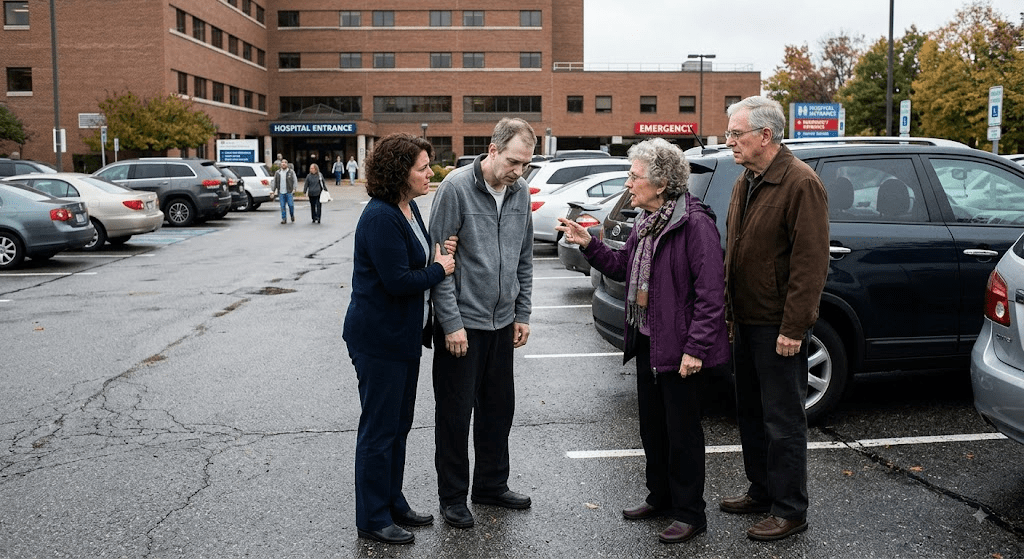
When death is on your calendar, the mask comes off. You stop pretending. You stop caring what people will think about you. It is the end of everything on this Earth, and you don’t have time for such bullshit.
But religion doesn’t have to make you a jerk. One of my favorite encounters is with a woman pastor friend from Canada, who starts every conversation with me with the question, “How are you, Mike? How do you feel? How’s the cancer treatment going?” Then she always says something like, “It must be difficult. I cannot imagine what you are going through.” On top of that, I can tell she’s sincere. Is that so hard?
A lesson I have learned, one of survival, when you face something challenging in your life, surround yourself with encouragers, not schmucks. But doesn’t that go for when things are going well, too?


Leave a Reply