This will be a sidebar to the series I am writing about the history of Western thinking. I came across an excellent lecture that could benefit many people, and I wanted to share it.
An estimated 46% of people who leave their childhood Christian faith say that Christianity appearing irrational is the cause of that leaving. I’ve been writing about this issue for more than twenty years, and those people are always my focus. When present-day postmodern Christian gurus say that your rational doubts about Christianity are a spiritual problem, it is not helpful for many of them. In most cases, it is a problem of reason.
I can say with great confidence that if I hadn’t found Thomas Aquinas in the 1990s, I wouldn’t be a Christian today. Considering where I was at the time, it is remarkable that Aquinas resonated with me. It is complicated, but I had turned to the Christian organization L’Abri Fellowship for help. Their motto is, “Honest answers for honest questions. I was involved with their ministry for about five years.
Francis and Edith Schaeffer founded L’Abri in the 1960s in Huémoz, Switzerland. When Francis developed leukemia in the early 1980s, they moved the ministry to Rochester, Minnesota, so that Francis could have treatment at the Mayo Clinic. I took a position at Mayo Clinic around 1996, partly so I could be involved in the ministry there, since Edith and many staff from Switzerland were still there. Francis had died a decade earlier. Their whole focus were Christians who were having serious doubts, had been abused by the church, or people considering Christianity for the first time.
L’Abri was very helpful to me, but one thing makes this story odd. Francis Schaeffer did not hold Thomas Aquinas in high regard. He says that Aquinas made human reason autonomous, and it was therefore harmful to Christianity as a whole. That is, in my opinion, Schaeffer showing his protestant side.
The other issue is that Martin Luther opposed Aquinas’s view that Nature and Scripture are co-equal revelations of God. Luther’s (and the protestant church) view was Sola Scriptura, or Scripture alone. I remember in my evangelical days, we were taught that this was one of the main reasons that we should not consider Catholicism as part of God’s true church.
But having studied Aquinas myself, I do not agree that he made human reason autonomous; he put it back in its rightful place as God-given and the primary tool we have for finding factual truth.
We are living in an age where irrationality is championed by the Christian and the secular as well. But that’s not normal, and that’s why I’m doing this whole series on the history of Western thinking and how we got here.
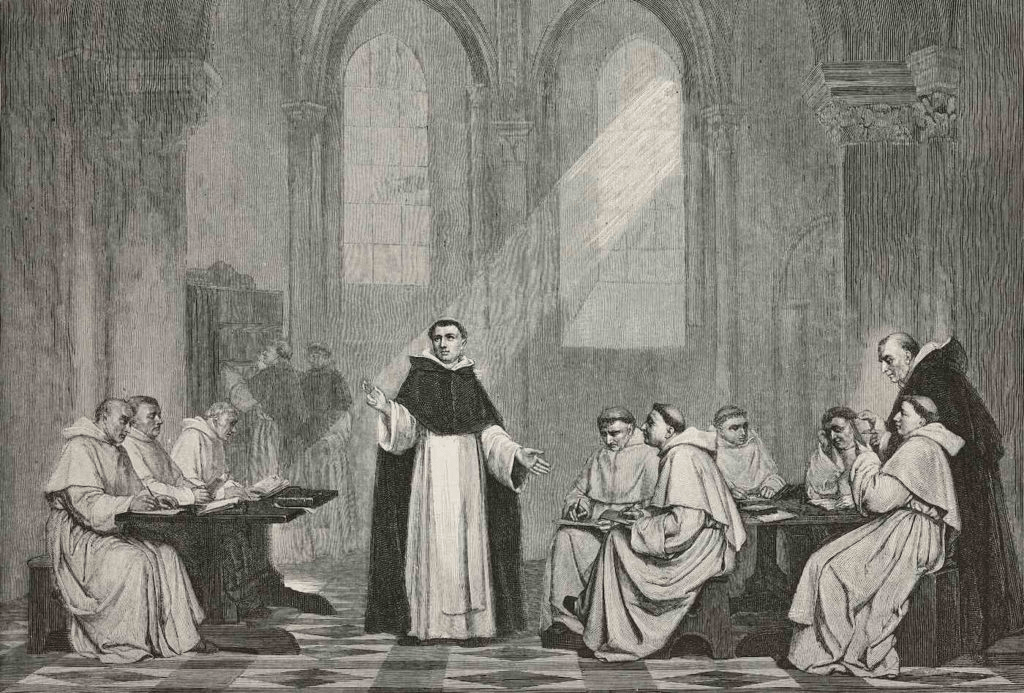
I’ve had Catholic friends tell me that I should have converted to Catholicism in the 1990s and I would be better off today. That’s possible. If I were to do the last 30 years over, I think I would have. But now, after having suffered an incredible amount of abuse by the organized-protestant church, it would be hard for me to start over with any new church. I am presently loosely involved with the best church I’ve ever known. Religion is very competitive, and if you do not conform, you will have hell to pay. Our church is very accepting of most people, all races, all sexual orientations, and such. But neither the conservative nor the progressive church is open to people who value human reason because of the cultural climate we are living in.
Let me add one more tidbit before I turn you over to the video. I write a lot about reason because we are living in abnormal, irrational times. But to be clear, and if you listen carefully, you will hear Aquinas saying the same thing: you cannot know with certainty that God exists by reason alone. Because we are flawed humans, our reason can take us most of the way to finding God, but not the whole way. There comes a point where you make a moral choice to follow Jesus, not as an irrational leap, but as a well-thought-out decision, looking honestly at all the options.
Soon, I will return to the historical saga. Then I want to address important issues people face today.
Mike
Let me mention that Averroes was the main source for reason and the teachings of Aristotle being reintroduced into Europe. Averroes was living in Spain in the twelth century, a muslim moor and his ideas had a great impact on the Catholic Scolastics and Aquinas himself… but there were important differences.


Leave a Reply