I learned this term from David Howard, who goes by the moniker The Naked Pastor and creates cartoons to deconstruct unhealthy Christian ideas. Below is his cartoon. His building shape always represents the church.
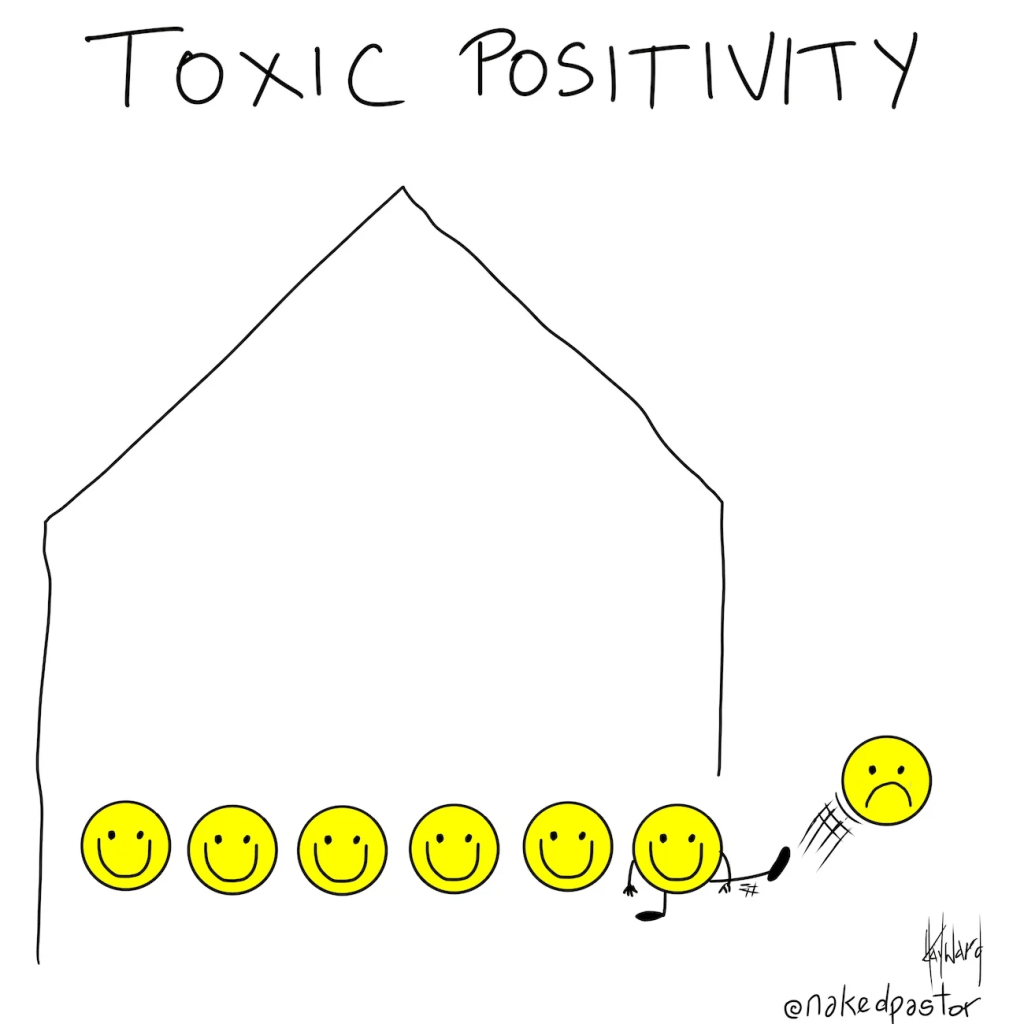
A myth in practical Christian living is that everything is bliss. The high school teacher who recruited me to a discipleship group told me, “If you follow Jesus, God will build a hedge around your life, and you will not have the problems of sinners, such as divorce, poverty, addiction, depression, or diseases like cancer.” Interesting that not only did I get cancer, but his wife divorced him. But the point I hope to make is that real life is not always bliss. While a positive attitude is good and helpful in finding happiness, I believe some parts of the church have fallen into this Toxic Positivism, where a dark gap exists between the bliss we pretend and the real life of broken people on a dangerous Earth. But it goes far beyond positive attitudes and into delusion. In the Christian world, none of us are as good as we think we are.
This delusion has two problems. When your self-assessment is not realistic, you make no effort to do better. I saw this all the time in the discipleship group where the word we threw around was “godly.” All of the leaders were “godly,” which had the practical connotation that we were near perfection. When you are perfect, in your own mind, you do not recognize when you are emotionally abusive to others, and therefore you do not mend your ways. Men emotionally abusing their wives in that patriarchal society was the most common example. Remember, the whole Christian law is summarized in love.
The other problem with this common brand of Christianity is metaphysical: a belief in a detachment between soul and body. Everything is spiritual. In other words, the belief that the physical brain has no relevance to our persona, or soul. Without a material foundation, we believe that our souls are fluid and that, in an instant, when we become a Christian, all our prior mental health issues go away. But that is not true.
Mental illness is an issue of degree. We all have unhealthy ways of thinking at times, and it is rooted in the material. It comes from the genetically based structure of our individual brains. It comes from the way we were raised, and it comes from life experiences such as trauma. When you believe that you are exempt from unhealthy ways of thinking because you are a Christian, or even “godly,” you lose all insight into who you really are.
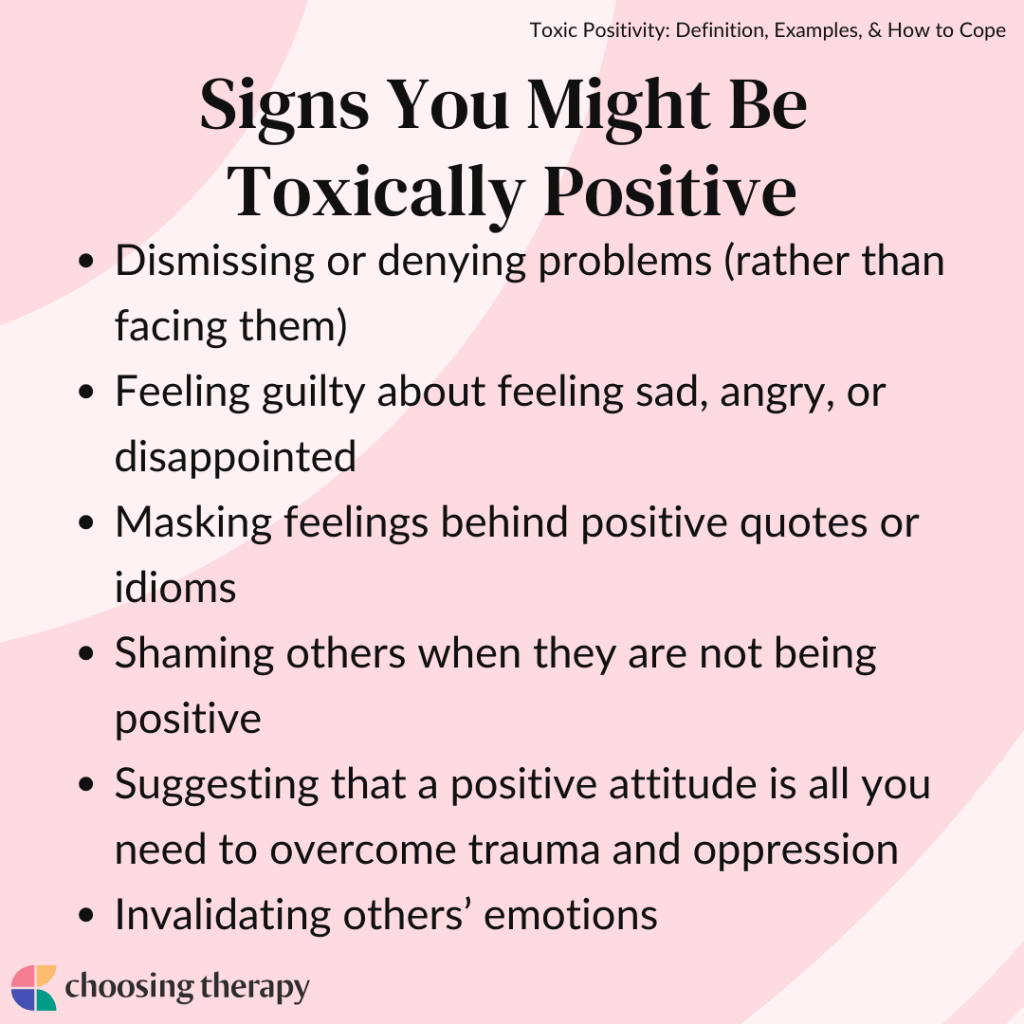
I will give two examples: one is where I’m the “perpetrator,” and one where someone else was.
Personal Example:
I am working on a book right now, How Cancer Taught Me to Swear. As part of this research, I have been looking closely at how Christian culture has developed its views over time, including how it has influenced general, secular Western culture. The idea that Christians have their own language, where certain words are taboo, is rooted in two things: the early Christian Gnostics, who thought everything bodily or material was dirty, and the Victorians, who wanted their own language to prove they were better than everyone else.
But why the Victorians picked the words they did was because they saw “negative” emotions themselves as sin. But human emotions are the spice of life. That includes anger, frustration, love, euphoria, depression, shame, anxiety, fear, and the list goes on. But Toxic Positivism says that all “negative” emotions are sin, and only positive (such as euphoria) are good. The only problem with the so-called negative emotions is when we allow them to go to seed (or they just go to seed without any of our control), such as lasting and deep depression or rage. Remember the Bible says, “be angry… but don’t let the sun go down on the anger,” which I believe is a metaphor for not letting it go to seed. So, the Victorians banned all words that show negative emotions… a tragedy.
I have also gone back over my life with a fine-tooth comb, trying to “Know Thyself” once more, or better. As part of my material brain, it has to do with genetics and the way I was raised and personal trauma; I navigate toward anxiety. I have done a huge amount of work on this flaw… since I left evangelicalism. Huge amount. For example, I had acrophobia and took up rock climbing and mountaineering to confront that fear. Public speaking scared me, so when I was at Mayo Clinic, I signed up to travel the world giving lectures on the science and treatment of headache disorders. But while in evangelicalism, I had to pretend and self-deceive that I was perfect, and looking back, I know that some of my behaviors were motivated by anxiety that I could not admit.
Even recently, I made the mistake of sharing with a local friend, who has an evangelical perspective, about my history of anxiety. What a mistake! He used this as a weapon to browbeat me every time we got together. He defined every word I said and action I took as my “Mental illness of anxiety.” He couldn’t believe that any real Christian could have such a flaw (and was totally blind to his own flaws). Toxic Positivity. No, he was not the other example; I just threw that in.
Example in Another:
The other example was a ministry leader that I was under for a while. Inwardly, I recognized he was very manipulative and abusive to his own family and to other people. He was pushing me to do the same, and I regret that I did. Yet, per our ministry culture, we pretended he was godly, almost perfect. So, when he did narcissistic things, cruel things to his wife and kids, and others, we pretended that was the way God wanted it. Eventually, as I was coming to my senses about him and evangelicalism in general, I realized that his behavior was very unhealthy for himself and those who had to deal with him.
One day this leader confided in me that both his parents were raging alcoholics and abusive to him and his sister, but when he became a Christian, all of that went away for him, with the help of the Holy Spirit. He had no insight into how he was treating people because he didn’t see the mind-body connection that none of us can escape.
A psychiatrist friend said something interesting to me once: “A lot of mental illness can hide in a church.” The reason this is true is that many forms of Christianity create dead space between who we believe we are and reality. A lot of nasty things can hide in that dead space. While I could not find statistics about sexual abuse in the church compared to secular institutions, which one was worse, it was clear that the church hides it more. Toxic Positivism. You can’t talk about the negative at all.
Lastly, what I have gleaned from my deep thinking about this issue is that when tragedy does strike someone in a Christian setting, it has to go underground because it is an affront to Toxic Positivism, the blissful life of the Christian. I could be wrong, but I observed that when I was diagnosed with cancer, my Christian friends stopped using the common greeting, “How are you?” I think they feared I might tell the truth that I was doing poorly at the time. Some stopped talking to me altogether. My secular friends would go out of their way to ask, “Mike, how the hell are you doing? It must be tough.”
But I’ve done the same to others. So, the point isn’t to complain about being wronged. It is about our Christian culture and the total intolerance for anything negative. I think the institutional church could be much better if we didn’t have all those dark things in our lives hiding beneath the shiny pews of bliss.
I’ve been a member of many Christian small groups, and they all have something in common: they focus the meetings on an author, sermon, or book- anything external, not allowing any dead space or time where someone might mention something negative about their life (such as they just learned their son or daughter is addicted). Got to keep up that façade, so we can’t talk about that. What a lost opportunity.
I have found private prayer meetings where people share what is really happening in their lives and pray together as a much healthier way to function, if there is encouragement. But I’ve also seen a church dissolve such a meeting, not because it wasn’t well received and attended, but because it had “too much negativity.” A discipleship group friend referred to such prayer meetings as a “Den of Loosers.”This meant that people in those groups were being too honest about their struggles.
I have one last example that just came to mind. I loosely participate in an online multiple myeloma support group. I’ve noticed a pattern that any time someone posts something “negative,” such as, “My myeloma is back, my bones are breaking, and I’m in severe pain, and I’m scared I’m dying,” one hundred percent of the time Christians will come on and tell them that the problem is that they need Jesus and they themselves don’t have pain, don’t fear death, and their lives are bliss because “they have Jesus.” Disgusting. Toxic Positivism. I want to grab that person who shared about their pain, hold them, and cry with them. Shit does happen is a powerful theological truth. The church’s only calling is encouragement, even in the hard things.
Respectfully, Mike


Leave a Reply