I never know why people are coming here, but I can see what they are reading. I’ve had a surge of hundreds of new readers in the past few days, and they seem to be drawn to my writing about my myeloma journey. I don’t like writing new things about my cancer because I am doing so well right now. However, I am editing a new book I’m working on, How Cancer Taught Me to Swear, and for them, I will share an excerpt- an entire chapter about how I was diagnosed.
Chapter Twelve, Diagnosis
Someone said, “I’m glad it wasn’t ALS,” and in hindsight, I agree. Yet, at the time, I was banking on death by ALS as a way out of the ordeal of the twitching, a symptom that no one could understand. There would be times, over the next three years, when things were so bad that I wished I had died from hyperkalemia on that first night.
The ambulance paramedics and nurses tucked me into my ICU step-down bed, Denise walking through the door within minutes. Soon, the admitting nephrologist came by. “Mr. Jones, we will work to find out why your kidneys have shut down, with some more blood work, then bone marrow and kidney biopsies. If we can’t get your potassium down in a couple of hours, we need to insert catheters into your vena cava, down to your right atrium, and start dialysis.”
“I did have MUGUS, in case you didn’t see that,” I said. “Couldn’t this be multiple myeloma?”
“Yeah, I guess,” she said, shrugging. “But your calcium is normal, which would be inconsistent with multiple myeloma. We’ll rule out the rest. I see you were taking ibuprofen. It can rarely have an idiosyncratic reaction, causing total renal failure. That’s our hope because that situation is often reversible.”
Although I had worked, slept, and done rounds in hospitals many times, I had never been a patient except once. I was trying to tackle a drunk friend in a high school scrimmage football game, and he elbowed me in the nose so hard that it required surgery to straighten it out, not for cosmetic reasons, but because I couldn’t breathe. But that surgery was my only night in a hospital before that day.
I was given more of the diarrhea slurry, Kayexalate. As soon as the colonic firehose started, the invasion of the body snatchers began. Bad timing. They came and took my blood by the bucketful, took me to a CT scan, a full-body bone scan, a chest X-ray, an EKG, a bone marrow biopsy, and a kidney biopsy.
I had to sign a waiver before going into the procedure room for my kidney biopsy, noting that if the needle hit a major artery, like my aorta or renal artery, I could die. But what choice did I have? A nursing anesthetist gave me conscious sedation, but I never dozed off and heard every word of the conversation between the nephrologist and her. Pretending to be asleep, I heard the nephrologist say she was anxious, “I’ve only done one kidney biopsy, and that was in my residency.” The nursing anesthetist said she had watched her colleagues do a few and showed her where to insert the needle. I kept my eyes shut as my confidence waned. But she nervously stumbled through the procedure, and I was back in my room for more of the snatchers.
After my last blood draw of the evening, the nephrologist returned to tell me that my potassium was still dangerously high and they had no choice, if they wanted to save me, but to put the two catheters into my chest as a conduit for dialysis. It was another decision point: Do I let nature take its course, or do I proceed with the procedure?
The cut to my upper right chest and the insertion of the two catheters went smoothly. At that juncture, I was assuming that the hyperkalemia was causing my unbearable twitching, and after the six hours of dialysis, it would be gone. Relief at last. Feeling better. If only the cause of all this were a few ibuprofen tablets, my life could be back to normal in a week… but unfortunately, it didn’t work that way.
That evening, a dialysis nurse came into the room, rolling a washing-machine-sized dialysis unit and a cart of her supplies. She was kind and took the time to explain the dialysis process to Denise and me. She was trying to be hopeful, explaining that patients in acute, reversible renal failure only require a few days of dialysis. Yet, we knew that would all depend on the diagnosis. She did mention, and I already knew, that the catheters in my chest are for emergency access to my central blood flow, but they are only good for 90 days. If I require long-term dialysis, she added, “You must have a permanent connection between a vein and an artery in your wrist… but hopefully, that would not be necessary.”
The two rubber catheters in my chest were still quite sore and would remain so for the six months they were in. Several times, I brought up that I had been told they were only good for 90 days, and now I was at 4, 5, or 6 months. But the nephrologists just nodded. Reading their minds, it seemed like they didn’t think I would live long enough to justify an AV graft in my arm for dialysis access. I grew to hate those tubes, making it very difficult to shower, impossible to use a hot tub, and impossible to do any physical activity without them catching on clothing or other items. They gave me the feeling, too, that I was no longer human but some type of cyborg, some of my parts artificial. Yes, I loathed them, but they were my lifeline, literally.
The dialysis went as well as I expected, with the eternal hope that lowering my blood potassium would stop the nightmarish twitching. During the procedure and for the rest of the evening, the twitching worsened. However, my right arm numbness did get better after a few days, and I suspect it was the retention of fluid due to the renal failure that was putting pressure on the nerve root, and not cervical fractures from multiple myeloma. Thank goodness.
The next evening, the nephrologists visited me after a busy day in their outpatient clinic. With a quick knock on my door and a couple of nurses in tow, she walked in. I could see my diagnosis in her somber face, lacking only words to confirm the bad news. She flashed a quick crocodile smile and said, “Mr. Jones, we have the results of your labs, bone marrow, and kidney biopsy, and it appears… no, it’s certain that you have multiple myeloma.”
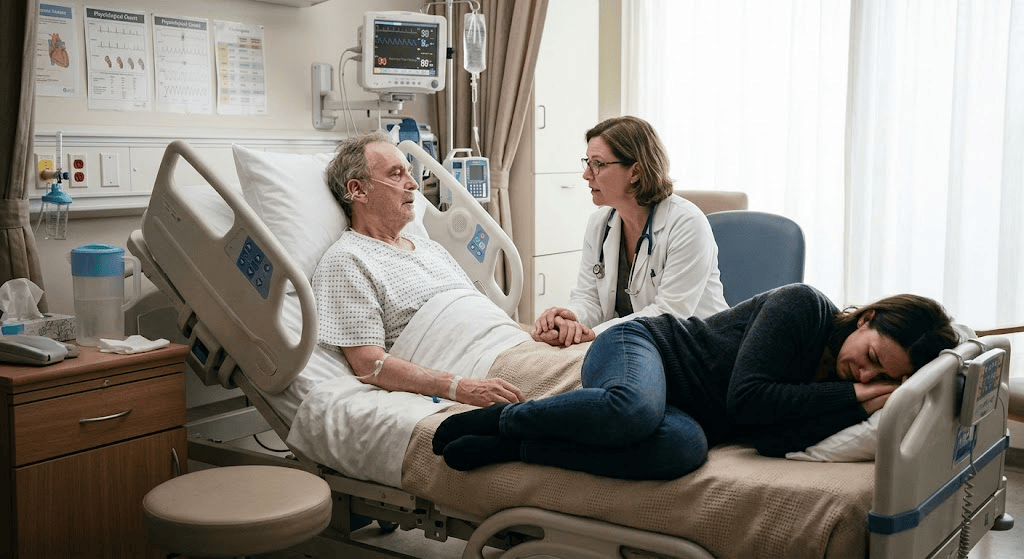
I heard Denise, who was sitting behind her, let out a soft moan, collapse onto the foot of my bed, and start sobbing. I reached for her hand but couldn’t find it.
“What did the tests show?” I mumbled.
Knowing I was a PA, she spoke without her typical layman’s translation. “Your protein electrophoresis shows that you have a lambda light chain level of 3600 mg/L.”
“Remind me what the normal range is,” I asked.
“Normal is 5.7 – 26.3 mg/L,” she said.
I just stared at her for a moment, and she continued, “Your kidney biopsy confirms that’s why they failed, showing light chain deposition disease, and your marrow is 30% myeloma.”
I nodded.
I glanced behind her and saw Denise, continuing to sob, her gripping the bedspread unintentionally pulling it toward her. Watching her in distress overwhelmed me with guilt. A memory of me standing outside the security fence at Dubai International Airport, her inside, ready to board her plane for New York, we were reaching through the chain links to touch fingers… if only I had called it off then, saying goodbye forever, she would not be in this position of heartache at this moment, forty-five years later. Then, rather than her flying home to Minnesota and having to explain to a fiancée that “I’ve met someone,” perhaps the two of them would have married, never left Minnesota, and lived happily ever after, like a team of healthy horses, into their late nineties. And for me? I would have gone on to Pakistan, where I would try my best to forget her, if only. I would then have lived my life as a celibate, monk-like, and when cancer came calling at age sixty-three, I would have no one to hurt with my curse… but myself. Not a wife and five children, whom I loved beyond comprehension and whom I had brought one of the greatest heartaches they would ever have to bear. Yeah, I had brought this to her.
I looked at the Nephrologist. “So, what’s the plan?” I mumbled.
“We’ll be turning you over to the oncology service, as you will be started on treatment as soon as possible. They should be here later this evening. If they can’t see you, their nurse will be here in the morning, and they will see you tomorrow evening. I spoke to them, reviewed your labs, and they do want to proceed with a plasmapheresis program, once a day for five days, to reduce the amount of the free chains as quickly as possible.”
She typed on a laptop for a moment and then turned back to me, “You know, you probably hadn’t had symptoms of renal failure because you were in such good shape, running and climbing your mountain. Most people come in much earlier because they have all the classic symptoms.”
Had my training for Greenland been a curse?
She added, “You know, you are lucky because with a potassium level as high as yours was, it would have killed most people, but because your renal failure had been gradual over months, allowing your body to adjust to the toxic level slowly, you survived.”
While I wanted to know everything, I also wanted the woman and her entourage to get the hell out of my room so that I could hold Denise and we could cry together.
I had said one reason I hadn’t seen a provider sooner was that not knowing with certainty that I had ALS gave me space for denial, and it was like Schrödinger’s Cat: a cat in a box that is neither alive nor dead until the box is opened. But now the box was open… not only was the cat found dead, but it wasn’t even Schrödinger’s.


Leave a Reply