The media theorist Marshall McLuhan famously wrote, “We don’t know who discovered water, but we know it wasn’t a fish,” describing cultural blindness to prevailing norms. We can’t see our own culture until we’ve tried living in a completely different one. But even when we experience a different culture, we can assimilate or become like the “Ugly American” who sees the foreign culture as stupid. My dad, who lived in England during World War II, often spoke of how stupid the English are. While I was hitchhiking in France, an Englishman picked me up, and for the next twenty hours of driving to Geneva, he talked about how stupid the French are.
I am thankful for my opportunity to live in a radically foreign country, Egypt, and I bounced between the two extremes of assimilation and being an ugly American.
What we call Christianity carries the bulk of its weight in culture and tradition. The three main church divisions, and the hundreds of subdivisions, are slight variations in those cultures and traditions, each thinking theirs is closer to God’s plan.
This allegiance to our local culture is profound. If you think for a moment, you will remember many stories, movies, and books where a child is exiled, or even murdered, because they violate one of their family traditions.
Jesus describes this problem as the problem of wineskins: you cannot put new wine in old skins, or it will burst.
In Colossians 2:8, Paul warned the Colossians not to be taken captive by human traditions. Just as Paul said anger isn’t sin, but it can go to seed as sin, he implies here that human traditions aren’t necessarily bad, but letting them control you isn’t healthy.
I have been involved with at least twenty churches in my life, and I can say with confidence that the church I am affiliated with now is the best. That said, even my church is shaped by culture and tradition. For example, our pastor, who, as far as I know, is loved and admired by our congregation, if she announced one day that she was going to suspend the Sunday morning worship service, which takes a huge amount of work to produce, and replace it with a meal and service projects for the community, there would be outrage. People would think she has dementia or has lost her freakin mind. If she pushed this change, I think they would run their beloved pastor out of town on a rail.
Paul, or whoever wrote the book of Romans, wrote in chapter 12:1 that being a living sacrifice is our way of worship. Yet tradition says worship must be Sunday school, singing hymns, and hearing a sermon.
I will remind you once more that the Christian church is shrinking, becoming less relevant to the greater society, and the major reasons people are leaving are culture and traditions. For decades, I have been screaming about this demise, but now I realize no one was interested in what I had to say because they value their culture and traditions more than they value the continuation of the church (meaning the people) into the next century. I will circle back to these thoughts, but I will end this post with another example of how the church, as we know it, is bound to its traditions and culture.
After leaving the mission field in 1990, we moved to Duluth, Minnesota. I wasn’t even sure God existed then, but Denise wanted to keep our kids in church. So, after visiting several churches, we settled on one: a Christian and Missionary Alliance Church. I knew for one thing, rather than returning to the pretentiousness I was accustomed to, I was going to speak honestly.
If I remember right, I became a deacon in that church, a lay leadership role (out of habit, since I had always been an elder or deacon in the churches I attended). During their major planning meeting for the next year, they had the clear goal of ministering to and having outreach in a lower-middle-income community about five miles away. It was a well-described community, set apart from the rest of greater Duluth, because it was an old Air Force Base.
Before the next meeting, and taking them seriously, I did my due diligence by walking around that target community and seeing that they were mostly young married people living in their “starter” homes in the reasonably priced old Air Force housing. I found a community center (the old officers’ club) in the center of the housing area, and it was a beehive of activity. I also found that one of the greatest needs was child care in that community, where both the father and mother were trying to work to make ends meet.
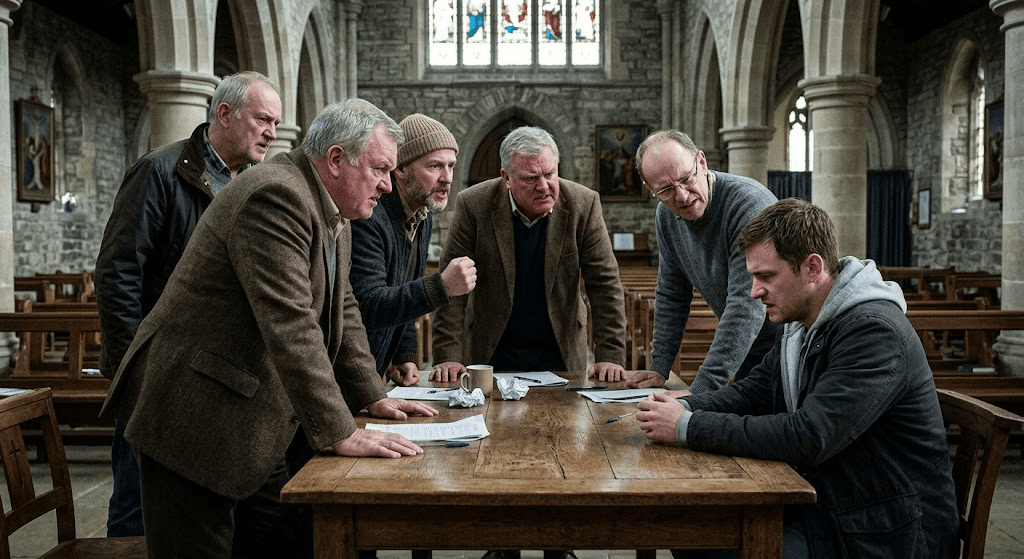
At the next meeting, I presented my information and a plan to reach and minister to these people. If we were serious about our goal, I suggested we take our Sunday morning church service to that community center, which I found we could rent for about $50 a Sunday, and create a daycare service, with members rotating as child caregivers.
The room fell silent, then the first of many deacons expressed their outrage at me. “You are new here and don’t realize how we saved and worked to build this beautiful church building, and you suggesting that we abandon it is outrageous.” Then, one by one, they expressed their disdain for me personally, sorta like that scene in the movie Airplane, where people line up to slap the woman having a nervous breakdown.
Because I had made such an offensive suggestion, I became the devil in their eyes and, like most churches I’ve tried to be involved with since 1990, I was relegated to the lowest of members; no one wanted to hear anything I had to say again. I only took them seriously when they said their goal for the year was to minister to that community.
Mike


Leave a Reply