There are events in some people’s lives, or maybe even most people’s, that are horrendous. If they do not leave the victim with full-blown PTSD, then they leave them with a slightly milder version. From the trauma of war, to losing a spouse, to being jilted by the love of your life… to being diagnosed with incurable cancer, or even curable cancer if the battle is formidable.
I’m trying to get away from discussing religion directly, but so many of us are influenced by the ideas of religion, even those who have no personal faith tradition, yet live in a Christianized culture. To keep it simple, it is a very popular notion in Christianity that we are only spiritual beings with no material connection to our body. With that idea (which I don’t think is accurate or healthy), and with the fluidity of being only spiritual, we could be completely healed through the practice of certain rituals, such as prayer and faith.
I heard a conversation years ago at a church that went something like this:
Christian 1: “Well, you know Brenda is dealing with depression again and wants us to take her off the list of worship helpers,” said with an eye roll.
Christian 2: “You do know about what happened to her, don’t you. They were carjacked, and the robbers shot her husband to death in a gunfight with the police. He died in her arms, and she told me that she was diagnosed with PTSD.”
Christian 1: “But that was years ago… why’s she still depressed about that?”
Christian 2: “It was five years ago and why wouldn’t she still be dealing with something so horrible?”
Christian 1: “Frankly, because she hasn’t learned to trust in the Lord. The Bible says, ‘Do not be anxious about anything, but in every situation, by prayer and petition, with thanksgiving, present your requests to God.’ So, I think it is just an excuse.”
But in the real world, our brains and emotions are material. Whether it is abrupt, horrific trauma or long term chronic low-grade trauma, the architecture of the brain changes, never to be healed again, any more than growing a new limb after an amputation. For many people, it is a one-way bridge. They can learn to adapt or cope with what is left, but believing they have healed and returned to their old self is a delusion.
I got up this morning at my daughter’s house, took a quick look at the news and messages, and saw one from a multiple myeloma support group. A sufferer was sharing that she is in complete remission (better than me), yet she feels great grief because she has lost her old self. After a formidable three-year fight, she looks different, feels different, and has lost her career and most of her old friends. She asks the group, “How do you find your old self again?”
There was a consensus that… you can’t.
Below is an excerpt from the new book that discusses this. The book actually has a whole chapter, “The Loss of Mike,” that addresses this phenomenon, but that would have been too long.
From Chapter Nineteen of How Cancer Taught Me to Swear; The Loss of Mike:
The real casualty of cancer, or any traumatic intrusion into someone’s life, is the loss of the previous life or self, and it changes you even if you fight that change with every breath. This loss of the old self strongly influences your sense of significance. Your sense of significance powerfully shapes your will to live and fight. The will to live and fight often determines the outcome more than the treatments. They carried me into a hospital one day, and the Mike that had entered never came out. But what came out was some mediocre replacement, a remnant of my old self, and inferior proximity. It is crossing a one-way bridge… There is no turning back. You must find a way to make something new, something worthwhile from the remnants.
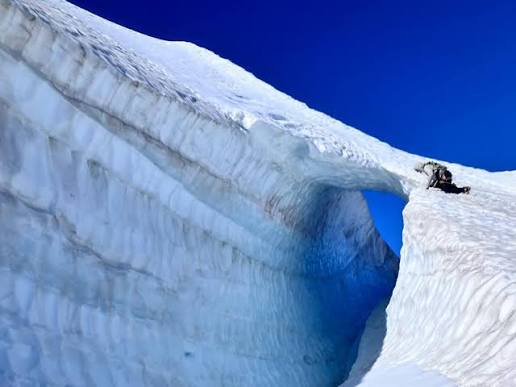
When I climbed our local stratovolcano, Mount Baker, with my wife and my son Tyler, we enjoyed the windy summit for a few minutes before heading down. Massive glaciers clad the cone’s flanks in a vertical ice cliff called the Roman Wall. As glaciers slowly slip downward, they form large cracks called crevasses. On Baker, these crevasses can be more than a hundred feet deep. In winter, snow covers most of these crevasses in one of Earth’s snowiest places. Climbing the volcano in early summer means these cracks are either still fully covered or crossed by robust snow bridges. However, we climbed later in the summer, which gave us better weather and less snow to trudge through on the lower flanks, but the daunting crevasses higher up were covered by dwindling snow bridges thanks to the unusually warm summer. During our climb, we crossed a snow bridge near the summit that was only a couple of feet wide and slushy, spanning a five-foot gap over what seemed like a bottomless pit. By the time we started down, the hot sun had softened that snow bridge even more.
Denise crossed first, and as she stepped across, large chunks of wet snow fell into the crevasse. Roped to Denise, ten feet ahead of me, with my son Tyler behind, I crossed, and as I did, I felt the bridge crumble even more, leaving only a six-inch-wide arch of snow.
Once across, I turned and sat on the glacier facing my son, digging the crampon heels into the ice to keep me from sliding toward Tyler. I drove my ice axe as far as I could into the glacier, then held on and motioned for Tyler to cross. If he fell through, I was locked on the glacier, with Denise equally secured behind me, so we could arrest his fall into the crevasse. Once Tyler was on our side of the crack, I grabbed him and held on as the last remains of the snow bridge fell into the abyss. From then on, we couldn’t go back the way we came. That route would be impassable for the rest of the climbing season, unless you were as agile as an Olympic broad jumper.
This is what the crossing is like from normalcy to tragedy. There is no way back; your previous life is forever gone. With trauma, our brains go through architectural changes that are permanent, and we can’t process thoughts in the same way as before. Kübler and Ross described the five stages of the grief of dying as Denial, Anger, Bargaining, Depression, and Acceptance (DABDA). While no two people experience this process the same way, this crossing into cancer passes through some, if not all, of these stages. Even if you recover and live a long life, your old self is still forever lost. You have the choice to try and adapt, live pretentiously in a delusion, or give up.


Leave a Reply