
Skeptics face a dilemma that often makes it impossible to stay in the organized church. I want to explain this from a skeptic’s point of view, with lessons for good people who love the organized church and don’t want to see anyone leave.
The only honest, rational way to approach this is through a sociological perspective. We are all members of several overlapping social groups. We have our family, city, country, professional, or religious groups. Imagine we are standing in the middle of several intersecting spheres, like bubbles, each representing a social group. Virtually all religious groups believe that they are exempt from social rules, as their group is uniquely “of God,” spiritual or supernatural. But believing they are excused from typical human social interactions, which have been observed for centuries and are now well-defined, does not make it true, and this makes even discussing this topic laborious.

Game Theory
One simple way to define social interactions of any group is through variations of game theory. I’ve called religion a game, which to some people sounded condescending, but that is not how I meant it. Game theory is a way to define social interactions in competitive settings without condescension, and I will demonstrate that nothing is more competitive than religion. John Harsanyi, John Nash, and Reinhard Selten coined the term and developed the idea in the 1990s. They won a Nobel Prize in 1994 for their work applying game theory to economics.

If you imagine a board game or a field game like soccer or football, there are three major defining properties. A border determines who is in the game and who’s not. Then there are rules for how to earn points, and how points determine the winner.
Organized religion is no exception; it has clear boundaries: who is a member and who is not. A less defined boundary includes those who regularly attend a formal worship service on Sunday morning, whether they are members or not. The organized church has many rules to the game, some written, such as codified dogmas, but most are unspoken social mores. For the conservative churches, not adhering to the codified dogmas not only means you are not a member, but also has severe moral consequences. You are the enemy of the creator of the cosmos and are damned to eternal torture. Not following the unspoken rules may be less severe, but you are still considered a bad person and are socially shunned. So this game of rule following becomes very competitive.
The Basis of Christian Rules
All cultures have two levels of rules: written (what I will call codified) and unspoken, which are referred to as social mores. Virtually all Christians believe that their rules, both codified and unspoken, come directly from the Bible. I’m not sure, but I believe that the Catholic church also believes that such rules, while not clear in the Bible, can come from the church and/or the Pope.
To be honest, this is where the problem begins. The Bible, like any human-written text, is imperfectly interpreted. Otherwise, there wouldn’t be well over a hundred different Church denominations, each with a slightly different interpretation. Many conservative churches believe the Bible is magical, and when you read it, if you are a moral person, you will get one clear set of rules that is absolute and perfect because of that God-spell.
Most Christians are surprised when I claim that the vast majority of rules don’t exist in the Bible at all, but are: 1) projected into it from the reader’s prevailing culture or 2) a False inference is made from words in the Bible. Being a bit facetious, one example from #1 is someone from a culture that deems all non-heterosexual behavior as evil (even before Christianity came to that culture) will read a verse: “Sally sells seashells down by the seashore,” and conclude (from their projection) that Sally is poor and has to sell seashells because God hates her because she is obviously a lesbian. A blatant example of #2 is: imagine a verse says, “The trees are green.” Then you make a false inference that all trees must be green, so when you see a (red) Japanese Maple, you will delude yourself into thinking it is green because you think the Bible says so. A more practical example of #2 is Colossians 3:8, which instructs believers to put away anger, malice, slander, and filthy language from their lips, and you can conclude this applies to saying words like “shit.” In my study of how the Greek word (aischrologia), translated as “filthy language,” was meant in the first century, it referred to abusive or hateful words. Saying shit as a violation of this verse was a false inference, created by the Victorians as a rule in their game of competitive piety. If they could create a language unique to them, they could prove they were better than others.
But culture is so powerful; once you’re taught to read the Bible a certain way, it’s psychologically almost impossible to unsee what you have always seen in the text. In summary, for the conservative Christian, and somewhat for the progressive, their particular interpretation of the Bible is considered absolute and perfect; thus, it is the bastion for criticism and condemnation of those who don’t see it that way.
Codified Rules
From my reading of the Bible, the true essentials of being a Christian are very simple: following Jesus of Galilee. Jesus taught that He was from God, a personal God who creates and communicates (as different from the God of atheistic views of Buddhism or pantheistic views of some sects of Hinduism). Jesus only taught to love that personal God and to love the people God has created… full stop. All other rules are extraneous. If you want to include the Old Testament’s Ten Commandments, that would be reasonable, I suppose, although Jesus said that love would cover those rules as well.
If you are really into the game of competitive piety, as I once was, you constantly mine the Bible (like gold mining) for more rules you can follow to prove you’re better than others.
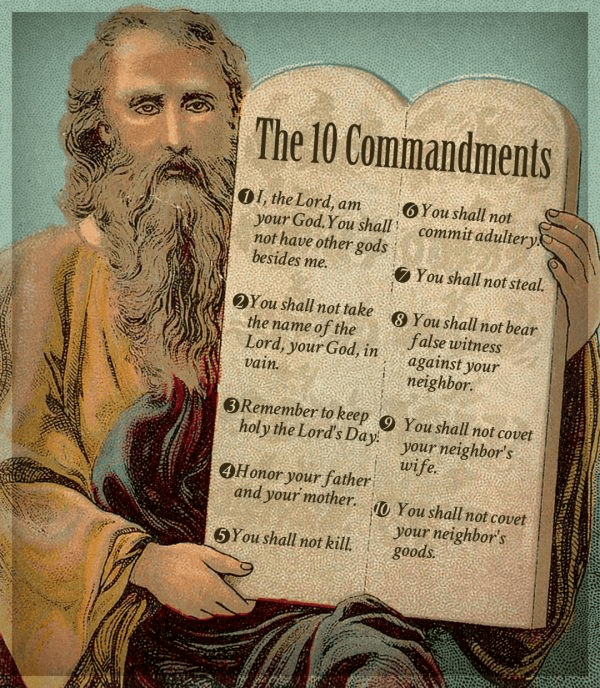
Speaking of the Ten Commandments, here is another example of projection. Exodus 20:8 says, “Remember the Sabbath day by keeping it holy. 9 Six days you shall labor and do all your work, 10 but the seventh day is a sabbath to the Lord your God. On it you shall not do any work, neither you, nor your son or daughter, nor your male or female servant, nor your animals, nor any foreigner residing in your towns. 11 For in six days the Lord made the heavens and the earth, the sea, and all that is in them, but he rested on the seventh day. Therefore the Lord blessed the Sabbath day and made it holy.”
100% of the time, modern Christians will project onto that verse the idea that it means going to a church worship service on Sunday. It does not. The Sunday morning worship service was invented in the fourth century. This verse is clear that it is about human rest, not worshipping or attending a program.
The codified dogmas of a particular church should be this simple: to love God and people, but all churches add a series of dogmas you must believe; in conservative churches, these codified rules are in the dozens. My last church wanted to make believing in a six-thousand-year-old Earth one of those, which forced me to leave that church when I was declared to be a “non-Christian” because I didn’t adhere to such a notion. I could list those codified rules, but they would include all dogmas of over a hundred denominations. You can look them up.
Unspoken Rules (Social Mores)
While the codified dogmas are in the dozens, the unspoken rules (social mores) are even more abundant, and, as I said above, not adhering to them will at least result in social shunning. Social shunning is meant to force someone to conform to the group’s mores or leave. Trying to remain in the group without adhering to the unspoken rules creates unsustainable tension for both the individual and the social group. Keep that thought.
I will list some of these unwritten rules, or mores, in modern American Christian culture. It may be true that conservative branches of Christianity have many more rules than progressive ones, but there are plenty to go around.
- God wants us to go to Church on Sunday mornings and worship him. Not going is morally wrong. Going faithfully marks a good Christian.
- Tithing, or giving money to the church, is not just a practical exercise (or the church must close its doors and lay off the staff); it is also considered a moral failure if you do not do it.
- Do not say a long list of words that have been deemed obscene over the last two hundred years.
- You must be positive at all times. It is okay to say, especially while standing in a church, “it is a wonderful day,” but you better not say, “I’m sad,” “I’m mad,” or “I’m in pain.”
- Do not drink alcohol.
- Pray before you eat, especially if other Christians are watching.
- For the past two hundred years (since Kierkegaard), reason is considered “of the flesh” rather than from God. We don’t look at evidence and reach rational conclusions (we all do, but we shouldn’t admit it); instead, we must rely on God speaking directly to us. Everything is subjective because it is built on emotions, disguised as spiritual.
- If someone is rational or analytical, they are to be pitied as not living in the irrational spirituality that God wants. They love the devil more than God.
- You must have certainty, even without evidence, about Christian things, including that God exists, Jesus was the Messiah, and that the rules here were given by God, not just our culture. Questioning any, or God forbid, doubting any, is morally wrong.
- You must believe everything a pastor says, or everything a popular teacher and author says. Questioning what you are being told is a sign of spiritual weakness.
- You must believe that supernatural miracles are happening every day and all around you, and speak about them in front of other Christians, even if you have to lie about them.
- Because reason and deduction from observing evidence are seen as morally inferior, you must be superstitious. Everything from a falling leaf from a tree to great wars was directly caused by God’s providence (not to mention cancer). Some things might be caused by a devil, but nothing happens by chance or through the standard laws of nature and physics.
- You must go to the Church service on Sunday mornings, and you must pretend to love it, even if you don’t. You must pretend to love church music, even if you hate it. You must also love the rituals, including the hymn karaoke part of church, because that is what God wants.
- Science is of the devil, and saying you learn something from science gets you laughed at.
- If someone says they experience God objectively, by studying wonders of nature, it means they are inferior because you can only know God spiritually.
- All positive human emotions must be relabeled “spiritual” to have value.
- In conservative churches, and among conservative people in progressive churches, there is also a “shit-list” of people you must hate: anyone who is different from you.
- Lastly, to show these rules in cultural context, in the modern American church, during Sunday morning worship, everyone must wear a shirt… and pants.
There are many other unspoken rules of modern American Christianity, but I will stop here.
I’m going to continue this series, again, trying to make sense of why the church is such an inhospitable place for some people who love God deeply and how they could make it better.
Respectfully, Mike
Game Theory

Codified Rules
Unspoken Rules (Mores)
The Psychological Level


Leave a Reply