I am waiting on my chemo infusion, so I have time to write.
Standing in our church’s fellowship hall a few years ago, after I had led a class on science and faith, a kind friend said he couldn’t relate to the class because he doesn’t appreciate science. He shared that he felt closest to God in the magic of a mystical church service, but he respected my viewpoint. I shared with him that I respected his view too, as it was the standard one, but for me and many people like me, that doesn’t work. I had spent almost forty years in a subjective and irrational Christian spiritual/mystical world, inside the doors of a church, whenever they were open… which left me wanting. Yet, when I walked through the Louvre Museum, when I sat in the audience of an orchestra performing complex classical music, when I looked at the order of higher mathematics, and when I look at an image of our cosmos from the James Webb space telescope, I felt the presence of God in a mighty way. I am brought to tears. As Pythagoras (570 BCE) pointed out, music is just acoustical mathematics.

I think those who honestly search for truth and end up as atheists stop their search prematurely. When I realized that I had been lied to about evolution, the age of the earth, our true social motives, about the “gay agenda,” and about so many things, I saw no hope in believing in a Christian God anymore. As I’ve said before, theism is filled with absurdities… but so is atheism.
As I continued to meditate on the big questions of life, I eventually ran into the brick wall of atheistic absurdities. It would take me hours to explain, but in summary, it was about the fine-tuning of the universe, consciousness, and the loss of meaning.
I will be clear, you cannot reach certainty about atheism or theism, on reason alone. That is what I am often acused of. Reason is wonderful, beautiful, divine, but we mere mortals have imperfect reasoning. Thomas Aquinas was clear about this when he said that you can find God and have a relationship with God via reason alone. But to fully understand the nature of God, it takes a divine revelation. Objective reasoning is essential, but not the whole story.
I will reiterate that I am writing this series because the second divine book of God, the study of nature, has been abandoned by the church. This started two hundred years ago when the Enlightenment began to challenge, not the Bible, but Christian traditions. In response, the church declared war on science and reason, creating its own path (thanks to Soren Kierkegaard) to find purely subjective truth. I feel it, therefore it is true.
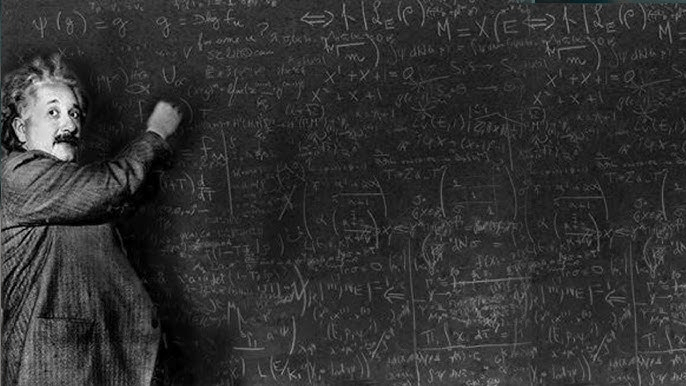
As I had shared with the respectful friend, mathematics is one of the most remarkable fingerprints of God. Because the entire cosmos is built on a scaffolding of mathematics, great mathematicians, like Einstein, can sit in a dark New Jersey office, scribble on a slate blackboard with chalk, and make fantastic discoveries about our universe, billions of miles away, or about minuscule, subatomic particles that no one can see without a giant collider. Most people don’t realize how incredible this is! Humans did not invent math; we only discovered it. That’s why I call it the native language of God, because people invented all other languages. I can say, without mathematics, I would probably not be a Christian today. That will seem absurd and even anger many Christians. But if I said that a certain verse in the other book, the Bible, had not been there, I would not be a Christian, then that’s okay.
Below is a very short introduction to Math and it’s evidence of the nature of God. It is quite simple, beautifully done, and short.
Respectively, Mike


 J. Michael Jones
Leave a reply to Glenda Charman Cancel reply