If you stay tuned to this article, I want to re-focus on the positive attributes of the organized church, including the Sunday morning worship service. But first, there is a caveat.
The Cavaet
In the best-selling author (including Sapiens) Yuval Noah Harari’s latest book, Nexus, he is on the same page as me, noting that our present culture of giving up all aspirations for factual truth will, in the end, be a disaster (which we are already witnessing). As a historian (he is a professor of history at the Hebrew University of Jerusalem), he approaches this through the flow of human history. One of the recurring themes of his examination of history is that when human institutions lack “self-correcting mechanisms,” they fail. He concludes his book by examining the growing influence of AI, which lacks these self-correcting mechanisms at this point.
As a self-declared atheist, Harari’s approaches religions with unfiltered scrutiny. He observes that when human religious institutions declare that they are speaking for God, then they immediately lose any sense of self-correcting. How can you correct God, if God is perfect?
Harari focuses on one period of both Catholic and Protestant churches, the hunting down, torturing, and killing of so-called witches in Germany in the 16th and 17th centuries. It is important to mention that more than 80% of the 60,000 killed during this time were women. He asks the question, “Where were the moral voices to stand for justice?” Most of these people rounded up had no evidence of practicing witchcraft, but needed a simple referral to the King by the church, and almost any man could report a witch to the church. But the church claimed that it was God who was behind these atrocities.
Paul’s warning not to become captive to traditions and human philosophies has generally been ignored since the crowd became a church. It’s human nature. Christians create systems, organizations, rituals, and habits, and then assign the authorship to God, putting them out of reach of criticism or change. I’m considered a wierdo, or the enemy of God, because I challenge just a few of the Church traditions, such as my seeing reason and seeking evidence, as the way God wants us to find truth.
I would be a horrible pastor because I have thin skin. However, I’ve often served in many roles in the church. I’ve witnessed many times how congregants lose their minds when we try to make trivial changes, such as the time of worship. Usually, those congregants evoke God as the author of the status quo.
I was in one church where the pastor wanted to evolve into a mega church, starting with a massive building program, and he invoked the name of God as being behind his move. At the same time, another group (fiscal conservatives), who were against going into debt for the massive new church, also invoked the name of God as being on their side. It ended in a nasty war of words (and almost a fistfight), and the church failed. It reminds me of Able Lincoln’s famous writing: “In great contests each party claims to act in accordance with the will of God. Both may be, and one must be, wrong. God cannot be for and against the same thing at the same time.”
So, this is the problem. All churches, all denominations, invoked God as having the authorship of their precise tradition, mores, and habits. Therefore, the structure and nature of the church become “sacred,” untouchable, and they will hold on to their forms even as those forms fail. Then it becomes an issue of wineskins as in Jesus’ parable.
To be clear, and I will write more about this, my goal, unlike that of the house church guru of the 1990s, Gene Edwards, is not to destroy the traditional church. The traditional worship service and church organization are meaningful for a large, although shrinking, swath of the Christian populace. But I advocate for grace toward us, who dream of a better way, and to allow them to express and create space for us within the traditional church. This is the hope of the future.
A Benefit of the Established Traditional Church-Stable Leadership
In a previous post, I told the story of how, in the mid-1990s, I attempted to start a house church. I had good intentions. I did my due diligence carefully, spending a year in study and then visiting what was considered the best home church in America. Yet, as soon as I launched my meetings, it began to go off the rails because those coming had already been brainwashed by the Christian culture at large.
One of the reasons I launched this church was because of the untruths being delivered from the pulpit of the large (500-member) evangelical church I was attending. Typical of evangelicalism, we were being bombarded by conspiracy theories (the Clintons torturing and murdering Christians, the Gays having meetings to figure out how to destroy Christianity by turning our children gay, black helicopters tracking Christians by the deep state, and Bill Gates is the anti-Christ) and other nonsense.
As I’ve said, since the mid-nineteenth century, the church started another tradition, a change in their epistemology, believing that truth is subjective, created intrinsically, not by following the evidence. Therefore, the church is now awash in lies, and nobody seems to care. I will say again, asking, “Where is the evidence?” is the greatest question a Christian can ask.
When I started my house church, five families joined us. However, due to this same tradition of making shit up with no evidence, it became a battle. The other church tradition, competitive piety, played another major role. So, as I have mentioned, one family was asserting they were better than the rest because they follow all the Jewish laws and customs (calling themselves messianic Christians). The next family was far into Christian nationalism and wanted us to take up weapons to fight the liberals, and they, at least the husband, saw themselves as far superior to the rest of us. The next family, the wife saw herself as far above the rest because she was a prophetess, and God was constantly speaking to her through objects. Like during one meeting, she pretended to fall into a trance and said a housefly landed on her shoulder and whispered in her ear a message from God that Denise and I, and our house, were full of demons. Now, the timing of this prophecy was interesting because I had just challenged another wacko prophecy she had the previous week. And there were many more things going wrong, and I had no respect as a leader and no control. It was like trying to herd cats, insane cats. I’m sure someone with better gifts than I could have handled this better.
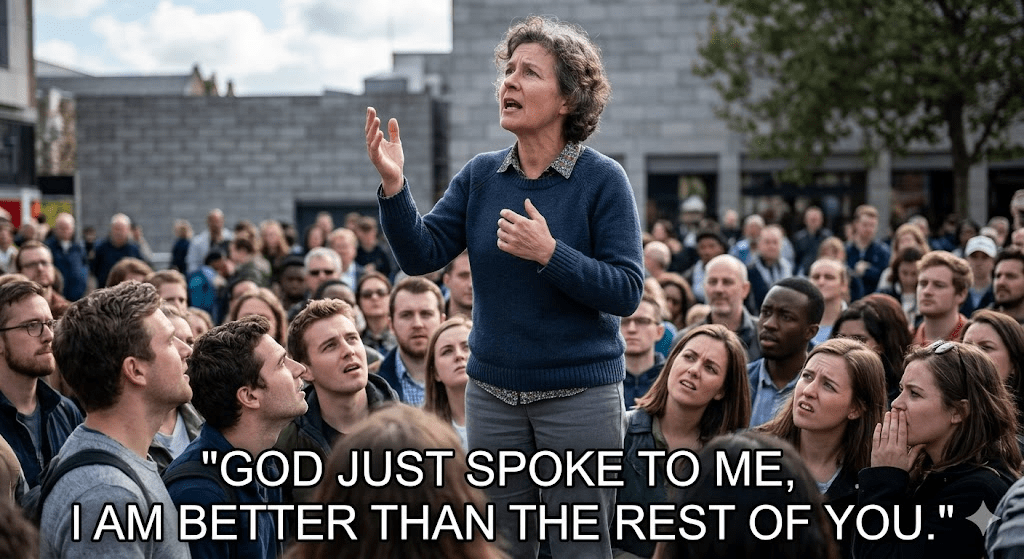
It became clear that they had left the organized church because it would not tolerate their insanity. So here I was, attempting to pursue a more thoughtful and honest rendition of the church, and they were seeking the opposite. I had no choice but to dissolve it.
Additionally, when I visited this premier house church in Colorado, I left feeling uneasy. They were doing a lot of things right. But, having been in a cult once, I sensed a cultish theme developing, primarily two classic symptoms. The first was that the leader was dominating, referring to himself as the world’s only modern apostle (church planter). Again, it is the act of making God the author of something we create (his role as the leader). Secondly, playing into this infamous habit of competitive piety, they saw themselves as far better than the Christians in the traditional church. Years later, I did some research on them, and yep, they evolved into a full-fledged cult with ugly infighting and even lawsuits about abuse.
It is not a perfect world, so we must live with what we have. My idealism of the house church has faded in time. After my experience, I have greater respect for the eldership of the organized church; the traditional hierarchical system has some benefits, including stability. But here is the rub with that. As I mentioned, the church I left, even the leaders and the elders, were far into the usual evangelical conspiratorial lies. Here is the other thing. I had always respected the theological and Biblical guidance of a team of elders and the hierarchical leadership of a church. However, the churches I knew that were most serious about following proper dogmas and “training in righteousness,” all of them, fell head over heels for the MAGA cult, without giving it even a second thought. So, having the traditional church leadership isn’t always a benefit either.
I am not finished with this topic, so I have at least one more post.
With Respect,
Mike


Leave a comment