Future Plans
I hope to finish this series of articles on the organized church with two more posts and then move on. I mentioned that my readership quintupled a couple of months ago to more than 1200 readers per week, which is still minuscule for any blog, and I wanted to understand what happened.
I have been studying what people are reading and how much time they spend on each article, and it has surprised me a bit. The most popular articles are the ones I have written over the past seven years about my cancer and about suffering in general. After I finish my thoughts on the organized church, I will try to return to those topics; however, it will be a little hard for me to write about, as while I still have cancer, I am in remission, and my suffering is minimal.
But I am writing a book right now about my journey with cancer and the things I’ve learned. The book (How Cancer Taught Me to Swear) deconstructs my boyhood, Appalachian culture, and the general Christian and American cultures’ approaches to tragedy, and I write with a satirical tone. I will draw from that book as I move forward.
Regarding my thoughts on the post-Christian world we live in, I’ve decided that as soon as I launch How Cancer Taught Me to Swear, I want to write a nonfiction book with a working title, POST CHRISTIAN: A Field Guide to Navigating the Wilderness.
The Organized Church
Now, back to the organized church. I will remind you that, for the purpose of these articles, I will call what is translated “Church” in our English New Testaments the Greek word ekklēsía, “Crowd.” Ekklēsía does refer to people, not an institution. I will use the word “church” in its colloquial sense at present, meaning a building, an institution, and sometimes a local group of people.
Last time I mentioned the atrocities in history committed by all branches of the church as proof to me that it is not a holy institution, but a human endeavor. But I want to be clear, this does not mean I think the organized church is evil. Just like any human institution, a school, a company, or whatever, it can do great things or evil things because these institutions reflect fallen people who have created them.
Except for one year, circa 1995, when I attempted to start a home church, I have been involved with the organized church for 69 years, which includes good churches and bad ones.
The worst was the one I was raised in, which was in the Bible belt. I suspect that church was not that unusual in that area. The pastor had little personal spiritual interest, preached from Paul Harvey or Peanuts, in a very boring tone. His right-hand man was a habitual pedophile whom we boys had to hide from when we were at church. Sunday school was where we, the younger kids, would sit with the high schoolers and hear the boys talk about how far they got with their girlfriends, sexually, the night before. But going to church was an act of penitence. We all hated the Sunday morning worship service and were thrilled whenever it was canceled due to a furnace problem, snow, a power outage, or the pastor being sick. But we only went to church to avoid making God mad at us, to prove to others that we were good people, or as an act of penitence to cover our sins during the week.
You can argue that my view of the church is biased because of my upbringing, and you might be right, to a point. However, even that church, as bad as it was, had some redeeming qualities, offering a sense of community at times and supporting people who were sick or facing other crises. To my mother and my aunt, as they grew older, they found most of their social connections through that church, and it had a sum-positive influence on their lives (despite the pastor attempting to rape my mother when he came over for a bereavement visit after my father had died).
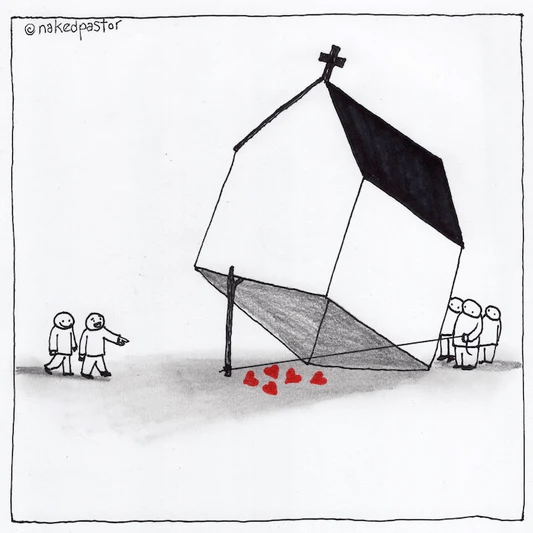
I have to say, the church I attend now, and have for ten years, is the best church I’ve been involved with in my life, with wonderful people and the best pastor I’ve seen. Yet, even there, I know that I am not welcome into the spiritual life, as I have attempted to be part of a small group and teach Sunday school. It is not that the whole church is unwelcoming; many are, but it is the culture of American Christianity that if I share any of my personal views, such as human reason is a gift from God and we should look at evidence to reach conclusions, someone is always ready to tell me that I’m not a real Christian, even there. But those people do seem to be the minority, which is about the best I can do.
This church is also focused on the things that Jesus taught, serving the marginalized, rather than getting mixed up in culture wars or politics, unlike the churches I was involved with in college and grad school, which are now Christian nationalist.
Looking at churches historically, I also recognize the good they have done. I mentioned the atrocities only because they are often taboo to mention in Christian circles. I taught a class on church history when I was an evangelical, and while I may have included unflattering things in the history of the catholic church, I never mentioned the torture, murder, rape, sexual abuse, etc. that taints the history of the protestant church.
But you will find much good in the history of the church. While churchmen (meaning women and men) started slavey, churchmen also tried to put a stop to it—the same with Nazism. The church often stood with the poor and the marginalized. Created beauty in architecture, fine arts, and music. Brought a sense of justice to places.
But when I look at scripture honestly, I only see recommendations for the Crowd, not what we call the church. So, if the church is a human institution, that institution is not codified (made into God’s law) and can be changed.
Suggestions for the Future Church
To this day, I do not enjoy the Sunday morning worship service. “Worship” is an Old Testament, Jewish Temple idea. The New Testament is clear, Jesus said that worship would not be fixed on a place but in truth. As the author of Romans (perhaps Paul) wrote in 12:1 Therefore, I urge you, brothers and sisters, in view of God’s mercy, to offer your bodies as a living sacrifice, holy and pleasing to God—this is your true and proper worship. The greatest act of worship I’ve witnessed in my life was a nun, Sister Emmanuel, who had moved into the garbage dump outside of Cairo, Egypt (where I worked now and then) to serve the poorest of the poor. She had given her life and her body as a living sacrifice.
Now again, as I write this, I must be clear. I am not a religious person, so when I argue against a concept, such as Sunday morning worship service, I’m not saying it’s intrinsically bad or evil or sin. I don’t make these things a moral problem. Those are good people, most better than me, who love Sunday morning worship.
The point I am making is that Sunday morning worship, while it has been part of the Christian tradition for almost 2,000 years, is not set in stone. Not a mandate. It is a culture, a tradition.
The traditions, as I’ve written before, are not a problem unless they hold us captive. In this case, if we are losing a large part of our populace, because we require them to participate in Sunday morning worship service, to prove they are good, so God won’t be mad at them, and for their act of penitence. As I’ve discovered, the only mandate I read in the New Testament for the Crowd is to meet to encourage one another. While the pastor can offer some encouragement from the pulpit, and our pastor is great at it, I think other settings are far more conducive to it. Even coffee hour is a better setting if people actually speak positive things to encourage each other. I miss coffee hour because the setting is very dangerous for me due to my weakened immune system.
So, again, to be clear before I go, I have no hope of stopping churches’ worship services. Many people love that hour, far more than I do. It is part of their good upbringing and personal culture. But I only wish there was an option for those who are no longer of that temple culture. Again, my favorite modern Crowd (which I have only read about) is a group that meets in a pub in Oxford, England, for encouragement and thoughtful and honest conversations. Wild horses could drag me away from that meeting… especially if the beer was good.
In Peace,
Mike


Leave a Reply