Because some of my readers are focusing on my journey with multiple myeloma, here is another excerpt from my book (a work in progress): How Cancer Taught Me to Swear.
There was another aspect of cancer that I did not see coming, but in retrospect, it was a no-brainer. Cancer makes you a narcissist. To survive, you must become consumed with your own needs. Unlike the mythological Narcissus, you don’t look into a lake, see your beautiful reflection and fall in love. No, you see your own hideous reflection, your deterioration, your wounds, and you see yourself like a helpless fawn who has fallen through the ice on the frozen lake, and you are obsessed with saving yourself. As with the fawn, along the edge of the lake, there are doctors, nurses, PAs, NPs, and family members throwing ropes toward you, but in your desperation, your thrashing, you can’t see them. Mixing metaphors, you become the baby down the well, the soccer team in a flooded cave, the astronauts trapped in a broken spacecraft strung between the Earth and the moon. The entire world stops for you… But it is only your internal world. The real world doesn’t give a shit about you, as it has its own problems to work out. Meanwhile, you are burrowing so deeply into your own pain that you stop giving a shit about the world.
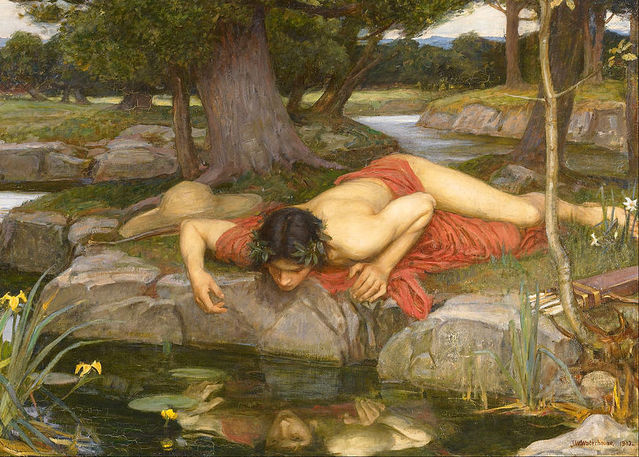
In this formidable fight, tit for tat, dying, then living, only to start dying again, your eyes becoming increasingly myopic. You become a self-obsessed toddler. Your needs trump others’ plans for you. You reject trips when you need to rest, invitations when you must stay near a toilet, and you reject beautifully crafted meals, replacing them with the bland, in order to save your organs. Worst of all, you stop hearing the voices of others who are also in need. Everything becomes background noise to your cancer.
Denise and I never made a decision that the other disagreed with until I had myeloma. I bought a cheap convertible against her wishes. I started building a cottage in spite of her hopes that I wouldn’t. Yet I know I would not be alive today if it were not for the cottage; it pulled me off the couch to do hard manual labor.
I can’t say if the convertible was life-saving, but it is possible that it was. I owned it during those months when the stem cell transplant had failed, the suffering was unbearable, and I was constantly considering whether to be or not to be. Driving into the North Cascades with the top down, the cold wind in my hair, the heated leather seats thwarting my constant chill, may have been the straw that kept the camel’s back from breaking, giving me enough will to live… for one more week. I cried when a teenager T-boned me, doing sixty on a mountain road, totaling my “cancer car.” She was fine. I was so focused on the car that it took several days to notice my purple shoulder, a bruise from the airbag impact.
There must be self-empathy too, although that may be an oxymoron, as empathy is the ability to feel other people’s pain. Self-pity may be a better term. As I have written, there is a place for self-pity. The soldier who drags himself out of the line of fire, after losing his leg, and then applies a tourniquet to the stump, does so out of self-pity combined with self-preservation. With no self-pity, he would lie there in the war until he bled to death.
But like I’ve also written, self-pity, while healthy to start, must be self-limiting before it becomes destructive. That was the other benefit of my cottage, my healing hut. The hard work helped to end my season of self-pity. The cancer sufferer, if they live more than mere months, must find a place, an ear to hear others again. The caregiver who had been talking about their physical pain for months, but was of a tone that you were deaf to. One day, you must hear them, turn to listen, and apply the true meaning of empathy.
Some of the happiest moments of my life were when I was forced to see the suffering of others. The first time I walked into the “Village of Garbage” outside of Cairo, it was the closest to hell of anything I had experienced. It’s where more than thirty thousand people live in a landfill, the landfill burning day and night. Barefooted children wearing dirty, discarded clothes, eating from the garbage that they were sorting beside a dead and rotting donkey, and wading in a “lake” of sewer water, coming down from the wealthy apartments on the cliff above them. All my personal problems vaporized. My heart turned outward, not inward, during those two years.
It was the same when I entered a refugee camp in Afghanistan or when I worked in rescue in an earthquake in Pakistan, where eighty-five thousand souls perished. You become so consumed with the others that you forget yourself completely. You don’t eat, you don’t drink, you don’t poop, and you almost forget to breathe until someone slaps you, bringing you back to yourself.
By the third year of myeloma, when I started to see that I might survive an immediate death, I knew I had to start opening my eyes to the others, starting with my own family, then the world. I remembered echoes of Denise having joint pain, but I had never focused on it. I had lost touch with what was happening in my children’s lives, focusing instead on their lack of interest in my troubles. This had to change.
During the season of serious suffering, I became acutely sensitive to others’ criticism. Their sharp words cut like a razor and not just a butter knife. Suffering does this to you, turning all your senses on edge.
I just had lunch with a friend last week who was diagnosed with a progressive and terminal illness soon after I was. I asked him, “Do you find it hard to handle criticism since your diagnosis?”
He looked stunned. “No one has ever criticized me since I’ve been ill,” he answered. “I couldn’t imagine why anybody would do that.”
It made me re-examine myself. Is being criticized my fault? This friend is a secular man with no religious affiliation. I have found the religious world to be a different animal. There smiling faces abound, but some of them have pointed daggers under their cloaks. They use their daggers to probe your armor, looking for a chink, a place to thrust. I know from experience, when I was a religious fraud, that the demise of a brother or sister could fuel my own quest for piety. Spiritual vampirism. Shameful. We only have one commandment, and it wasn’t to be pious; it was to love others.
My problem is that my religious armor has many chinks. Pretense can cover a multitude of sins. I try to live honestly, asking the really hard questions and sharing vulnerably about my own weaknesses. This invites deep personal attacks, as to the religious, everything is a moral problem. While I speak in philosophical terms, sometimes it provokes a deep personal response, which, on a good day, is water on a duck’s back. But when suffering drives you into narcissism, you feel every cut. Self-obsessed. But it has been over a year since I’ve had such an attack, and it is time to move on.
On this side of suffering, at least for now, I fight to turn my eyes outward again, to see others’ pain. My new mantra is asking, sincerely, not as a formal greeting, “How are you? What’s going on in your life? How can I help you?” I think about the suffering of the world and locally. I want to get to know my wife and children better, who may have gotten lost from me in the fog of my illness. I want to avoid those religious people who carry daggers under their cloaks… Life is too short for that.
One of the things I like most about my church is that it is a service church that seeks to help those in need. It is outward-looking as a church should be. I want to participate more in those programs. For the needs of others, I find redemption from my narcissism. The Message says it like this (Philippians 2:4): Don’t be obsessed with getting your own advantage. Forget yourselves long enough to lend a helping hand.
Mike


Leave a Reply