I am working on two books right now. A novel, The Agony of a Woman, and a cancer memoir, How Cancer Taught Me to Swear. From what my readers are reading, there seems to be a great interest in my journey with Multiple Myeloma. So, today, I am posting an excerpt, the complete chapter twelve, from my memoir. It is still a rough draft, but I think some will find it interesting.
Chapter Twelve
When I had dreamed of dying, like most people, I imagined myself living a healthy life until my nineties, then going to sleep one night… and never waking up. But I did the math, and the odds of such a happy ending are less than 5%.
With my children on their way, even my son and his family from Minneapolis were in the air, likely somewhere over Montana, I had a few minutes to think about my future or lack thereof.
Considering my age, sixty-three, and in severe renal failure, and having my particular myeloma genetic signature, my mean life expectancy was eleven months. When I saw that number, my expiration date, I felt a cold chill flow over me. Acid in the pit of my stomach. I was on death row, and the month, but not the date of my execution, was scheduled, or so it seemed. Once I knew how I would likely die, complications from multiple myeloma, the question for me was specifically… how?
I looked up famous people I knew who had died from multiple myeloma, such as Geraldine Ferraro, the first woman to run for Vice President of the US. I read that she went to Massachusetts General Hospital for a typical myeloma bone fracture in March 2011. She had been battling the disease for twelve years. While at the hospital, she was diagnosed with pneumonia and succumbed to the infection with her family in her hospital room on March 21st. Overwhelming respiratory infections are one of the most common ways that we, myeloma patients, die.
I had friends who experienced the nightmare deaths from COVID-related pneumonia, and it was a slow suffocation. Pneumonia related to multiple myeloma, I assume, is no better. But I heard of a possible worst way for us to die, and I heard it from caregivers in an online support group. Some of their loved ones were so overwhelmed with the spreading disease that their bones basically turned to chalk and broke, causing unbearable pain, and lesions spread to extramedullary (outside the bone) spaces, such as the lungs or brain. I remember one caregiver sharing how she had to go outside the hospital and cry because her husband was in the ICU, screaming, going out of his mind in pain, and no drugs could control it. The fear of suffering is worse than the fear of death.
We grow accustomed to the notion of death, yet not always to suffering. The day we are conceived, we are programmed to die. Biologically, it doesn’t have to be that way. But here is the problem from a strict biological perspective. Living cells must reproduce to replace those damaged by physical trauma, infectious agents, or other mechanisms. They are very good at reproducing themselves, but sometimes they err. Aging and dying are an accumulation of those mistakes.
In the Christian narrative, death is the result of Adam and Eve’s sin or fall from grace. Therefore, redemption is the restitution of life and the end of death. However, as I’ve gotten older, having observed life and studied the cosmos, I now know a God that is much bigger than the simple Bronze Age God I was taught as a child. In other words, this whole concept of death and redemption is much more mysterious than the simple fairy tales we learned as children.
I’ve shared how it seems we are born into a world that is centered on us, and where suffering and death are incomprehensible, except, sadly, for those with childhood diseases or other tragedies. But eventually, that magical thinking must end when we witness death among our families and friends.
In our youth, we rarely think about death unless we are sick, have friends who die, or have close calls with death ourselves… usually inside an automobile. When I was an officer in the Air Force, I had several pilot friends who told me that they had a dream of dying in a plane crash. Hitting the ground at a thousand miles an hour, so hard, the rescuers would never find a body part, and death would be instantaneous. “That would be glorious,” they would say. But would it? Most of them were B-52 or KC-137 tanker pilots at my base. It would be hard to do a nose-dive and crash in a B-52, as it is huge; more like a falling, burning strip mall than a nose-diving rocket. But this idea of going out with glory must only come when someone is tired of this life, as there is no glory in any death.
But as we age, even if we are healthy, the thoughts of death start to take up more and more space inside our heads. Larry David, comedian and writer, said when he was in his twenties, living frugally in New York City, trying to make a career, his mind was constantly thinking about sex. Not because he was having a lot of it, but because he wasn’t. But when he turned seventy, the sexual thoughts in his mind were replaced by thoughts of death. Every day, he says, he thinks about how he would die.
The sudden onset of a potentially terminal illness takes away the myth, ends the delusion, and puts the end of our earthly existence on the calendar. It was an overwhelming feeling, like none I had experienced before, and I wasn’t sure where my emotions would take me.
My first step, to be fair to my family, was to plan my death, or at least how I wanted things to be handled after I was gone. I have known people who, in trying to help the so-called “loved ones” escape at least some of their pain, planned a lively, happy celebration. A death party. I considered that, but again, I knew that sorrow has no escape, that you pay the piper sooner or later.
As I wrote earlier, I think Mediterranean cultures handle emotions, including grief, better than Northern European cultures. It is better to give voice to the pain than to pretend it isn’t real. Maybe it is this aspect of the Mediterranean culture that allows people to live longer and healthier there, and it’s not just the diet.
If I had not been clear by now, I am an enigma. I take the belief in a personal God very seriously, as I do following the historical Jesus of Galilee. But I also love reason and science. With that said, I don’t care much for religion or superstition, but I’m in good company, as neither did Jesus. Religion took so much of my early life, and that part was not healthy. It was pretentious. So, for my family, after my death, I didn’t want an event that would be a phony religious celebration, while my wife would be comfortable with a church service, neither my children nor I would be.
Then comes the question of what to do with my remains. My mother had grown up with the myth that a lot of people “wake up” hours or days after their death, even while being embalmed or cremated. So, she wanted neither. This left an impression on me, and there is nothing more terrifying than the thought of waking up in the middle of your own cremation. It is true that early church leaders, such as Tertullian of the second century, opposed cremation because of its association with pagan customs. A century later, the Christian apologist Minucius Felix opposed cremation because it made the resurrection of our bodies more difficult. But really? Would it be more difficult to reassemble a body that is reduced to ashes than one that has been digested and pooped out by worms or dissolved by the digestive enzymes of bacteria?
In those quiet hours, waiting for the next test or treatment, the thoughts of my own death were overwhelming. It became so real, no longer just an abstract theory. I looked at my arms, rubbing my fingers across them, those arms which had been familiar to me for 63 years, within days, weeks, or if I were lucky, months, would be ashes or decay.
There is a philosophical and, at times, theological concept of psychosomatic unity. It is the feeling that you and your body are the same. Your body defines you. Most of us have this type of body awareness. But with the onset of cancer and illness, I began to feel the cleavage of myself from my body. My body had betrayed me. It was now working against me, toward my death, not my happiness. It was like I was a Siamese twin, and my twin was trying to murder me, so we had to be separated. Later, with tubes, wires, scars, and deformities taking over my body, the cleavage became more pronounced.
I looked at the black spot on my right forearm, a chunk of deeply buried pencil lead. I remember the day I got that mark, in the third grade. I was sitting behind Lisa Simmons, and I was pulling on her pigtails… the way I flirted at age nine. But I was oblivious to the fact that she didn’t like it and was becoming more frustrated each time I did it. The next time I pulled her blond twig of hair, she spun around and stabbed me with her pencil. The lead broke off deep under the skin. No, I never pulled her pigtail again. And I certainly didn’t invite her to be in either of my sisters’ weddings.
When I got home, my mother looked at the pencil lead and was worried. It turns out, she HAD heard of “lead poisoning.” She thought, however, that it referred to pencil lead, not the type I was chewing just a couple of years earlier. She took me over to our neighbor, Tommy’s dad, who worked nights and was home, and he looked at it. He explained, “I don’t think the stuff that’s in pencils has real lead in it; we just call it lead.”
He was right. When the first natural deposit of graphite was discovered in Borrowdale, England, in the seventeenth century, it was mistakenly identified as a lead alloy and called plumbago, meaning “black lead.” Pencils, previously called styluses, were made from the metal lead and left a gray mark on paper or other surfaces. This new graphite left a much darker mark and was quickly adopted as a writing material, and the name “lead” stuck.
Graphite is formed when dense carbon deposits, such as coal or other organic material, are compressed under high heat over very long periods of time. The deposit in Borrowdale is estimated to be over 330 million years old. So, a tree in some primitive swamp, over which giant dragonflies, with wingspans of two feet, flew, and early reptiles crawled, would have collected light from the sun that day, turned into the material carbon, deposited, and ended up inside my arm. The early sunlight’s energy would be liberated when the temperature of my arm reaches seven hundred degrees inside a cremation oven, bursting into a little flame and releasing that stored primeval sun’s energy—a grim thought.
After an hour, I had settled that it would be easiest for Denise and the kids to have me cremated. But I never wanted my body to be in an urn on someone’s fireplace mantel, as that would be creepy. Eventually, someone’s cat would knock it off and make a mess, leaving the family member in a dilemma and me… inside a vacuum cleaner bag. I think it is beneficial for a family to have a place to focus their grief. I thought about where to spread my ashes. I know people who could spread them on Mount Everest, or some other exotic place. Likely, no one in my family would ever have the chance to visit those exotic places, and they would be more likely to forget me. My family forgetting me is the greatest of my fears about dying.
When my wife, son, and I climbed our local stratovolcano, Mount Baker, my wife carried the ashes of one of her friend’s grandmothers. When she dumped the ashes out into the sixty-mile-an-hour westerly wind at the summit, I assume they ended up over all of eastern Washington and Idaho.
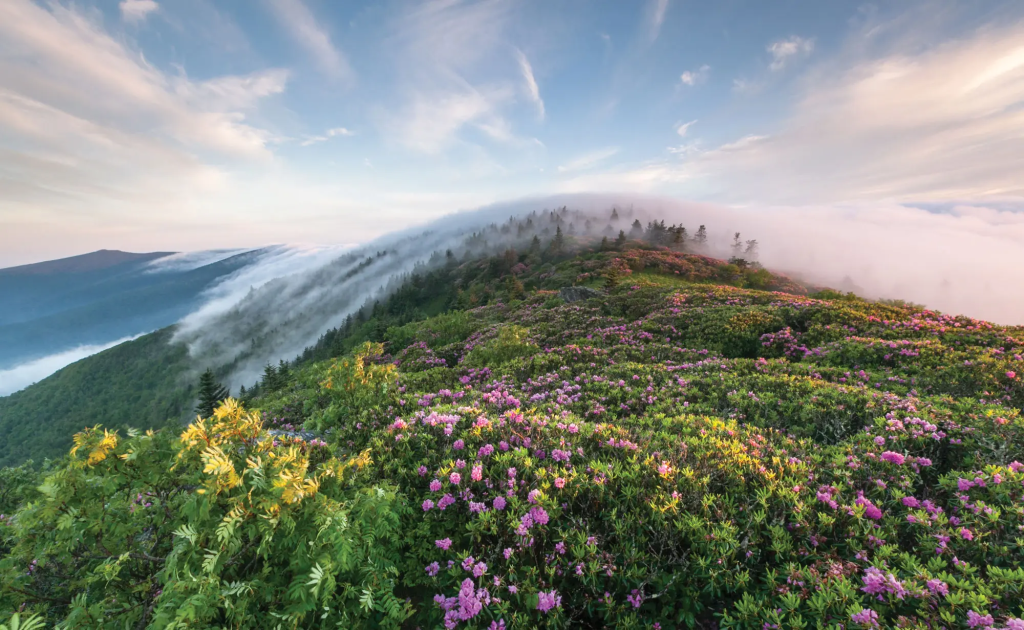
I settled on a place that means a lot to me and reconnects me with my boyhood home, the Round Bald summit in Roan Mountain State Park, Tennessee. When I was in college, I spent many days and some nights in that high place. A bald mountain top, nearly six thousand feet above sea level. With your view unobstructed by trees, you can see forever.
My most memorable trip on that part of the Appalachian Trail was a winter backpacking trip in 1976. I was taking two novices, Gene and Jane, with me. A couple of days before that trip, the weather forecast turned brutal, predicting heavy snows, plunging temperatures, and high winds, creating blizzard-like conditions at the higher elevations. The idea of camping in those conditions sounded exciting to me, but I needed to check with my camping partners first. They gave an enthusiastic thumbs up, so we set off. Fearing the roads after the storm, we parked my jeep at the end of that twenty-mile stretch of trail, and Gene drove his Honda Civic to the top of the mountain, realizing we might have to leave it there for a few days until the roads reopened.
As we sat in Gene’s car, the rain pelted it, then turned to sleet, then to big, beautiful snowflakes. We grabbed our backpacks and headed up the steep bald, the snow falling so densely we could barely see the trail. It was magical, and the thoughts of that hike, that mountain, brought a big smile to my face, lying in my hospital bed, forty-two years later.
On the perilous morning on the mountain, the magical snow began to thicken and fall horizontally as the winds picked up, gusts so strong that it was hard to stand. But we were still enthusiastic about the trip, feeling we could make it across the mountaintops over three days to my Jeep parked on the other end. But, as we reached the three-sided Appalachian Trail shelter, the weather was getting rougher, the temperatures hovering near zero, a very cold day for the southern Appalachians. The wind was biting through our clothes and extinguishing all our attempts to start a fire, or even to light a small cookstove. It was then that we realized that, as we say in the South, “This thing has gone plumb cattywampus.”
It was a rough night. I had winter-camped before, years later in the Upper Peninsula of Michigan, but never in conditions as bad as those that night. I had a down sleeping bag rated to about 25 degrees Fahrenheit, and I can’t remember what kind my friends had, but theirs weren’t as good.
We brought a tent for our second night, when there was no shelter, so we decided to tie it up inside the wood lean-to to block the fierce wind on that first night. To make matters worse, Jane had just spent several days in the hospital prior to the trip and was ill during the night, having to get up and walk out into the storm. I would lie there shivering, worrying she would get lost in the white-out conditions. I had heard of an Everest climber’s tent partner going out in the middle of the night to pee in a storm at Camp 4 and never being seen again. Roan Mountain certainly wasn’t Everest, but the storm was as bad. Thankfully, Jane returned each time.
Our food for that first night was supposed to have been filet mignon. My mother was working in a butcher shop at the time, and she felt that all the ills of humanity could be cured by a good steak. On a previous winter camping trip with two friends, I had taken a similar pack of steaks, and my two buddies and I, also in an Appalachian Trail shelter, sat around a fire with two feet of snow around us, cutting strips of the steaks with our Bowie knives and holding the meat over the flames. I have to say, it was the best steak I had ever eaten, in the best setting, and I’ve had a steak in Manhattan’s finest, where men in tuxedos stood as stewards ready to serve us, even to cut our steak for us, if we wanted, and then hand us post-dinner cigars.
But on that night, atop Roan Mountain with my two friends, the raw steaks were frozen like concrete, and we had no source of heat. Someone, maybe me, had brought a box of fudge. We put the box between us, under the sleeping bags, breaking off pieces as they thawed and eating them. But we were cold, and I kept checking on my partners, “Are you guys okay?”
But the next morning, with the weather no better and a brush with hypothermia during the night, we knew we had to turn around and try to find our way through the storm back to Gene’s car. That was a five-mile hike, while going north to my Jeep would have been fifteen.
Our tent was coated in ice and wouldn’t roll up, so the best we could do was wad it into a big ball. Jane volunteered to carry it. We took off across the balds, back south, toward Gene’s car, into the whiteout conditions, marching, leaning into the wind, trying to find our steps. I brought up the rear, just so I could keep my eyes on my friends, spread out, with a dozen yards between Jane and Gene, and Gene and me, each of us on the edge of our partner’s visibility.
I was wearing a ski mask, and Jane and Gene knitted beanies. During one period of the hike, Gene turned to me, and his face was as white as milk. Had he put some kind of cream or ointment on his face? I walked up to him, and in my horror, I realized his face was frozen. Trying not to panic, I gave him my ski mask and took his beanie.
It wasn’t much later that Jane paused, and as I caught up with her, she said, “I have a problem.” She showed me her hand, the one with which she was carrying the tent, wearing only a thin glove, and one with a hole in the fingers, and like Gene’s face, those fingers were solid white. Frozen.
“Put your hands in your pockets!” I screamed.
“What about the tent?” she asked.
“Drop it,” I said.
I was a very poor college student at the time, and I had borrowed that three-man tent from a friend. I would spend the next two years searching that mountainside for that tent, never finding it.
We finally made it to Gene’s little Civic, which was covered in an inch of ice, and we couldn’t get in. Luckily, two guys were camping in the parking lot. They had driven from Chapel Hill, where they were going to school, to try out their new winter sleeping bags after hearing about the storm. They were real mountaineers, climbing in the Rockies and the North Cascades, where I now live. They had ice axes with them. Gene used the ice axes to beat the hell out of his car until we got the hatch door open and climbed in. It was still late morning, so we spread our three sleeping bags over us, the two men from Chapel Hill disappearing into the storm. I never saw them again and assumed they had driven off the mountain.
Our car battery was dead, and without the heat of a running engine, our breath froze on every surface. We feared we would have another, even colder night on the mountain, and dying from hypothermia was a real concern. About that time, a Four-Wheel Drive truck with chains came up the mountain and was turning around in our parking lot. I waved them down, screaming, “We need help!”
It was strange, given that Southern hospitality is legendary, that the couple in the truck was not helpful. “Can you give us a ride down the mountain?” I asked them, tapping on the passenger’s window.
“No!” The middle-aged woman said, her window cracked about an inch, as if she were terrified of me.
There had been a murder of a woman, Janice Balza, in that same spot on the Appalachian Trail the previous year. She had been sitting by her campfire alone when a mental patient, Paul Bigley, hacked her to death with his hatchet because he thought her backpack was nice and he wanted it. But I think they had caught him by then. Maybe I looked like a mental patient, with messy hair and having gone without a bath or shave for a couple of days.
“Can we get in your truck to get warm? We’re freezing.” I asked in my most desperate voice.
“No!” she said again as her husband revved the truck’s engine.
Finally, I said, “My friends and I are in trouble; we’re going to die. Can you stop at the park headquarters and ask them to send help?”
The woman, fear written across her face like on the pages of a Stephen King novel, nodded, rolled up her window, and the truck’s wheels began to spin, taking off when it caught traction.
Hours passed, and no one came. With the sky growing darker and the short days of winter closing in on us, I began to think we would not survive to morning. I don’t remember fearing death so much then; I felt like I deserved it for taking my friends on such a poorly planned trip. But I worried about them. If they died, it would be my fault. That’s what was on my mind, dying as a jerk.
By the late afternoon, the wind had settled into random puffs that stirred the snow like fog. In the thin light of dusk, I heard a motor. I got out of the car and walked toward the highway, and to my unbelieving eyes, I saw a Volkswagen Beetle emerging from the grey bank of dusky snow. It was barreling up the steep mountain highway through the drifts. It turned out our savior that night was a local man who, on a dare, wanted to see how far he could make it up the mountain on such poor roads. His Southern hospitality made up for the couple before us as he took us to our Jeep, 30 miles away by road. From there, I drove my friends directly to the Emergency Department at the hospital in Johnson City, fearing that Gene would have facial deformities for life, Jane would lose her fingers, and I would be responsible for both. But fortunately, neither happened.
But that mountain, for better or worse, was a friend I would never forget and was the best place for my ashes. Since then, I’ve decided it would be better to spread my ashes here in the Pacific Northwest, since we no longer have any connections to Tennessee or those beautiful Appalachians, the loom of my life.
 J. Michael Jones
Leave a comment