This is part of an unedited chapter from the book I am working on. Since the last time I shared a somewhat narcissistic story, which some people might read as “how people wronged me,” I want to stay away from that theme by looking at the caregiver. I also wanted to end my postings about cancer with this one, but some multiple myeloma patients have asked about how I found out I had multiple myeloma, so I may or may not share one more posting before I move on.
I remember a patient of mine, Paul, who was seeing me for lifelong intractable headaches. It was a genetic disorder as his mother and sister also had it. The first time I met him, his wife, Jan, accompanied him. He mentioned toward the end of the visit that his wife, around forty years old, had just been diagnosed with metastatic breast cancer.
Over the next few months, I followed Paul, and sometimes Jan would come to appointments with him, and I could see the clear deterioration in her. Paul had mentioned that it didn’t look good, and they have two young daughters.
The next time I saw the couple, Paul was sitting in the patient’s chair next to my desk, and Jan was on the other side of Paul. I gasped. Jan looked like a Holocaust survivor, bald, with nothing but gray skin draped over her bony frame, a walker beside her chair. Out of compassion, I put my hand on Jan’s shoulder and stooped beside her and asked her, “How are you doing?”
Immediately, Paul sprang up and, in tears, shouted at me, “This is my appointment! Everything is about her, but this, for one goddamn minute, is about me!”
While I think Paul was out of line in the way he reacted, and I would focus on him for the rest of the appointment, I had struck a nerve. I imagine that, besides dealing with his own headache problem, he was exhausted mentally and physically, watching his wife die. I can’t imagine the worry, trying to work to pay bills, be there for her and the girls, and now having to wait on her day and night, physically.
Caregiving is a hard row to hoe for anybody. You have the stress of watching the person you love suffer, and you can’t do much about that. I think the worst is when the patient is a child. The most horrible moment of a person’s life that I could imagine was told to me by one such caregiver, my banker, Dana.
When I bought my little convertible, my cancer car, I went to the bank to get a certified check for the six grand. Dana, who was also my business banker when I owned my own medical practice, mentioned she hadn’t seen me in a while. “Well,” I said. “I was diagnosed with cancer, multiple myeloma, and I had to go to Seattle to go through a stem cell… or I mean a bone marrow transplant, and I just returned last Thursday.”
“That’s rough. How do you feel?” she asked as she was printing the check.
“I’ve felt better,” I said.
Without making eye contact with me, looking at her computer screen, Dana mumbled, “I know a little about that. My son also had a bone marrow transplant there.”
Since she looked like she was still in her thirties, I asked her, “How old was your son when he had his transplant?”
“Uh… he was twelve.”
The way she paused, the way she had used the word “was,” gave me a bad feeling. I wanted to leave the questioning there… but I couldn’t. “How’s your son doing now?”
“Uh… Jack,” she said as she put my check in an envelope. Then she looked directly at me: “Well, he had just turned thirteen the week before he died.”
“That’s horrible,” I moaned. Then I asked, “Was it leukemia?”
“Yep,” she said.
“The transplant didn’t work?” I asked (not knowing at the time that my own transplant would also fail).
“Well,” she said, her elbows on her desk, a sad look on her face. “It looked like it was going to work. The white blood cell count started to come down, then it skyrocketed. Because he had failed so many treatments, Dr. Brainard, his oncologist, got him into an NIH study of an experimental drug. It had terrible side effects, including vomiting and diarrhea, but we had a lot of hope. But the numbers weren’t improving. Then one day, Dr. Brainard stepped inside the door of Jack’s hospital room and gave me the “come here” gesture with his index finger. I went to the door and followed him to a private family conference room. He told me he was stopping the…” She gave me a little giggle, “The xyz100 a million or whatever the name of the drug was. His white cells were not coming down, but his platelets were… so low, he said if they didn’t stop it, he was going to have a hemorrhage… maybe in his brain.”
“Then what happened?” I asked, now my elbows on her desk too.
“Oh, I asked the doctor, who always had a new plan,” Dana shared, ‘what’s next?’ He just shook his head and whispered, ‘nothing… There isn’t anything left to try.’”
I just stared at her. She gave me a quick Pam Am smile and turned her chair as if she were getting up. “How did you tell Jack?” I abruptly asked.
Dana took a very deep breath, and for the first time, her eyes were starting to water. Had I asked too much?
She got up, pushed the door to her office closed, and sat back down. “Dr. Brainard knew I was a single mom and offered to join me to break the news to Jack, but I told him I had to do it by myself. I walked back to his room, where I could tell he was expecting me. I assume he had seen Dr. Brainard summon me, which he only did when there were tough decisions to be made.” A tear ran down her cheek, and she grabbed a Kleenex out of a little box on the edge of her desk. She lifted her glasses and wiped her eyes, but clung to the wad of Kleenex. “You see, when Jack was first diagnosed, his dad and I had promised him that we would take care of him and he would get better.”
I gave her a perplexed look, “His dad… Uh, where was his dad when you had to tell him the bad news?”
“You see, Jack had been sick for over two years. Jimmy, Jack’s father, one day announced, ‘I can’t do this anymore!’ you know, taking care of Jack when he was so sick. So, he left.”
“Are you serious? I asked with a raised voice, falling back in my chair.
“Jimmy wasn’t stable to start with. He had PTSD from the Iraq War. But when he left, he left completely. I mean, he cleaned out all of his stuff, and I haven’t heard a word from him since, and that was five years ago. He didn’t even come to Jack’s funeral. Because of the expense of the treatments and not having any money from his dad, I went into a lot of debt. I took an unpaid leave from my work as a teacher. After I lost Jack, Loren, the branch manager here at the bank, offered me an assistant manager’s job. It paid better than the school, and he’s retiring in a couple of years. He thought that if I played my cards right, I could have his job. I need it to pay off my bills.”
I started to stand up, but then eased back down into my chair. “If you don’t mind my asking, tell me how you broke the news to Jack?”
“I don’t mind,” Dana said. “Nobody has asked me this before, not even my mother. I walked back into Jack’s room, and he asked in his soft, precious, weak voice, ‘What is it, Mom?’
“’Jack, honey,’ I said. We’re going to take you off this awful drug.’”
“Jack was a smart kid; you didn’t get anything past him. He dreamt of being a merchant marine or commercial diver.” A big smile swept across Dana’s face. She looked down at her hands holding the Kleenexes. “His dad worked at the boat yard when he was with me,” she said. “Jack loved his dad. I’ve heard he’s moved back to his boyhood home outside of Spokane. I hear he has a drinking problem now.”
I just stared at her for a moment until she continued.
“Yeah, Jack asked me what treatment we were going to do next. I held his hand in mine, trying not to cry, and said, “Baby, we aren’t doing any more treatments.”
Tears began to flow down both cheeks, and Dana grabbed a handful of fresh Kleenexes off her desk. She took her glasses off and wiped her eyes. Suddenly, her door burst open, and another employee walked in. “Got your mail…” she announced and then stopped speaking when she saw Dana’s face. She just placed the envelopes on her desk and quietly walked back out and closed the door.
“Where was I?” Dana asked.
“You had just told Jack you weren’t doing any other treatments.”
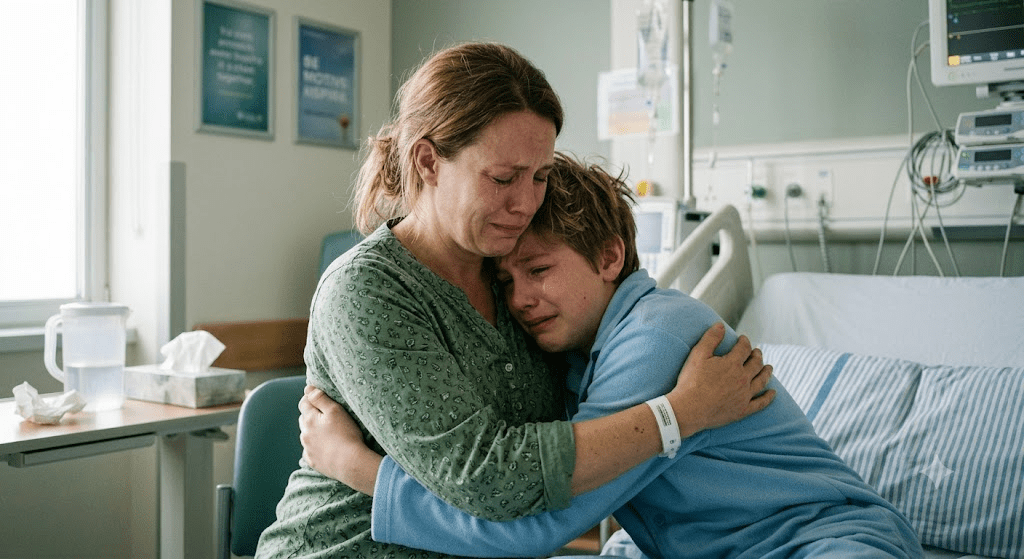
She nodded and looked very sad. “Yep, and then Jack started to panic and scream, ‘No, Mom! No Mom… I don’t want to die… please, Mommy, don’t let me die… please, Mom.” It seemed like he went on like that, the both of us bawling for what seemed like hours.”
I let out a slow, warm breath. Tears filled my own eyes. “How long before you could stop crying?”
“I’ll let you know when I do.”
But when your spouse or partner has cancer, it’s not much easier; you must take over more of the household responsibilities and work even harder to provide income. We patients can become angry and bitter, and even rage at the disease, but we turn it toward the caregiver, which is never fair. The hardest is the end-of-life care, or when the patient is so demented that they need constant supervision. I feel guilty that I couldn’t last a week with my mother and aunt at the end without wanting to pull my hair out.
Denise had spent the previous few years working hard as our primary provider, doing more of the housework than before, trying to play fix-it person when I was too weak to get off the couch, while worrying about losing me and living alone for the rest of her life. Her, feeling helpless to stop my cancer, my endless twitching and diarrhea… or my thoughts of ending my own life.
So, we must respect the caregivers, the unsung heroes of our battles with disease. For a couple, cancer bites them both equally. While only one feels it in their flesh, both of them feel it equally in their hearts. It shatters both their dreams and their peace.
Mike


Leave a Reply