Excerpts from: How Cancer Taught Me to Swear, An Intimate Pilgrimage into Myeloma (Part II)
I will do one or two more postings about my myeloma, and then I will move on. I am doing well right now, and it gives me the space to live in denial, so I would rather not talk about those darkest of days. If you have not read the previous post, please go back and read it, as this is a continuation of that. The following is a summary of a ten-page chapter.
I may not be the smartest person in the room, but I believe I am the most curious. My interest includes human behavior, my own, and others. I’ve spent countless hours contemplating these issues, including things I’ve observed along the way of my pilgrimage with cancer. Now, this focused exploration doesn’t mean that I am correct.
Significance
I believe the modus operandi of all human behavior can be boiled down to one thing: the pursuit of significance. We start our lives as the center of the universe, from our perspective. But then, as we become toddlers, preschoolers, teens, and adults, we must abdicate that lofty position in favor of being just one among billions. Yet we get up in the morning, shower, pursue careers and families, and try to conform to societal norms in an attempt to maintain some sense of significance.
One of the many lies that we people of faith tell ourselves is that we are exempt from this pursuit. Within Christianity, we tell ourselves that we must simply believe that we were created in God’s image, that God loves us, and that, in Christ, all our shortcomings are forgiven. Then, presto, like magic, our problem of significance is solved.
While those Christian ideals have some merit and are worthy of meditation and focus, they cannot solve this deep underlying desire for significance unless we are robots driven by AI software that can be simply reprogrammed. But we are not… are we?
Cancer’s Greatest Battle
I mentioned last time that I now believe that the mental health battle in cancer is more formidable than even the physical battle, and the physical battle is horrendous. This is the part of cancer, or any tragedy, that I didn’t see coming.
Cancer abruptly ended my forty-year career in medicine. I was carried out of my clinic on a gurney and never saw most of my co-workers or patients ever again. I never appreciated how much of my feelings of significance came from their positive feedback. Lost forever.
I have to go to a Freudian level to make sense of this next level of loss of significance, and that is the shame that accompanies cancer. No, I did not see that coming either. But suddenly, once the word gets out, the world treats you differently. I think it is worse in religious circles. People stop talking to you. Before, “How are you?” was a common greeting, but not after your diagnosis.
I’ve concluded that religious people do not want to hear about your suffering for two reasons. First, it would challenge their closely held ideal that God is just and fair. Therefore, even in cancer, they must project a justification onto you… You had it coming.
Soon after diagnosis, I had a letter from a Christian neighbor who said that part out loud. God told her that he had given me cancer because I was such a bad person. I hadn’t raped or murdered anyone. I hadn’t even set our garbage can in the wrong place. But I wasn’t going to her conservative church, which proved I was a bad person and God was going to kill me soon. I would rather have gotten a plate of chocolate chip cookies and a get-well card.
The “Sin” of Feeling
Since the time of the Victorians (late nineteenth century), Christianity has been perverted into a “cult of respectability.” Part of that cult is believing that human emotions are evil.
I learned, through weeks of study, that what we call swear words today were all invented during the Victorian period and for a reason. It has nothing to do with the Bible, but this weird idea that human emotions are bad. Swear words are condemned because they reveal the extreme of human emotions. The Victorians also taught us that you shouldn’t cry at a funeral—chin up—even if it is your mother’s… or your son’s. But I say that the wailing of the saint should surpass that of the sinner because they fully understand what has been lost.
But I say that the wailing of the saint should surpass that of the sinner because they fully understand the loss
J. Michael Jones
I further observed how, when I met friends from my Christian world on the street, I had become invisible to them. They might speak to Denise in a friendly manner, even ask her how she was doing, but never say a word to me. I was no longer human, maybe a plant or even an inanimate object, like a light post.
Confused by this sudden change in how some people related to me, it dawned on me one day that I was being treated by many old friends exactly how I imagined they would have treated me if my name were in the headlines for being arrested for being a child molester. Shame. Cancer reduces you to this because you stand, in their eyes, as a testimony to the unfairness of life, which contradicts their theology. Cancer must be your fault, your punishment for something… otherwise, they, being good people, would also be vulnerable. I remember doing the same, especially in my evangelical days. The worst was ghosting a good friend whose sister was tragically killed. I was afraid I would say the wrong thing, so I did the very worst thing I could have done: disappear.
I think this shame is worse in the Christian circles, as I, when I had the strength to drive again, looked up a couple of my old secular friends whom I had known through my career. They treated me profoundly differently. They not only asked me how I was doing but also asked for the very details of my suffering as caring fellow human beings. “Have a beer, Mike, and fill me in on the shit you are going through.”
The Loss of Family Significance
There was another profound feeling of insignificance, and that was in my family. This had a different impetus. It wasn’t about God’s justice or emotions being evil, at least not directly. But my own family responded very differently to me than I had responded to my own dad when he had cancer. After years of contemplation, I finally figured out it was a cultural problem.
I grew up in the heart of Appalachia, where we spoke a profoundly different love language than that of my friends in the Pacific Northwest, or even my wife and children. The major cultural influence on my family was the Scandinavian stoicism of the upper Midwest and the Pacific Northwest.
I learned about the Scandinavian concept of Lagom, which means showing respect and love for someone by never asking them questions about their personal or private life, especially when something is hard. In Appalachia, it is the opposite. The love language is to ask direct, uncomfortable, and deeply personal questions to show your love and interest. “Uncle Hank, are you still drinking? How can I help you?”
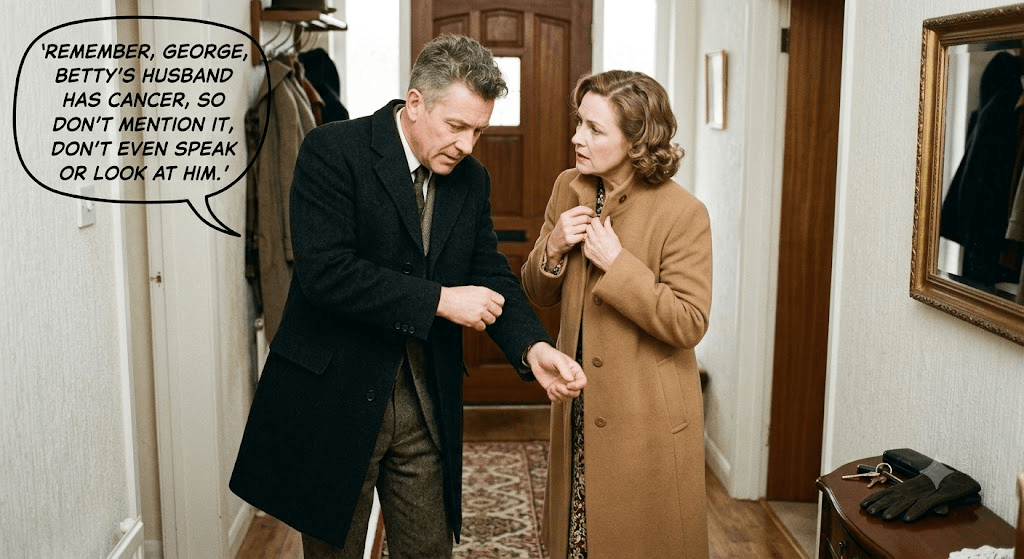
As I said in the last post, cancer is heavy and distorts the light of the memory around it, so I may be mistaken, but in the seven years I’ve had cancer, with a few exceptions, I’ve never been asked a single question about how I’m doing or my cancer treatment, not in my church, not in my family. You may be surprised to hear that the word “cancer” has never been spoken in our house, unless it was by me, and I tried to rarely talk about it. Most of my “talking about it” is here, in this blog.
Before I was ill, I saw a poster once that said, “Cancer is Isolating.” I assumed it meant that when you are under heavy treatment, in the hospital, you are alone. But I now know that when the biggest part of your life is taboo, that is isolating. If you have a new baby, or even a puppy, you are free to talk about it, post about it on Facebook, and people will ask you how it’s going. But when a tragedy is gripping your life, it must go underground. Others, it will be assumed that you are feeling sorry for yourself.
So, my greatest struggle before I understood the cultures was my sense of complete loss of significance. With this state of mind, it is hard to continue the physical fight to live. It was also during this time that I had three very painful confrontations with men in my church who came to my blog to “support me” but, after reading what I write, felt that God was calling them to put me in my place, as a very bad man. I am certain that their words would not have been so painful if I hadn’t already been at the very bottom of the pit with respect to feeling insignificant.
The Wrost Thing You Can Say to Someone Who Has Suffered a Personal Tragedy is. . . Nothing
J. Michael Jones
So, it was hard for me to understand this as an Appalachian boy that with the loss of my career, the loss of being a financial provider to being a financial consumer, the loss of my body, the loss of my respect in the world, family, or church… I was no longer lovable, totally insignificant, so why fight the cancer? It has taken a great deal of study, contemplation, and prayer to become culturally bilingual and to understand the love language of my family and Pacific Northwest church friends, which is so different than that of Appalachia.
In Closing
This is getting long, but I must end with two caveats. The first is being clear that I write as a typical patient with cancer who must suffer with these kinds of issues. No, I am not alone, nor do I pretend to be. I’ve asked fellow multiple myeloma patients in a large forum, “Did you lose friends, or did people stop talking to you after your diagnosis?” At least half agreed. We all share in the human condition, and even writing about this, I fear that I will be confronted once again, this time for wallowing in self-pity. But I am doing very well now, and there is no need to ask me how I am doing or to inquire about my cancer journey. I’m okay.
Secondly, I had written previously, “with exceptions.” Let me write about some of those exceptions.
When I was first diagnosed, a lady at my church, whom I barely knew, began to correspond with me daily to encourage me. She, too, had kidney disease. Her correspondence continued for most of that first year and was a godsend.
I was added to our church deacons’ prayer chain, and for at least two years, once a month, I received a call or e-mail asking me to update them on what was going on with me.
As I was going through the stem cell transplant in Seattle, a couple and a man from our church came down and visited me. I will never forget their effort, as Seattle is a hundred miles away.
While I was connected to a small group within my church, in three years, no one asked me about my cancer. Not because they are bad people, but because the culture deems it taboo. Yet I was just at a potluck with them, and someone, to my surprise, asked me for all the details about my treatments. I was moved to tears by their interest. The taboo spoken out loud.
Likewise, while my kids couldn’t talk about my cancer, my son-in-law recently broke the ice when he asked me how I was doing and what treatments I am on. This tells me that it was my failure in raising my kids that I did not teach them how to talk about feelings or ask hard questions. Both of which are part of the legendary “Southern Hospitality.”
My oldest son is in cancer research, including myeloma. In the beginning, he did speak with me about my disease, the genetics of it, and such. He did research for me during that first year, and I will never forget that.
Regarding my wife Denise, she doesn’t have to say the word “cancer” or ask me how I’m doing, as I overshare with her about how I’m doing.
To be clear, I don’t blame the people at my church or my family. They really are good people. I know now that my children do love me. But it is the culture that we live in that shames the disease of cancer. I hate the culture.
The Lesson for Me
In closing, I am not exempt from the ills of our culture. While it was part of my occupation to ask people how they were doing on an intimate level, I could do much better in the social arena. I had noticed that all my compliments came from my patients and colleagues, that during those years of cancer, when it seemed that I was only told bad things about myself, I did not have a healthy state of mind. Therefore, I am trying my best not only to ask people I meet how they are doing, especially if I know they are suffering, but also to offer genuine compliments. The Victorians trained us Christians not to complement each other, as it could lead to arrogance. That’s why you don’t applaud in church, no matter how talented the preacher or performer is. Here’s a compliment for the Victorians: for being such idiots, they managed England quite well.
2 responses to “Excerpts from: How Cancer Taught Me to Swear, An Intimate Pilgrimage into Myeloma (Part II)”
Headless Unicorn Guy
Since the time of the Victorians (late nineteenth century), Christianity has been perverted into a “cult of respectability.” Part of that cult is believing that human emotions are evil.
“Not out of any Heavenly Virtue, but Hellish Respectability.” — one of the Father Brown mysteries
Swear words are condemned because they reveal the extreme of human emotions.
To me, cusswords have always meant Strong Emotion.
I was no longer human, maybe a plant or even an inanimate object, like a light post.
Or that you were already dead.
Cancer must be your fault, your punishment for something… otherwise, they, being good people, would also be vulnerable.
Or Cancer Cooties are contagious.
I’ve had three prostate cancer scares (including two biopsies, two MRIs, and no positives) over the years, and the “God Punishing Me” fear was always part of the package. Not external but internal, more like the thought kept gnawing on my mind. (We really have to find a better indicator than PSA/free PSA. That indicator has given me three false positives so far.)
I was afraid I would say the wrong thing, so I did the very worst thing I could have done: disappear.
Very familiar with that sort of Analysis Paralysis. What I ended up doing in such situations was make contact but begin with “Anything I say is going to sound real stupid…”


Leave a Reply