History is profoundly important to how we understand our present cultural state. I make the case that our present hyper spirituality is an aberration in the history of the Christian church. Now, the cornerstone of Christian and even secular culture is a spiritual, mystical, or subjective experience at the expense of the objective, evidence-based understanding of reality.
There is a “Catch-22” situation with the understanding of history: it is the subjective, Christian norm to consider that the present culture, including church culture, is the way God wants it because of God’s providence. Most Christians participate in magical thinking by believing the Bible is perfect, despite that obivious changes over time, and that the church is perfect, despite its very unflattering history. Therefore, many Christians are ambivalent about the study of history. Yet the study of history quickly demonstrates that the false and evil thinking and actions of man/woman are prevalent, preverting God’s perfect plan… unless we agree with the French philosopher, Charles Baudelaire who wrote that “If God exists, He is the Devil.”
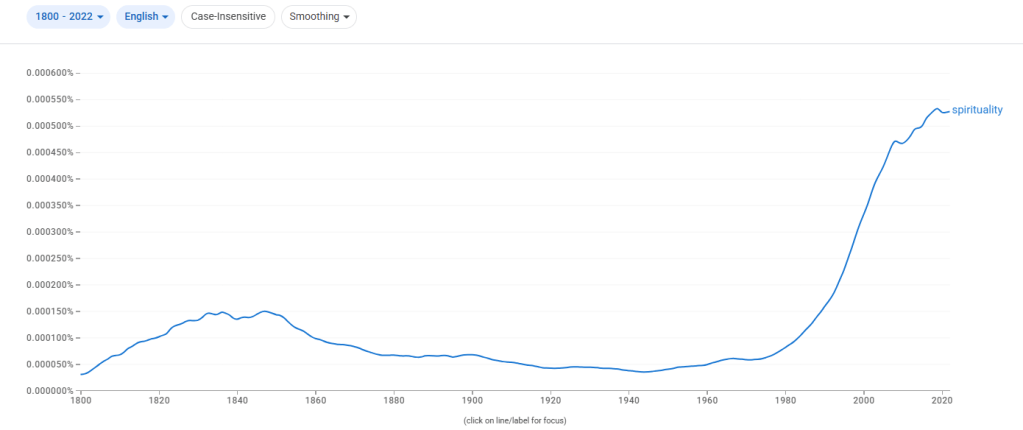
The Google Ngram Viewer graphs the use of English words in writing (especially books) over time. To illustrate the age we live in, the following graph shows the rise in the use of the word “Spirituality.” I will mention that the use of this word in the early 1840s (smaller bump up) was for a totally different reason, as during that time there was an explosion in the fad of “Modern Spiritualism” where there was a strong interest in talking to the dead; séances were a fad in every town.
The Prelude to the Christian Movement-AD 33
I must say that history isn’t always so simple. It is filled with countless players, some with only minor roles. If I try to address the historical story comprehensively, most readers (including myself at times) would get lost. So, I must write on the over-simplified side, which some students of history may find frustrating.
As Christianity began to take shape, there were many strong influences in the popular society of the time, some of which were absorbed into this new faith. The most significant philosophical trait of these influences was their take on dualism. Again, dualism is the idea that reality is sharply divided between the material and the other. The other could mean the spiritual, or, for Plato, the ideals. I wouldn’t call Buddhism dualistic because its major tenet is that all that we see is a delusion and there is no material world.
These influences include Judaism as a whole, including some of the Judaic splinter groups, such as the Essenes (the writers of the Dead Sea Scrolls). The main Judaist perspective, from what I read, was not dualistic but what we could call monistic, meaning the material world and God’s world were unified as good. After all, the book of Genesis describes that God created this material world and called it good. Also, the central teaching of Christianity is that God entered the material world in the physical form of Jesus, again suggesting a unity between the unseen and the seen.
The two greatest influences of dualism on the culture of the Levant, including Persia and Greece, were Zarathustra (religiously) and Plato (philosophically).
Zarathustra either 1200 or 600 BCE (debatable between dates)
Zarathustra, the founder of Zoroastrianism, lived in Persia. He held a profound view of reality as a dualistic framework of a battle between the good god of light, Ahura Mazda, and the evil god of darkness, Angra Mainyu. He did not see the material world as either evil or good, but rather as a battleground. It was created by the good god Ahura Mazda, but corrupted by the evil god Angra Mainyu. He saw human consciousness as divided between what we would call the rational brain and the spiritual side. But, Zarathustra, unlike modern Christian views, did not declare either side of the brain as superior to the other, but rather that they must work together. By the time this type of dualism entered the early church, it had declared the thoughtful brain to be from “the flesh” or the evil side of dualism.
Pythagoras (famous for his Pythagorian Theorem) 570-532 BCE
Pythagoras lived on the Greek island of Samos. Because his teachings were similar to Zoroastrianism, it is believed that he was influenced by the religious movement, although no concrete evidence has been provided. But Pythagoras became a major influence on Plato and helped guide his dualistic views. One of those was the binary nature of the material world (everything balanced by its opposite in nature, hot-cold, wet-dry, male-female, etc.). He also wrote about the dualistic nature of the person, the soul, and the body.
Plato circa 428-348 BCE
Lived in Athens, borrowed many ideas from his teacher Socrates and his hero, Pythagoras. Developed his idea of material dualism, between the material world, including our bodies, and the ideals, such as reason, and true mathematics. Unlike the later Christians, he place human reason as the pinacle of the ideals. The material was not seen as evil, but inferior. Not an illusion like the Buddhist, but real, but onlly a shadow of the real world. The Apostole Paul, as a Greek citizens, had certainly studied Plato, the most popular philosopher of the age.
The Essenes 200 BCE to 100 BCE
The Essenes were a Jewish sect that arose around 200 BCE. They had been greatly influenced by the Zoroastrians and developed a similar view of the battle of light and darkness. However, they saw moral darkness as taking over the material world as well as the human mind of reason and thought. Reason was only helpful if it was submissive to the spirit of God. They formulated the Christian Gnostic idea that this material world was dirty, wordly, including thinking.
Considering that this world was dirty, even evil, including the regular practice of Judaism and the temple in Jerusalem, their hope was apocalyptic. They saw that the end times were quickly coming when they, the sons of light, would do battle with the rest of the world, the sons of darkness, and win. Because of this apocalyptic view, they separated from normal life and lived in the wilderness, in places such as Qumran. It is there that they wrote what we now know as the Dead Sea Scrolls and hid them in jars.
Some historians believe that when the destruction of the second Temple in 60 CE, that the Essenes assimillated into the early church. You can still see many of the ideas of the Essenes in modern Christian nationalism, including that this world is lost to evil, reason and learning are of this evil world, and the hope comes in the great battle coming soon.
With this broad picture, I will leave and next time look at how the early church evolved into the Catholic church of the forth century.
Mike
 J. Michael Jones
Leave a comment