As I said in the beginning, I would work hard to keep this story simple. I had intended, following the chronological order, to move from Constantine the Great, who died in 337, to Augustine, who was born just twenty-seven years later, in Hippo, which is now in Algeria. However, first I must backtrack a few years to make sense of how Augustine reached his philosophical positions, via the influence of Plotinus, which became the framework of the church and Christian thinking from the Roman period until the arrival of Thomas Aquinas in 1225.
A Christian might say here, “Enough with all this philosophical bullshit, I know what the Bible says, and who God is, and I don’t follow any philosophy garbage.” But, I’m afraid you do. It is impossible to escape the cultural influence, especially if you don’t want to know about it. Ignorance is not bliss, but imprisions us without our knowing. History is the great teacher. Although Paul warned the church not to be taken captive by the various philosophies, it was from day 1 until the present. Most atrocities and moral failures (such as slavery or the present Christian nationalism) can be traced to the adoption of secular philosophies. I’m speaking in practical terms, not religious.
Plotinus
Plotinus was born in Egypt in 270 CE, more than forty years before Constantine became emperor, and had a profound impact on Augustine’s thinking. If Constantine was the architect of how the church developed, organizationally and in power, Augustine was the architect of how Christians thought into the Middle Ages.
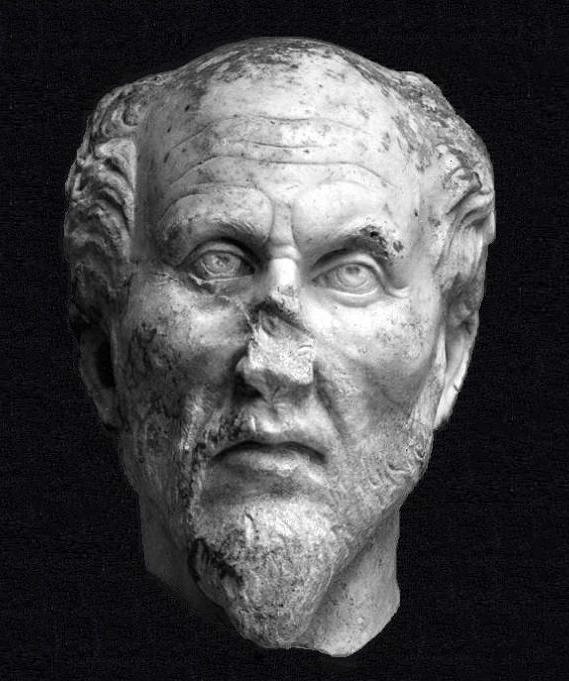
Plotinus was likely of Greek pedigree but rose to become one of the most influential philosophers of the Roman period. I will keep it brief, but it appears that he saw himself like a telescope (my metaphor, as telescopes did not exist yet) looking back through history to shine the light on Plato (who died in 348 BCE), which was over six hundred years before Plotinus was born. It wasn’t like Plato had not already been very popular in the Greco-Roman culture, but Plotinus refined his teachings and popularized them once again. Some historians say that he did more than magnify and focus on Plato; like an asymmetrical lens, he distorted some of Plato’s teachings from their original intent. As I am focusing on dualism, one of the most significant differences was in the nature of their dualisms.
While Plato saw reality sharply divided between two realms, the material and the ideals, Plotinus saw reality on a hierarchical scale between the insignificant and the most significant. The material Earth, dirt, nature, even his own body, were at the bottom of the value of reality. So much so that he refused to have any image, such as a painting, made of him.
On the other end of the scale, the highest value on his scale was “The One.” It would be fair to call this a God figure, but, in my opinion, it is closer to the Buddhist concept of a ubiquitous field of force, from which we all emanate. And the highest part of us would be what he called becoming one, again, with The One.
While Plato had human reason on the highest echelon of value, Plotinus had it in the middle of the spectrum, not good, but not evil, just trapped. It was limited because human reason deals with information of this material world, which itself was lowly esteemed.
There is a new-age myth that Jesus traveled to India to learn from the Buddha. Even secular historians find this idea preposterous. But it is true that Plotinus traveled to the East, primarily to Persia, where the leading religious thought at the time was the profoundly dualistic Zoroastrianism and its new (at that time) descendant, the religious cult of Manichaeism. Both were deeply dualistic, seeing the Earth as evil and dirty, including our souls and minds, and that our souls are trapped here, needing to escape. So, Plotinus took the Platonic idea of Dualism, but patterned it after the Manichaeans, putting reason in the dirty, inferior realm along with the physical Earth, and mysticism as a way to escape this dirty Earth.
While I agree that Augustine was a great scholar and theologian who shaped the church for generations, many of his ideas did not come from the Judeo-Christian tradition, but from these secular philosophies. At least his theological teachings, by his own admission, favored Platonic thinking, or what historians have more correctly called Neoplatonic thinking, after Plato’s ideas were reshaped by Plotinus, whom Augustine also adored. It is also historically clear that Augustine was part of the dualistic Manichean cult for a decade before converting to Christianity.
Therefore, for the next almost millennium, the church grew in power via the help of Constantine and became quite dualistic via the influence of Augustine. Christian mystcism arose and is favored by the present Christian culture, because we are returning to that same mistake of dualism.
The practical result is a period of time when Western civilization, while I won’t say collapsed, was stunted. It was Italian scholar Francesco Petrarch of the fifteenth century who called this period the “Dark Ages.” While there is honest debate today about whether this name was justified, it is clear that the society’s curiosity about the natural world did collapse. There were no nature preserves. No one climbed mountains or camped for enjoyment. Only the “spiritual” were subjects for art. Religious wars spread. The center of learning, mathematics, art, and astronomy shifted from Europe to China and then Baghdad after the rise of Islam. Muslims are still proud of their heritage in science and math, while the Christian world was otherworldly.
I will confidently say that the church became too heavenly-minded for much earthly good. I write because once again, this is the state of not only the Christian but secular cultures of today. In this age of postmodernism, we have lost our interest in factual truth, in learning, and focusing on the transcendent, as if this world isn’t worth saving. This, I’m afraid, will end in a disaster for the church and society as a whole.
I will end this segment by saying that my objection to dualism isn’t just a personal perspective, but it is against the fundamental teachings of the Bible and the Judeo-Christian tradition. The Bible is clear that it presents a monist reality. God created creation and called it good. The future of man/womankind is not in a mystical Heaven, but a renewed and restored physical creation. This tradition does not teach that our souls are entrapped in this dirty body (as Zoroastrianism, Manicheanism, or Neoplatonism does), but that Jesus entered the material world and thrived within it. He used dirt to heal a blind man, not thinking it was “dirty” but part of this beautiful creation. The Bible has high regard for creation as well as human learning, wisdom, and reason. There is a continuum between quarks and the “Heavenly,” not a sharp divide.
Once again, I will be clear. I am not writing as the traditional religious person who is out to prove that their ideas are superior and thus they are theologically superior. No, I write not that dualism is “sin,” but that monism (creation and the so-called spiritual have the same value) is better because history teaches us that when we view reality, human art and reason with this co-equal value, culture thrives. Much, much less suffering.
Next time, I will look at the developments at the time of Thomas Aquinas in the thirteenth century.
In Respect,
Mike
If you don’t believe me, please do your own study and look these things up.


Leave a Reply