In my last article, where I wrote that Thomas Aquinas inspired the Scientific Revolution and the Enlightenment, I skipped over the Renaissance. I think it was a subliminal error because I love Renaissance history so much; it is very hard for me to summarize. It is like visiting a mysterious old mansion, teaming with stories, secret rooms, tunnels, and fireplaces that pivot as doors, yet you only have the time to glance around the foyer for five minutes.
For years I had wanted to teach a Sunday School class about this vital period of transitions for our culture, or even write a book about it focusing on the philosophical changes. I never had that opportunity so the information, I’m afraid, had to sit to wither away in my aging, chemo-laced brain. But I had studied this period very seriously, spending at least a year, culminating in a visit to Florence, Italy for a week, circ. 2010, with a backpack full of books.
For almost a thousand years after Constantine empowered the church as the “walking boss” of the people (a walking boss is the prison officer who keeps the chain-gang in line), the philosophical basis of Western Civilization was dualistic, Neoplatonic, where there were two realities, the seen (material world) and the unseen (the church defined as spiritual). For most Christians during this time, nature wasn’t seen as nasty, as the early Christian Gnostics had, but just of little practical significance. Unlike Plato, who put reason at the pinnacle of the greater, unseen reality, the church put it into the seen world.

Because the seen world had less value in that system, human reason, an instrument of that world, was inefficacious. Therefore, people were prone to superstition, looking for meaning and answers within the unseen realm as an “irrational awe.” For example, the black death was being caused by God’s wrath, malicious poisoning, or even astrological alignments.
For many Christians looking backward, they would not see the problem, as once again we are living in a superstitious time where the “voice of God,” or even a “gut feeling,” trumps looking at evidence and, via deduction, reaching a conclusion. The irrational unseen is once again, superior to the seen and rational. You can stand up in any church, conservative or progressive and say, “God is that irrational voice that comes to your heart to draw you close and direct your steps,” and the congregation would be beaming with smiles. However, if you stood up in those same churches and say, “God has been so faithful to show me the evidence, from which I can make deductions, to find what I should do, and help me to understand who God is,” you would see puzzled looks and likely… very likely you will have a nasty conforntation with someone who feels compelled to attack you, explaing that you are not a real Christian with that thought.
Again, and I’ve said this a thousand times, is that I do not write to convert others to see the world rationally. I write because those with rational thinking (we all have think rationally) or at least says it out loud are not welcomed in any church. All churches are shrinking and this requirement to be superstitious is one of many reasons this is so. Secondary, life is better when we find factual truth based on the evidence and deductive, inductive, or abductive reasoning to find the truth. I could a thousand examples but just one, the life expectancy during that period from the Roman Empire up until the Scientific Revolution, was 25 years of age. Now, after the impact of that Scientific Revolution, the life expectancy in that same part of Europe is now 80 years old, and it is a much easier life.
And, in case you are new, I assert that human reason is not perfect, but it is a hell of a lot better than subjective superstition. And in that same thought, no, you cannot prove God exist by reason alone, nor can you prove that God doesn’t exist, but there is evidence that must be pondered.
While it may not be fair to use the term “Dark Ages,” clearly there was less scientific or artistic curiosity during this period than during the Greco-Roman period before or the Renaissance after this millennium. It may also be unfair to refer to the church as the warden of a chain-gang, yet if you study the Christian oppression, read the details about the inquisitions—the protestant church was no better than the catholic church—you will see the resemblance.
No, I’m not saying there was no good that came from the church. There are plenty of good things, but I do know that other Christians and I have practiced a revisionist history as we see the entire church just as God wanted it, and therefore, just like Mary Poppins, “practically perfect in every way.”
I must also mention that there were people living during this time, such as Saint Francis of Assisi, who valued nature as creation, both plants and animals, yet his highest regard was still held for the irrational and mystical.
Without question, the Catholic Scholastics of northern Europe, including Thomas Aquinas of Italy, laid the groundwork for the Renaissance, which arrived two hundred years later. They did this by abandoning the Neoplatonic philosophy, a dualistic approach setting the unseen against the seen, with the unseen most significant, in favor of Aristotle’s perspective of a unified view of reality.
This softening of the soil by Aquinas and his friends made it possible for the Medici family of Florence to find a new path for society, as they knew that the old Neoplatonic path wasn’t working. Culture was stifled.

The Medicis
The story of how the Medici family changed the course of Western Civilization, and almost single-handedly set up the new birth of Italian society, is incredible. But I will only give a glimpse, a simple look around the foyer.
While “Medici” means doctors, it likely reflects their ancestors being humble country doctors around Tuscany, before moving to Florence and becoming sheep herders. Eventually, the other herder families around Florence got the Medicis banished from the wool board, so they needed another way to make a living.
Giovanni di Bicci de’ Medici, the “godfather” of the family, started the first bank, the Medici Bank. Because of Bible verses such as Deuteronomy 23:19: “Do not charge a fellow Israelite interest, whether on money or food or anything else that may earn interest,” the church forbade the loaning of money on interest. The Medicis came up with a clever plan to use exchange rates between other European monies and the Florin (money in the Italian state around Florence). This made them profoundly rich, likely in today’s money, richer than Elon Musk.

Giovanni’s son, Cosimo, eventually became the head of the bank and the family. As the Medici’s grew in great power, Cosimo wanted to change the philosophy upon which their society was based as the old Neoplatonic view, the dualism of seen Vs unseen with the unseen held at a higher status, wasn’t working. To explore the new ideas for Italy and Western culture, he created the Platonic Academy of Florence. It was where a group of intellectuals met with Cosimo to create a new philosophical path forward. I cannot overstate the influence of what happened within those walls.
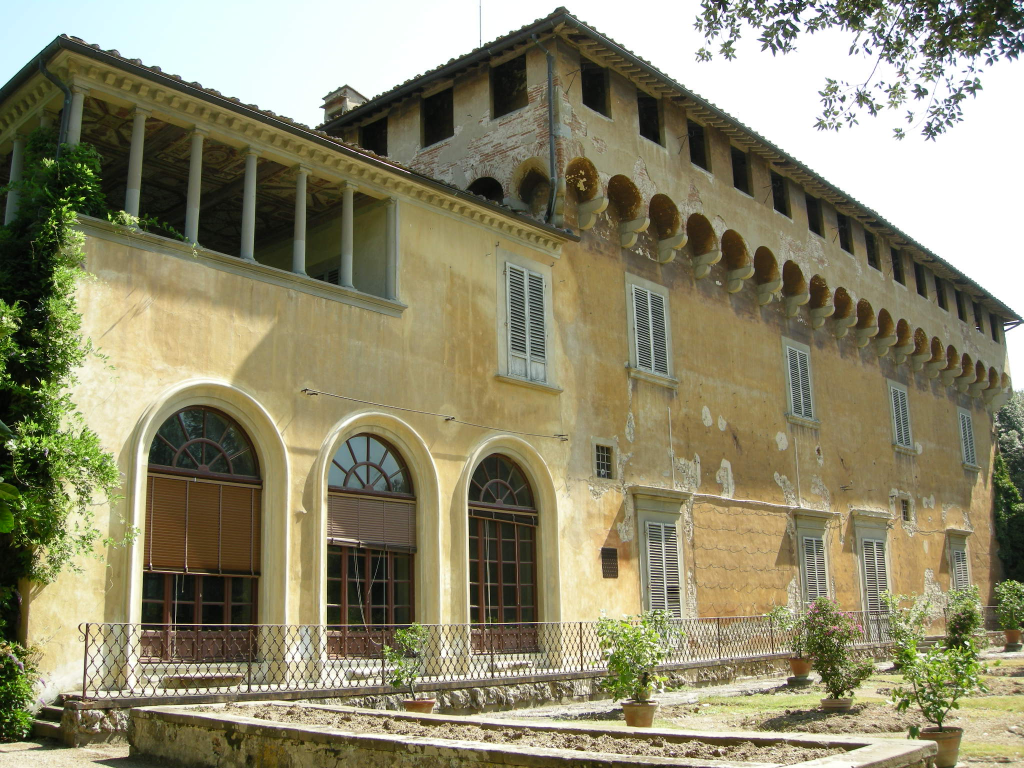
When I was in Florence, I tried desperately to find the Careggi Villa, but no one knew where it was (tourist or Italian locals). I also had limited internet access. But on my last night, I was able to find where it was… yet, having to catch an early train the next morning, I didn’t get to visit it. But I was surprised that a building that housed a profound discussion, that changed the direction of Western Culture, was so obscure.
I must end this here to focus on my family, which I am visiting in Minnesota. Also, because I don’t want to abuse your attention span with too much philosophical rambling.
With Respect, Mike
Pardon any typos as I had to type fast between family events.


Leave a Reply