Review
Søren Kierkegaard is often called the father of a new kind of Christian faith: an irrational faith. This type of faith has come to dominate Christianity in the last half of the twentieth century, so much so that if you resist it, both the conservative and progressive churches will marginalize you. Not knowing history, they feel this is the same faith that Christians have enjoyed since the birth of the faith. It is not. The inability to speak rationally within a church context is one of the top reasons people are leaving Christianity. As always, I do not write to criticize those who believe in this irrational faith, but to explain the circumstances to those leaving, in the hope that they will reconsider.
I’ve laid out the background, philosophically, on how we got to this point. The Scientific Revolution and subsequent movements through the twentieth century had a profoundly positive influence on our lifespan and quality of life. I believe these movements were so successful because they aligned with reality and discovered the best methods for uncovering factual truths. They examined evidence without bias and drew rational conclusions.
This rational approach created friction with the church because the church believed many things that simply were not true. Additionally, the rational revolutionaries went too far by concluding that if something could not be observed, it was not true by default. This included many things, such as the recorded miracles in the Christian Scriptures. Thirdly, science did not solve the human moral problem of causing suffering and death. A great disappointment.
The devout German Lutheran Georg Wilhelm Friedrich Hegel created a philosophical system of “synthesis,” where you look at two opposing ideas and reach a higher conclusion by taking the truths of each and merging them. He did the same with his Christian faith and the new scientific materialism (if it cannot be observed, it is not true). He arrived at a Christian faith that didn’t believe in miracles presently or as recorded in the Bible. This infuriated Kierkegaard. In response, Kierkegaard published Fear and Trembling in 1843 (under the pseudonym Johannes de Silentio), arguing that true Christian faith is irrational and not based on evidence or reason.
But like a virus, this new idea if an irrational faith was not contained just within Christian theology, but spread to the whole of culture in what we now call “Post-modernism” or that which came after the conclusion of the Scientific Revolution-modernity. In this belief system, there are no universal truths, but we each invent our truths irrationally or subjectively based on our experience. Donald Trump is the poster child of post modernism, where he creates his own reaility without caring about the objective evidence.
Kierkegaard’s False Assumptions
(Note: I pasted the full story of Abraham and Isaac at the bottom of this page)
In Fear and Trembling, Kierkegaard examines the story of Abraham and Sarah. God promised Abraham, despite him and Sarah being in their nineties and Sarah being infertile up to that point, that God would give them a son, and from that son many great nations and kings would come. Isaac was then born. While he was still a child, God told Abraham to kill Isaac as a sacrifice. Abraham doubted God when God told him he would still have a son, but he did not doubt God when God told him to sacrifice Isaac; the next morning, he gathered Isaac, firewood, and a donkey without question and headed to the mountain. God was impressed with Abraham’s great faith.
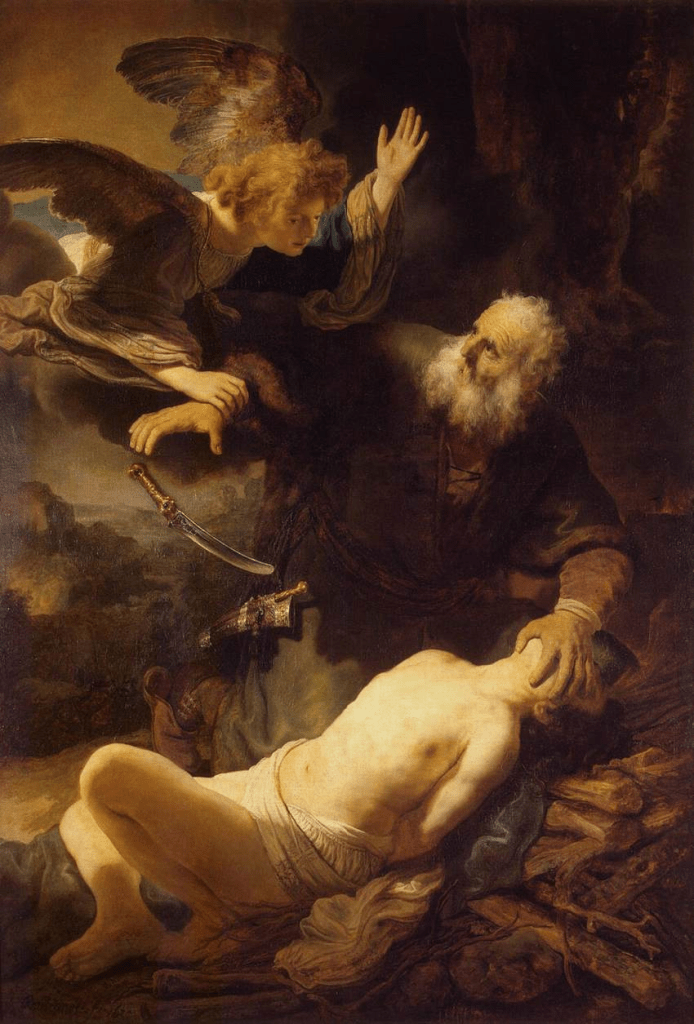
Kierkegaard spends the entire book arguing that Abraham’s faith, the true Christian faith, was not rational, but irrational. He writes that the law, written and unwritten, demands that we do not kill another human, and the law is rational. That, in appeal to common reason, it would make no sense to kill the son that God had promised to bring great nations. That the faith that God was trying to draw from Abraham in this exercise was a faith that transcended reason.
But this is not true. Put it in context: whether this story is historical or a metaphor, Abraham had an objective relationship with God. He met with God face to face, not in a dream or some mystic experience. This is not the same as religious people today who say they heard the voice of God, which is so subtle that there is no human way to distinguish this voice from powerful human, subjective emotions. All cults start with someone claiming they have heard the voice of God with total confidence.
Abraham knew that God was God, the creator of the cosmos and all of life. If God was indeed omnipotent and never lies, the only rational thing to do is to believe what he says. Abraham struggled with that (and that struggle was irrational) at first. But after seeing God deliver with the birth of Isaac, he did not question him again.
The irrational thing for Abraham to have done when the omnipotent, truthful creator of the cosmos told him to sacrifice his only son would have been not to believe him. The rational thing (God is in control, God is all-powerful, God never lies=God knows what he is doing) is to trust him and do what he says.
I was in a small group that followed several postmodernists (we create or own truth) Christian gurus. One of them echoed, loudly, the very words of Kierkegaard when he said, “We have evolved spiritually beyond reason, we transcend rational thought and now live in the post-rational Christian life that God wanted.” (my paraphrase). Then, after laying that groundwork, he went on to share, for an hour, things that were demonstrably untrue, and no one questioned him. That is the great danger of this kind of subjectivity: being cut off from reality and the great success that rational thinking has given humanity. That human reason, while imperfect, is God’s gift to humans as the primary tool for finding truth.
Now, in conclusion, if you do not want to believe anything I’ve written, that’s okay. I understand, yet I beg you to tolerate those who appreciate the factual reality and the God-given reason and don’t imply they are spiritually inferior because they don’t practice the kind of irrational, subjective faith that you believe in.
With Respect, Mike
I rest my case.
Footnote:
The Story of Abraham and Isaac
Genesis Chapter 22
Some time later God tested Abraham. He said to him, “Abraham!”
“Here I am,” he replied.
2 Then God said, “Take your son, your only son, whom you love—Isaac—and go to the region of Moriah. Sacrifice him there as a burnt offering on a mountain I will show you.”
3 Early the next morning Abraham got up and loaded his donkey. He took with him two of his servants and his son Isaac. When he had cut enough wood for the burnt offering, he set out for the place God had told him about. 4 On the third day Abraham looked up and saw the place in the distance. 5 He said to his servants, “Stay here with the donkey while I and the boy go over there. We will worship and then we will come back to you.”
6 Abraham took the wood for the burnt offering and placed it on his son Isaac, and he himself carried the fire and the knife. As the two of them went on together, 7 Isaac spoke up and said to his father Abraham, “Father?”
“Yes, my son?” Abraham replied.
“The fire and wood are here,” Isaac said, “but where is the lamb for the burnt offering?”
8 Abraham answered, “God himself will provide the lamb for the burnt offering, my son.” And the two of them went on together.
9 When they reached the place God had told him about, Abraham built an altar there and arranged the wood on it. He bound his son Isaac and laid him on the altar, on top of the wood. 10 Then he reached out his hand and took the knife to slay his son. 11 But the angel of the Lord called out to him from heaven, “Abraham! Abraham!”
“Here I am,” he replied.
12 “Do not lay a hand on the boy,” he said. “Do not do anything to him. Now I know that you fear God, because you have not withheld from me your son, your only son.”
13 Abraham looked up and there in a thicket he saw a ram[a] caught by its horns. He went over and took the ram and sacrificed it as a burnt offering instead of his son. 14 So Abraham called that place The Lord Will Provide. And to this day it is said, “On the mountain of the Lord it will be provided.”
15 The angel of the Lord called to Abraham from heaven a second time 16 and said, “I swear by myself, declares the Lord, that because you have done this and have not withheld your son, your only son, 17 I will surely bless you and make your descendants as numerous as the stars in the sky and as the sand on the seashore. Your descendants will take possession of the cities of their enemies, 18 and through your offspring[b] all nations on earth will be blessed,[c] because you have obeyed me.”
19 Then Abraham returned to his servants, and they set off together for Beersheba. And Abraham stayed in Beersheba.


Leave a Reply