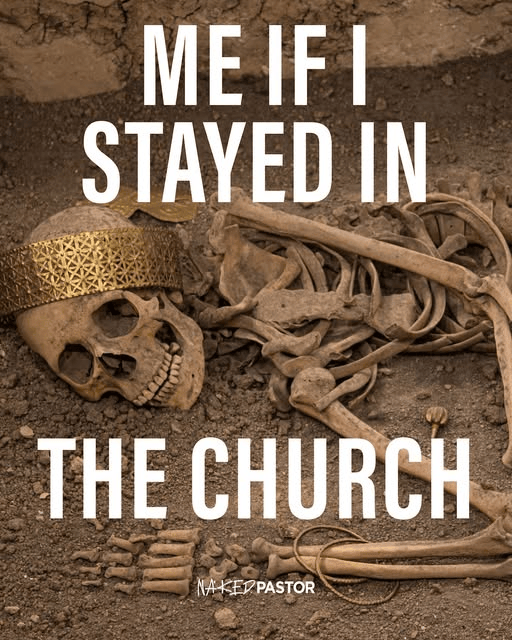
The top photo is from The Nake Pastor, who writes and cartoons for those forced out of the church. Keep that photo in mind, as it will become more poignant as I move forward.
Further Explanation
If I seem like an over-explainer, it is from experience. I am a retired (I hope) competitive piety gamer. I played that game well for almost thirty years as an evangelical. I have also been on the “bad end of the bull,” or the target of competitive piety, for thirty more years as a reformer. So, I know one of the tools or weapons of the competitive piety gamers is intentional misunderstanding. So when I write things many consider controversial, I do my best to explain what I mean. Then if the competitive piety player wants to misunderstand and make it what it’s not… that’s on them.
What I’ve tried to establish is that the Christian religion is not unique among human social groups in how it operates, except by claiming that its rules of engagement, both codified dogmas and unspoken mores, are from God, not a human invention. When you believe your traditions and rules are from God, they become an idol in themselves. I’m claiming that they are a human invention, just like the other social groups. This doesn’t make them necessarily bad, just extraneous.
I also am not advocating for the abandonment of all Christian traditions, as the majority of Christians would be left lost and confused, having known no other world than the traditional culture of Christianity. What I am advocating is that Christians would recognize that the vast majority of their beliefs and traditional practices and rules are cultural and therefore should be modifiable, as most people who are leaving Christianity, if not all, are over these cultural issues, including my own group of skeptical pilgrims. There’s the shame. At this juncture, the Apostle Paul warned the church at Colossae:
“See to it that no one takes you captive through hollow and deceptive philosophy, which depends on human tradition and the elemental spiritual forces of this world rather than on Christ.” Colossians 2:8
But this word “philosophy” is not just secular philosophy, but also the philosophies and traditions of the Christian religion. The operative words are “taking captive.”
Additional Unspoken Rules
I want to restate and make clearer that one of the major unspoken, and in some churches codified, rules is the “holification” of the Christian culture. In their eyes, their particular church denomination- Catholic, Protestant, or Orthodox- is “holy.” Their traditions, Sunday morning worship, sacraments, church buildings, pews, hymns, etc., are believed to be all holy, specifically set up by God, therefore unmovable.
I’ve told the story of when I, as an elder, tried to create a church meeting parallel to, and a substitute for, the Sunday morning church service that would meet in a bar on Saturday night. The purpose was to make Jesus’ teachings more accessible to the unchurched. Not only did I piss off most of the other elders, but the head elder declared me “demonic.”
The Psychology of Social Gaming
I want to dive deeper into the psychological aspects of social gaming, including its role in Christian culture. After examining many psychological theories of why we behave the way we do, I think that, for simplicity’s sake, the one core motive behind all human behavior is seeking significance. This is how we relate to others: we want to be liked to enhance our significance. We get jobs and try to earn as much as we can to make ourselves feel significant. We like to perform with our talents to enhance our feeling of significance.
Our role in the Christian culture is no different. We want to please God and thus feel significant. But one of the strongest tools for enhancing our feeling of significance in the Christian religious context, and the same in secular social groups, is comparison to others. This is where the game of competitive piety kicks in. The reason Christians hate the marginalized, LGBTQ, immigrants, Muslims, etc., is because demonizing people different from yourself is the most economical way to enhance your own sense of significance.
This competition goes further by turning inward toward other Christians. You scan their lives, their beliefs, trying to find a chink in their armor to prove that they are inferior to your own spiritual significance. This is exactly what happened in my relationship with my last good church friend: his constant scanning of my life to prove I was inferior to him. Men are especially guilty of this because I think they tend to feel more insecure than women. This is the real purpose of all the rules, including most of the codified and unspoken ones: proving you are superior by following them.
In my last posting or two, I want to look specifically at how Christians use this game to force those who don’t comply out of their churches… which I find regrettable.
Respectfully, Mike


Leave a Reply